
Fresco Sesco and Buon Fresco Process
Next
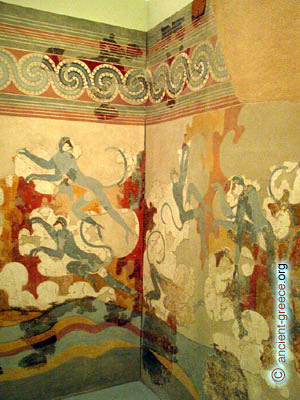
Fresco Sesco and Buon Fresco
Photo of the wall paintings of "The House of the Ladies" in Thera.
The fresco was unearthed in Akrotiri and it dates to the Late Cycladic I period (17th c. BCE). Thera Prehistoric Museum.
How they made the fresco:
Wall paintings of Thera were done in the buon fresco and fresco secco technique similar to the frescoes found in the palaces of Crete. This according to the information on the museum
First the wall was smoothed with a layer of mortar mixed with straw. On top of it, a layer of stucco (lime plaster) 1-2.5 cm thick was applied. On top of this layer more coats of finer stucco were applied. This created a solid foundation for the fresco.
While the last layer of stucco was still wet a taut string was pressed onto the surface to divide it horizontally into three zones.
A general sketch of the subject was incised on the surface or was painted with faint wash. The finished painting eventually covered this preliminary drawing.
Subsequently, and while the stucco was still damp so the colors were absorbed by the plaster, the large areas of the design were painted. Afterwards more details were painted either on the dry plaster, or on the already painted surfaces.
The Theran palette of colors was similar to the Cretan palette and included the white of the plaster, black (carbon), red and yellow (from ferruginous earth pigments such as hematite and yellow ochre), and blue derived from Egyptian blue, and glaucophane. All the colors were used in a wide variety of shades of the same color or from the mixing of different pigments.