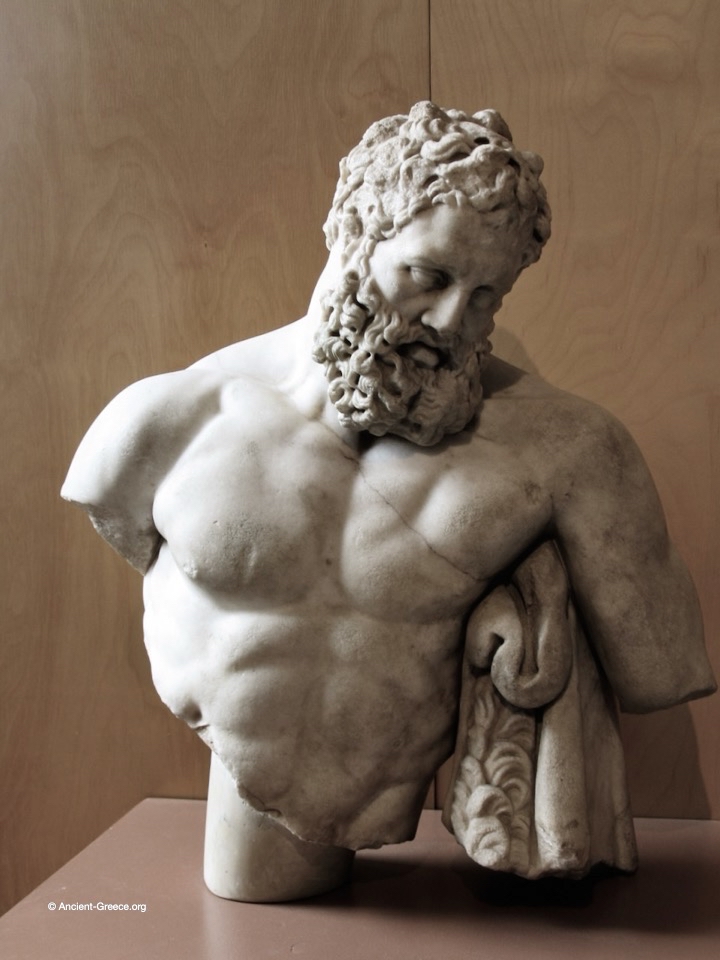
Weary Herakles ("Herakles Farnese" type).This Roman copy was modeled after an original 4th century B.C. bronze statue of Weary Herakles by the Greek master Lysippos of Sikyon.
Weary Herakles ("Herakles Farnese" type). This Roman marble sculpture is a 2nd-century CE copy (likely Hadrianic or Antonine) of the famous "Weary Herakles" bronze original by the 4th-century BCE Greek master Lysippos of Sikyon. Belonging to the "Herakles Farnese" type, the work depicts an aged and exhausted hero leaning heavily upon a club draped with the Nemean lion skin. The psychological depth of the original is preserved through Herakles' disheveled hair, knotted brow, and sunken eyes, which convey the physical and emotional toll of his Labors. While this specific fragment is incomplete—with both arms broken—the iconography of the type suggests he originally held the Apples of the Hesperides hidden behind his back in his right hand.
The lower portion was excavated from the South Baths at Perge and housed in the Antalya Museum, while the upper torso was part of the collection at the Museum of Fine Arts, Boston. Following years of negotiations, the MFA transferred full ownership of the upper fragment to Turkey in 2011, allowing the two pieces to be reunited. 2006