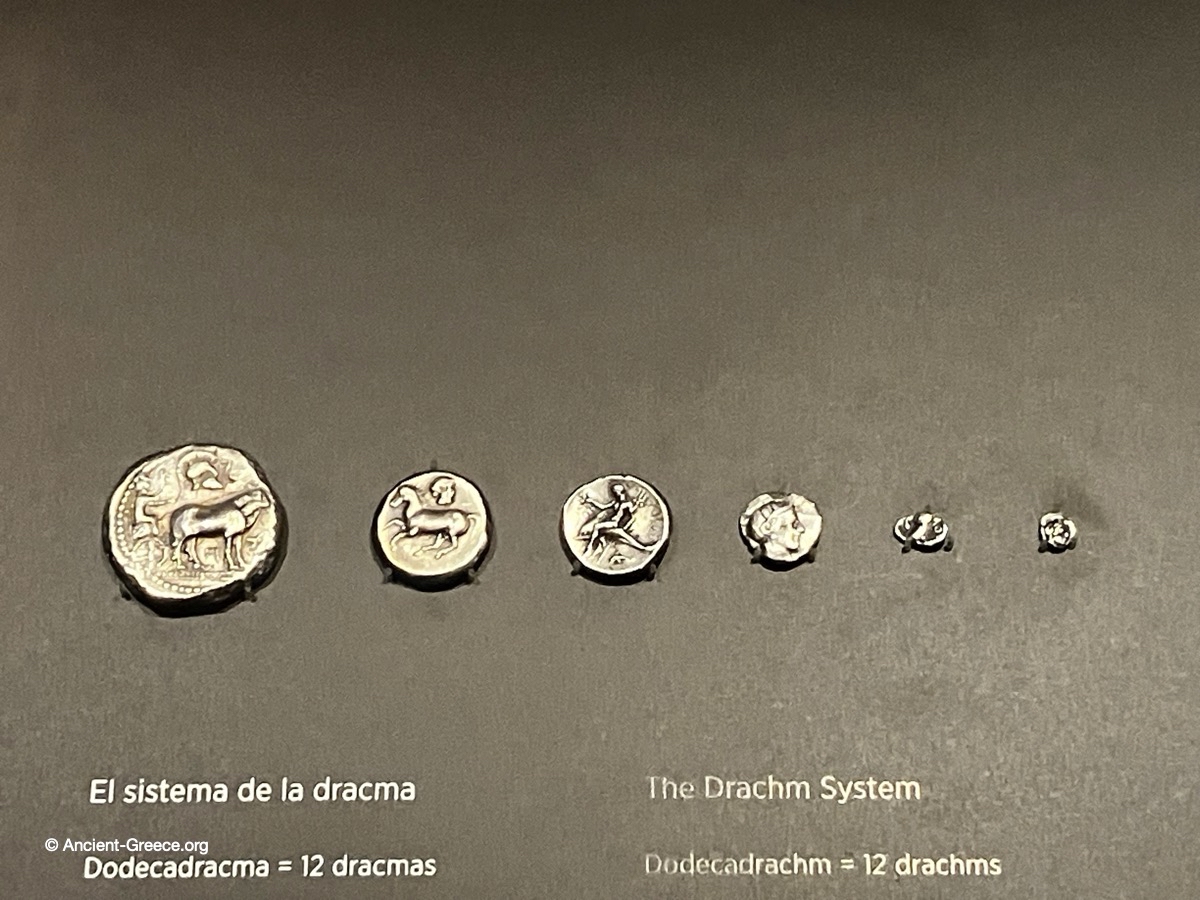
The Drachm System Denominations. The Dodecadrachm (the largest coin) is a masterpiece of early 5th-century BCE minting, likely an Orestian or Derronian issue from Northern Greece/Macedonia, identifiable by the distinctive ox-driven cart motif.
Starting from the largest coin on the far left and moving to the smallest on the far right, the denominations pictured are:
Dodecadrachm: Worth 12 drachms. These were exceptionally large, rare silver coins often issued by the kings of Macedon or in Syracuse to commemorate significant military victories.
Tetradrachm: Worth 4 drachms. This was the "standard" high-value coin of the Greek world (most famously the Athenian "Owl").
Didrachm (or Stater): Worth 2 drachms.
Drachm: The primary unit of the currency system.
Obol: Worth 1/6th of a drachm. This was a small silver coin, famously placed in the mouths of the deceased to pay Charon for passage across the River Styx.
Hemiobol: Worth 1/2 of an obol (or 1/12th of a drachm). These were incredibly small, often less than 10mm in diameter, and were frequently carried in the mouth by ancient shoppers because they were so easy to lose.
Exhibited in the Madrid National Archaeological Museum, Madrid, Spain.