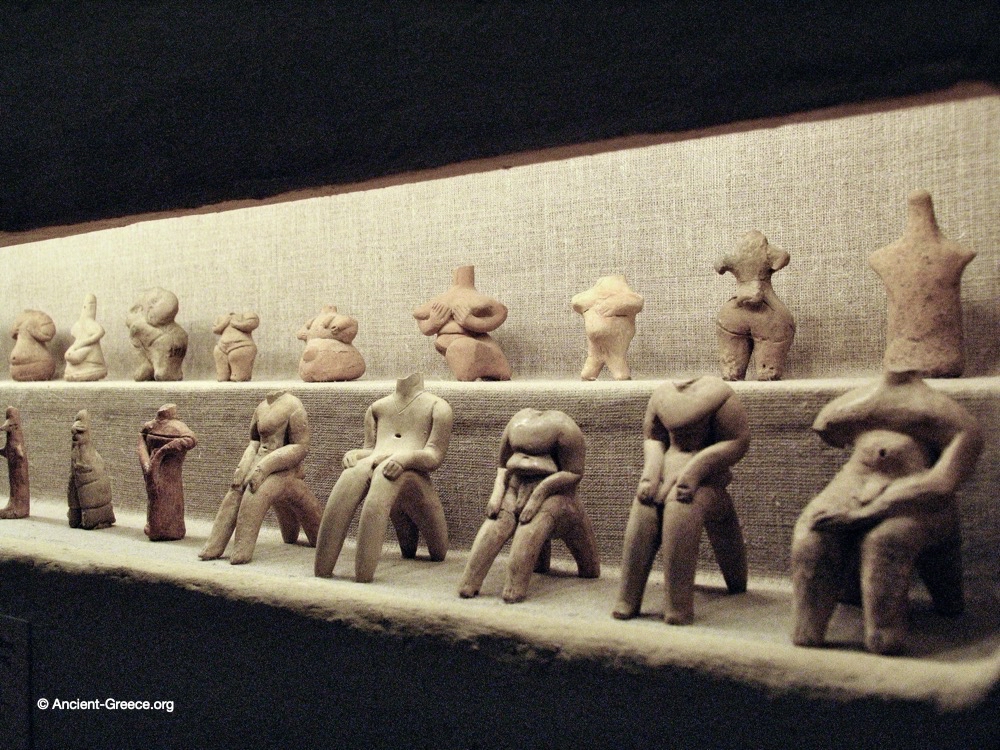
Female and male clay figurines declaring various positions (standing, seated), gestures, age and human activities. Thessaly. Early Neolithic period, 6500 - 5800 BC to Middle Neolithic period, 5800 - 5300 BC.
Most Neolithic figurines from Thessaly and the Aegean in general.
I portray women with accentuated sexual characteristics. Neolithic people laid stress on the fertility aspect of the female through the position and particular gestures of the figures and by depicting an obese female body (hips, belly, breasts).
Female figurines have been found in all the Neolithic settlements in Thessaly, both inside and outside the houses, in places for storage, food production and tool making, in ovens, with ornaments and with tools for milling and weaving
The fact that female figurines are associated with every aspect of household activity indicates the active role of women in the running of the house and their symbolism in important sectors of production.
This emphasis on the female in the symbolic system of values of Neolithic folk reflects the acknowledgement of the power of women, who played a vital part in securing the survival of the community and in maintaining social cohesion.
In Neolithiccommunitieswoman wasthe archetype,symbolically embodying many of the metaphysical powers, which protected agriculture and ensured the prosperity of the Neolithic household and the community.
Most of the figurines come from surface surveys and collections and are disassociated from their socio-cultural functions. The fact that many were found discarded and broken shows that they had a limited period of use, and their presence in houses, storerooms and occasionally in graves indicates their connection with crops and survival.
Various interpretations have been suggested for their function. Because female figures are more commonly represented, some scholars suppose them to represent fertility goddesses; others see them as toys or charms or ornaments, and others again regard them as objects with multiple uses and functions, depending on the context in which they were found.
Many archaeologists associate them with Neolithic human's process of communication, as part of an exchange of messages and knowledge.
The interpretation of the figurine-models, however, remains an open question.
These objects were the creative and imaginative language of the Neolithic folk. A well-made, economical, restrained language, it expressed the essence in the simplest fashion. We can discern in the figurines' masses a profound knowledge and love of life.
Source: Volos Archaeological Museum, Volos, Greece. Στό Αθανασάκειο Αρχαιολογικό Μουσείο Βόλου.
Art Ceramics Clay Original Photo Sculpture Statuettes Stone Age Volos Volos Archaeological Museum