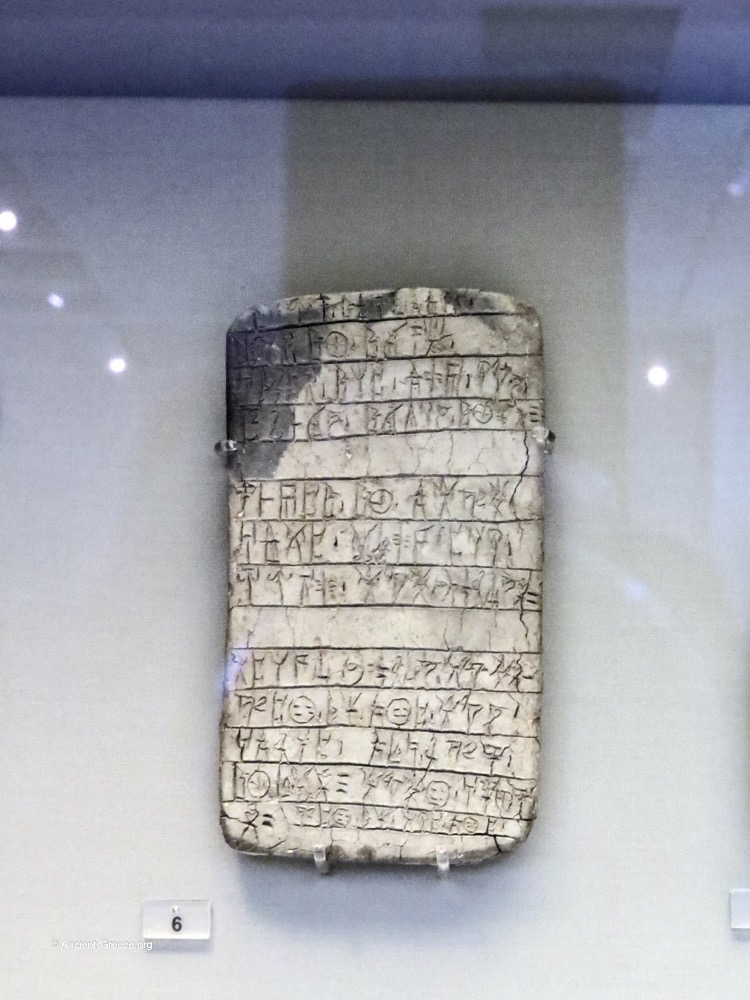
Linear B tablet
LINEAR B TABLETS
Linear B is the first form of Greek writing. It was a Mycenaean adaptation of the earlier Minoan Linear A script. In 1900, Arthur Evans recognised and named these first Aegean scripts in the palace at Knossos in Crete, which was occupied by the Mycenaeans after 1450 BC. But the language of the Linear B texts was not read until the greatest archive of clay tablets was discovered in the Mycenaean palace at Pylos in 1939. British architect Michael Ventris, with the assistance of philologist professor John Chadwick, deciphered Linear B in 1952 and showed that the Knossos and Pylos tablets were written in an early form of Greek, earlier than that of the Homeric poems.
Linear B is a syllabic script with approximately ninety syllabic signs, ideograms and numerals. The palace bureaucrats kept these inscribed clay tablets, which were administrative documents such as lists, inventories and tax forms. These documents provide invaluable information on palace hierarchy, the professional and social classes, and the production and manufacture of goods.
The clay tablets come in two shapes. The larger ones are rectangular and the smaller ones are elongated and leaf-shaped. Some tablets are inscribed on both sides and there are groups of tablets referring to the same subject. The tablets were stored in the palace archives, arranged by subject inside baskets, which were marked with clay labels bearing brief information on each basket's contents.
The text was inscribed on a damp clay tablet using a sharp bone or metal stylus. Then the tablet was left to dry in the sun.
When the Mycenaean palaces were destroyed by fire in approximately 1200 BC, these clay archives were baked and so preserved
until today.
Source: National Archaeological Museum in Athens, Greece
Athens Attica Bronze Age Clay Inscriptions Mycenaean National Archaeological Museum Original Photo