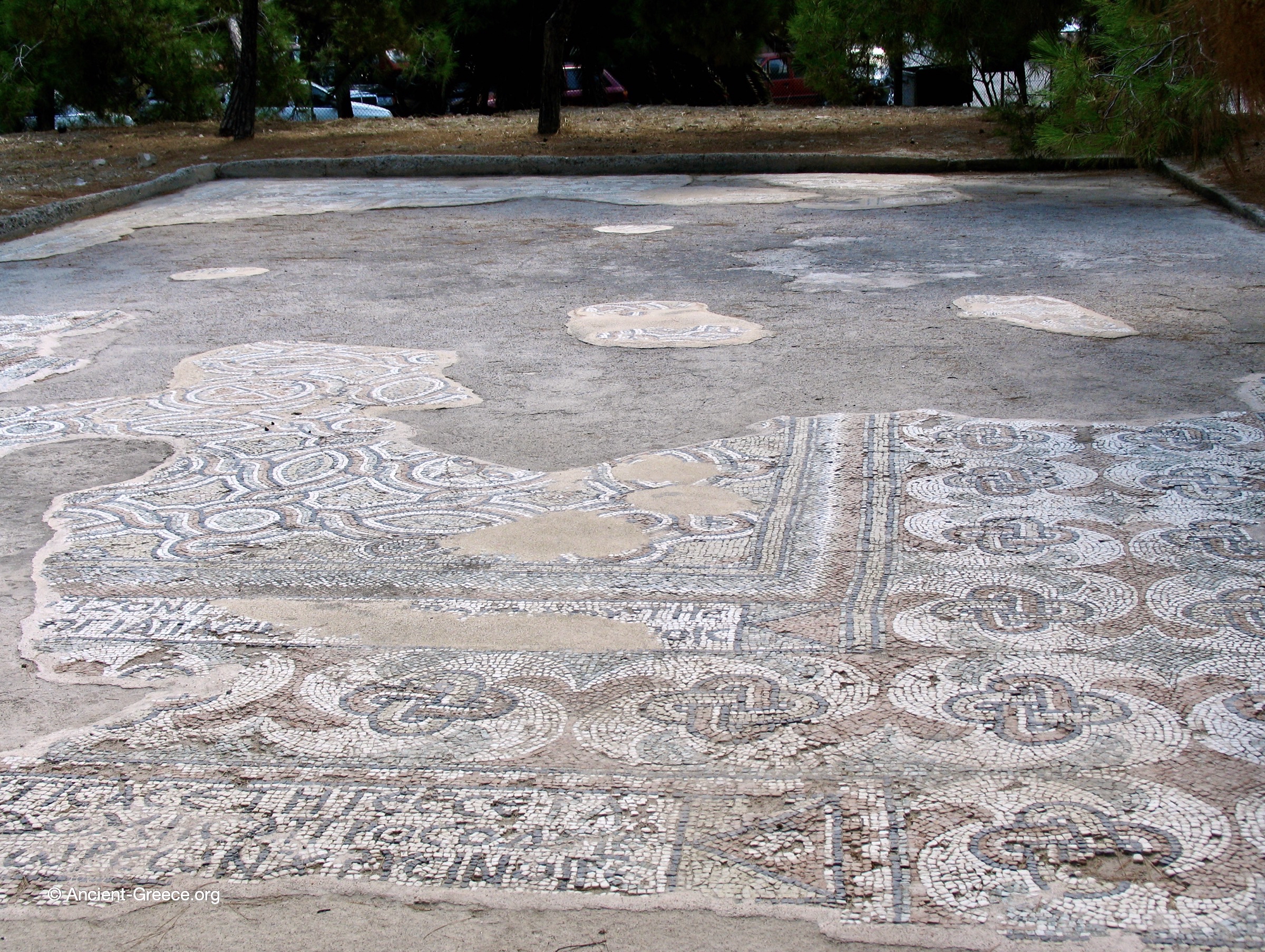
The mosaic decorated the floor of the Jewish synagogue of Aegina. 300 and 350 CE. The building serves as a poignant physical link to the tradition of Hellenistic Judaism, where Jewish communities flourished within a Greek cultural framework, often adopting the Greek language for their liturgy and inscriptions.
The mosaic decorated the floor of the Jewish synagogue of Aegina. Discovered in 1829 to the East of the "secret harbour" in the midst of an important quarter of the ancient city, the building has been excavated only in parts because of its modern superstructures. During the investigations remains of an older predecessor have been identified (hatched walls).
Through the entrance in the West and an antechamber people reached the main hall which measured 13.50 to 7.60 m. To the East - oriented towards the city of Jerusalem - a raised apsis was annexed in which the shrine for the Torah was stored. Between apsis and main hall stood the reading-desk (white recess in the eastern mosaic-frame).
For the purpose of preservation the mosaic has been removed from its original context to the actual position.
It displays the typical decoration-patterns of mosaic-floors of the 4th century AD consisting of artistic geometric designs in a rich scale of colours. At the west side near the entrance two donation inscriptions are visible. They refer to the erection of the synagogue using revenues of the community and donations of its members when Theodoros was head of the synagogue for four years. The completion of the synagogue and the bedding of the mosaic took place when his homonymous son held the same position.
The Jewish community of Aegina has been established probably when Jews and other refugees resorted to the island in the course of the Barbarian invasions into Greece at the end of the second and during the third century AD. The abandonment of the synagogue is testified by several Christian graves in the foundation walls of the building (dotted rectangles). The mosaic has been created between
300 and 350 AD.
Its sophisticated geometric designs and two Greek inscriptions recording the contributions of the synagogue's leaders, such as Theodoros the Archisynagogos, to its construction.
Το περίτεχνο ψηφιδωτό δάπεδο της αρχαίας συναγωγής της Αίγινας (περ. 300–350 μ.Χ.). Η συναγωγή ανακαλύφθηκε το 1829 κοντά στον «κρυφό λιμένα» και αποτελεί έναν σημαντικό υλικό σύνδεσμο με την παράδοση του Ελληνιστικού Ιουδαϊσμού, όπου οι εβραϊκές κοινότητες άκμασαν μέσα σε ένα ελληνικό πολιτισμικό πλαίσιο, υιοθετώντας συχνά την ελληνική γλώσσα στη λατρεία και τις επιγραφές τους. αποτελεί έναν σημαντικό υλικό σύνδεσμο με την παράδοση του Ελληνιστικού Ιουδαϊσμού, όπου οι εβραϊκές κοινότητες άκμασαν μέσα σε ένα ελληνικό πολιτισμικό πλαίσιο, υιοθετώντας συχνά την ελληνική γλώσσα στη λατρεία και τις επιγραφές τους. Το ψηφιδωτό, το οποίο έχει μεταφερθεί στον αρχαιολογικό χώρο της Κολώνας για προστασία, φέρει σύνθετα γεωμετρικά μοτίβα και δύο ελληνικές επιγραφές που μνημονεύουν την προσφορά των αρχισυναγώγων, όπως του Θεοδώρου, για την ανέγερση του κτιρίου.
-- Kolona archaeological site, Aegina Island, Greece.