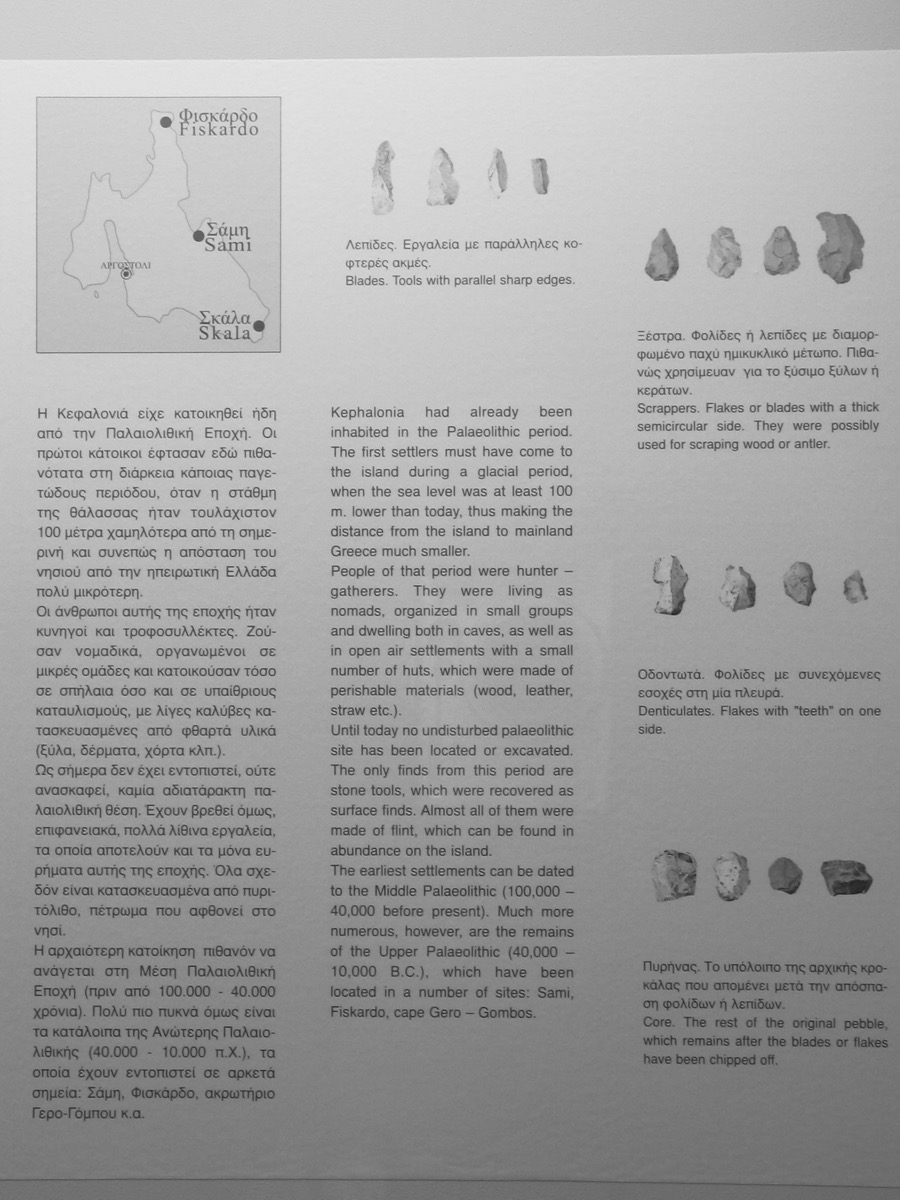
An informational panel providing a comprehensive overview of the Palaeolithic period on Kephalonia.
The text explains that the first settlers likely arrived during a glacial period when sea levels were at least 100 m lower than today, significantly narrowing the distance to mainland Greece. These early inhabitants were nomadic hunter-gatherers who utilized flint, abundant on the island, to create various stone tools. The display highlights the transition from the Middle Palaeolithic (c. 100,000–40,000 before present) to the more numerous remains of the Upper Palaeolithic (40,000–10,000 BCE), with key sites located at Sami, Fiskardo, and Cape Gero-Gombos.
Ενημερωτική πινακίδα που παρέχει μια ολοκληρωμένη ανασκόπηση της Παλαιολιθικής εποχής στην Κεφαλονιά. Το κείμενο εξηγεί ότι οι πρώτοι κάτοικοι έφτασαν πιθανώς κατά τη διάρκεια μιας παγετώδους περιόδου, όταν η στάθμη της θάλασσας ήταν τουλάχιστον 100 μ. χαμηλότερη από τη σημερινή, μειώνοντας σημαντικά την απόσταση από την ηπειρωτική Ελλάδα. Οι άνθρωποι αυτοί ήταν νομάδες κυνηγοί-τροφοσυλλέκτες που χρησιμοποιούσαν τον άφθονο στο νησί πυριτόλιθο για την κατασκευή λίθινων εργαλείων. Η πινακίδα αναδεικνύει τη μετάβαση από τη Μέση Παλαιολιθική (περ. 100.000–40.000 πριν από σήμερα) στα πολυπληθέστερα κατάλοιπα της Ανώτερης Παλαιολιθικής (40.000–10.000 π.Χ.), με κύριες θέσεις στη Σάμη, το Φισκάρδο και το ακρωτήριο Γερο-Γόμπου.
-- Exhibited in the Argostoli Archaeological Museum, Kefalonia island, before it closed down due to ear quake damage in 2014.
Argostoli Archaeological Museum In Situ Ionian Sea Kefalonia Museum Collection Reconstructions and Plans Stone Age | Λίθινη Εποχή Tools and Resources