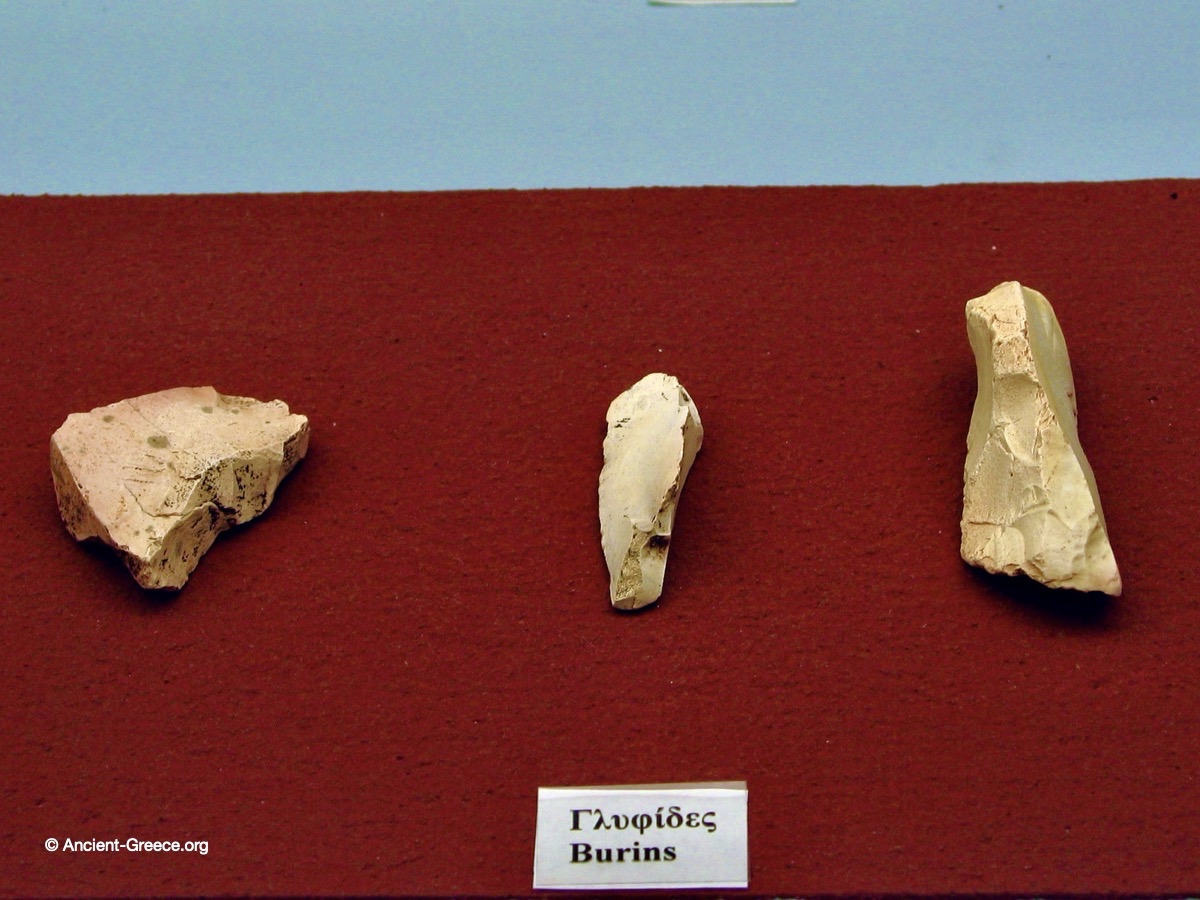
A set of flint burins (Γλυφίδες) dating to the Upper Paleolithic period (c. 35,000–10,000 BCE).
These specialized stone tools feature a sharp, chisel-like edge created by a specific flaking technique, allowing early humans on Kefalonia to engrave or carve bone, antler, and wood. Found primarily in coastal and cave sites, they represent some of the most sophisticated hunting-and-gathering technology of the Ice Age. These were displayed in the prehistoric section of Room I at the Archaeological Museum of Argostoli.
Σειρά από γλυφίδες (burins) από πυριτόλιθο, που χρονολογούνται στην Ανώτερη Παλαιολιθική περίοδο (περ. 35.000–10.000 π.Χ.). Αυτά τα εξειδικευμένα λίθινα εργαλεία διαθέτουν μια αιχμηρή απόληξη που μοιάζει με σμίλη, η οποία δημιουργήθηκε με μια συγκεκριμένη τεχνική κρούσης, επιτρέποντας στους πρώτους ανθρώπους της Κεφαλονιάς να χαράσσουν ή να επεξεργάζονται οστά, κέρατα και ξύλο. -- Exhibited in the Argostoli Archaeological Museum, Kefalonia island, before it closed down due to ear quake damage in 2014.
Argostoli Archaeological Museum Ionian Sea Kefalonia Museum Collection Original Photo Stone Stone Age | Λίθινη Εποχή Tools and Resources