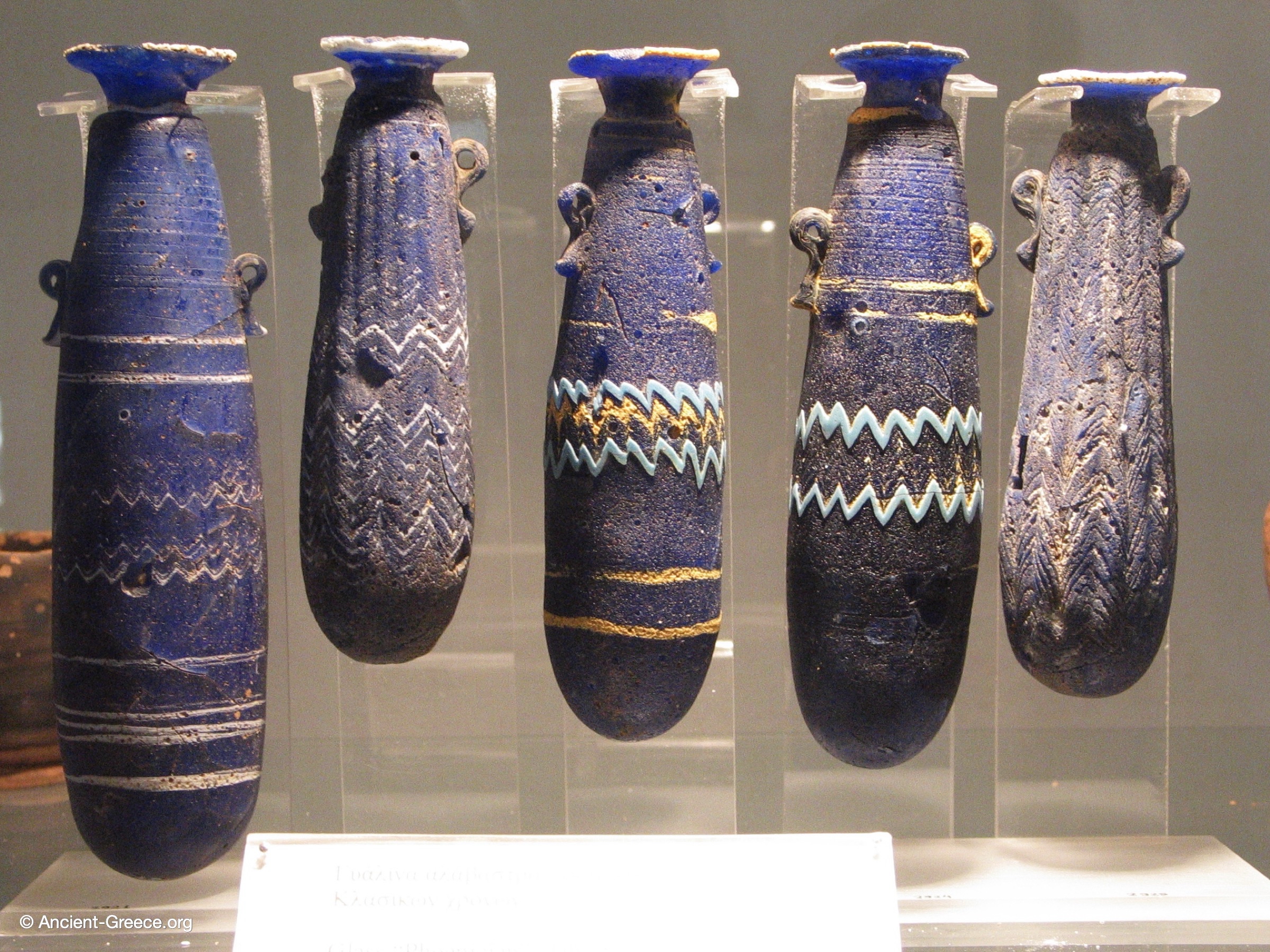
Glass "Phoenician" Alabastra
Ambracia
5th–4th century BCE
Core-formed Glass
Daily Life / Personal Adornment
These core-formed glass vessels, commonly referred to as "Phoenician" or "Eastern Mediterranean" types, were luxury items used to store precious scented oils and perfumes. They feature a deep blue base decorated with opaque white, yellow, or light blue glass threads applied in zigzag and feathered patterns. In ancient Ambracia, such alabastra were highly valued status symbols, often found in the burials of wealthy women or used in life within the gynaiconites. Their presence in the city highlights the active trade networks connecting Epirus with the major glass-producing centers of the Eastern Mediterranean during the Classical period.
◈ ◈ ◈
Γυάλινα «Φοινικικά» Αλάβαστρα
Αμβρακία
5ος–4ος αι. π.Χ.
Πολύχρωμη Γυαλόμαζα
Καθημερινή Ζωή / Προσωπικός Καλλωπισμός
Αυτά τα γυάλινα σκεύη, γνωστά ως «φοινικικού» τύπου ή τύπου Ανατολικής Μεσογείου, αποτελούσαν είδη πολυτελείας για τη φύλαξη πολύτιμων αρωματικών ελαίων και μύρων. Διακρίνονται για τη βαθυκύανη βάση τους, διακοσμημένη με αδιαφανή λευκά, κίτρινα ή γαλάζια γυάλινα νήματα που σχηματίζουν ζικ-ζακ και φτερωτά μοτίβα. Στην αρχαία Αμβρακία, τέτοια αλάβαστρα ήταν περιζήτητα σύμβολα κοινωνικής θέσης, και συχνά βρίσκονται σε ταφές εύπορων γυναικών ή χρησιμοποιούνταν στον γυναικωνίτη. Η παρουσία τους στην πόλη υπογραμμίζει τα ενεργά εμπορικά δίκτυα που συνέδεαν την Ήπειρο με τα μεγάλα κέντρα υαλουργίας της Ανατολικής Μεσογείου κατά την κλασική περίοδο.
Photographed in the Archaeological Museum of Arta, Epirus, Greece. - Αρχαιολογικό Μουσείο Άρτας, Ἠπειρος, Ελλάς - 2004 in the old museum building.