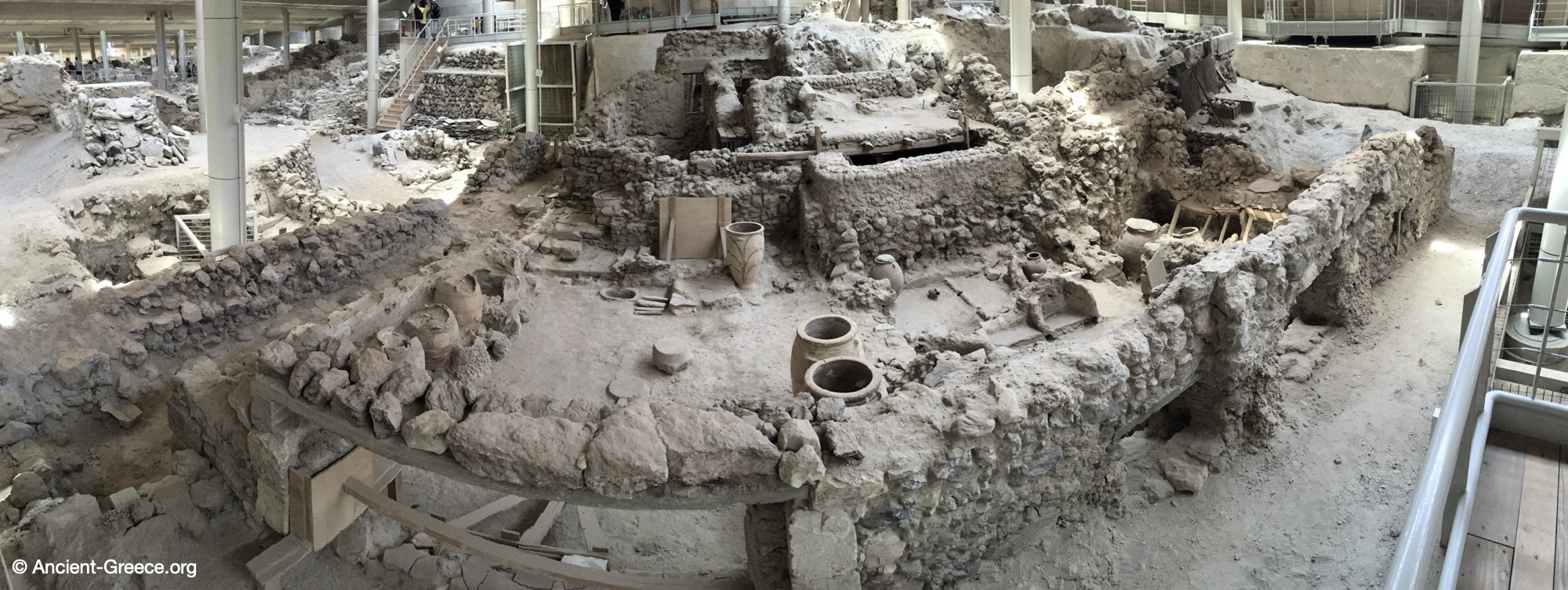
Pithoi Storeroom, Akrotiri
Akrotiri Archaeological Site, Santorini
17th Century BCE
Bronze Age
Stone, Masonry, Stucco, and Wood (Remnants)
Architectural view
This panoramic view captures the Pithoi Storeroom, revealing its complex interior arrangement and relationship to the surrounding Cycladic streetscape. The facade is defined by a large central opening and two smaller windows that provided essential light to the storage chambers within the ruin. Standing in their original positions as they were over 3,500 years ago, several pithoi remain in various states of excavation; analysis of organic remains within these jars confirms they stored barley, barley flour, and various seeds. The structure occupies a significant portion of the urban block, bordered by paved paths that characterize the sophisticated town planning of the Aegean Bronze Age. Within the Architecture of the southernmost room, a hearth—a low quadrilateral platform—is situated beside a small stone basin sunk into the floor. Evidence of productivity extends vertically, as numerous loom weights discovered in front of the large window indicate that weaving activities took place on the upper floor directly above the storage area.
◈ ◈ ◈
Αποθήκη των Πίθων, Ακρωτήρι
Αρχαιολογικός Χώρος Ακρωτηρίου, Σαντορίνη
17ος αιώνας π.Χ.
Εποχή του Χαλκού
Λίθος, Τοιχοποιία, Κονίαμα και Ξύλο (Κατάλοιπα)
Αρχιτεκτονική άποψη
Η πανοραμική αυτή άποψη αποτυπώνει την Αποθήκη των Πίθων, αποκαλύπτοντας την περίπλοκη εσωτερική της διάταξη και τη σχέση της με το γύρω Κυκλαδικό οδικό δίκτυο. Η πρόσοψη ορίζεται από ένα μεγάλο κεντρικό άνοιγμα και δύο μικρότερα παράθυρα που εξασφάλιζαν τον φωτισμό των αποθηκευτικών χώρων στο εσωτερικό του ερειπίου. Στις αρχικές τους θέσεις, όπως βρίσκονταν πριν από 3.500 χρόνια, αρκετοί πίθοι παραμένουν σε διάφορα στάδια ανασκαφής· η ανάλυση των οργανικών καταλοίπων επιβεβαιώνει την αποθήκευση κριθαριού, αλεύρου και ποικίλων σπόρων. Το κτήριο καταλαμβάνει σημαντικό τμήμα του πολεοδομικού τετραγώνου, πλαισιωμένο από λιθόστρωτα μονοπάτια που χαρακτηρίζουν τον εξελιγμένο σχεδιασμό των πόλεων στο Αιγαίο κατά την Εποχή του Χαλκού. Στην Αρχιτεκτονική του νοτιότερου δωματίου διακρίνεται μια εστία —μια χαμηλή τετράπλευρη πλατφόρμα— δίπλα σε μια μικρή λίθινη λεκάνη βυθισμένη στο δάπεδο. Η παραγωγική δραστηριότητα επεκτεινόμενη καθ' ύψος μαρτυρείται από τα πολυάριθμα βάρη αργαλειού που βρέθηκαν μπροστά από το μεγάλο παράθυρο, υποδεικνύοντας ότι στον όροφο ακριβώς πάνω από την αποθήκη λειτουργούσε υφαντουργείο.
Archaeological Site of Akrotiri, Thera Island, Greece. ◈ Αρχαιολογικός Χώρος στο Ακρωτήρι Θήρας. 2016
Aegean Akrotiri Akrotiri Archaeological Site Architecture Bronze Age Ceramics Clay Cycladic Original Photo Pithos Pottery Thera Urban Ruins