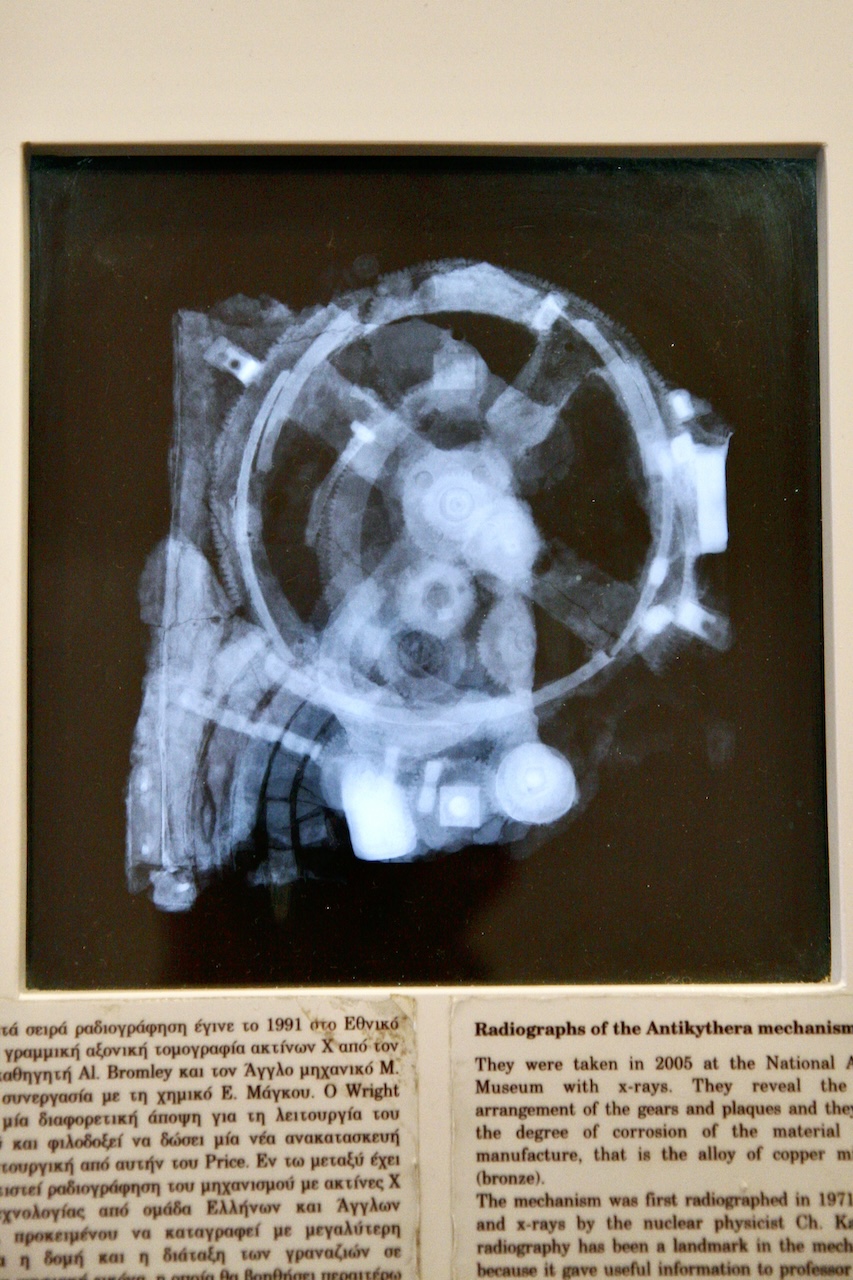
Antikythera Mechanism Radiograph. Circa 2nd – 1st c. BCE.
The museum explanation reads: "They were taken in 2005 at the National Archaeological Museum with x-rays. They reveal the complicated arrangement of the gears and plaques and they also imprint the degree of corrosion of the material used for its manufacture, that is the alloy of copper mixed with tin (bronze).
The mechanism was first radiographed in 1971 with gamma-and x-rays by the nuclear physicist Ch. Karakalos. This radiography has been a landmark in the mechanism's study, because it gave useful information to professor Price in order to create the exhibited reconstruction of the mechanism.
Another radiography was done in 1990 at the National Museum with stereo x-rays (under inclination) aiming at a ereo view of the gears arrangement. The third in sequence radiography was done in 1991 at the National Museum with linear x-rays tomography by the Australian professor Al. Bromley and the English engineer M.Wright in collaboration with the chemist E.Mangou. Wright expressed a different opinion about the mechanism's function and he aspires to create a new reconstruction of the mechanism, more functional than that of Price.
In the meantime, a group of Greek and English researchers are prepared to radiograph the mechanism with x-rays of high technology, in order to take with higher resolution its internal structure and the gears' arrangement in a three-dimensional view, which could help further the demonstration of the mechanism's operation."
From the 2013 "Το Ναυάγιο των Αντικυθήρων. Το Πλοίο, οι Θησαυροί, ο Μηχανισμός" (The Antikythera Shipwreck. The Ship, The Treasures, The Mechanism) at the National Archaeological Museum in Athens, Greece.
Antikythera Athens Inscriptions National Archaeological Museum Original Photo Reconstructions and Plans