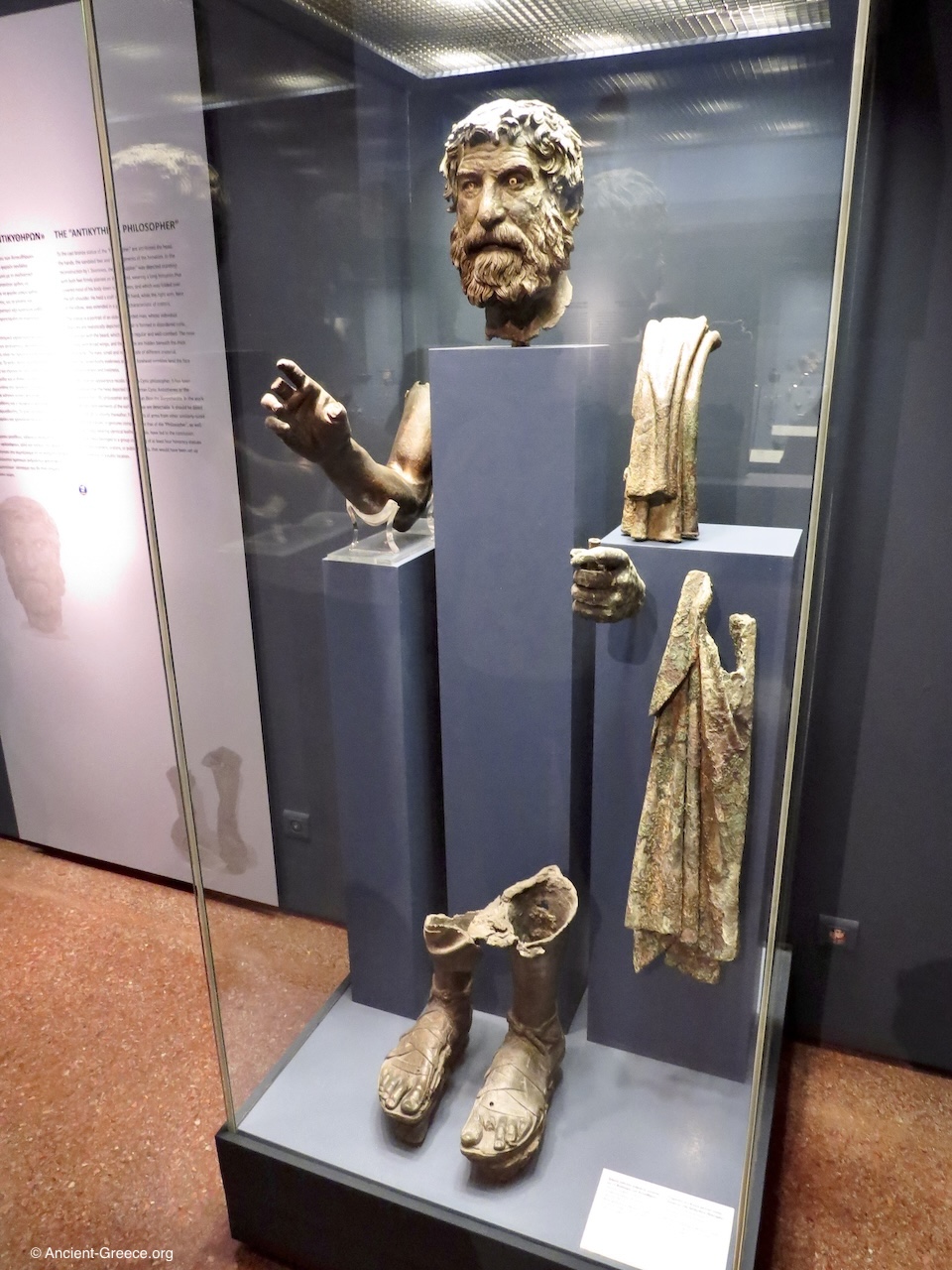
The Antikythera Philosopher bronze fragments. About 240 BCE.
Information from the museum's exhibit indicates: "To the cast bronze statue of the "Philosopher" are attributed the head, the hands, the sandaled feet and two fragments of the himation. in the reconstruction by I. Svoronos, the "Philosopher" was depicted standing with both feet firmly planted on the ground, wearing a long himation that covered most of his body down to the knees, and which was folded over the left shoulder. He held a staff in his left hand, while the right arm, bent at the elbow, was extended in a gesture characteristic of orators.
The statue is a portrait of an elderly, bearded man, whose individual features are realistically depicted. The hair is formed in disordered curls, in contrast with the beard, which is more regular and well-combed. The nose is long, with broad wings, and the thin lips are hidden beneath the thick mustache. The eyes, small and round, made of different material, and the raised bushy eyebrows and deep forehead wrinkles lend the face expressiveness and liveliness.
The unkempt appearance recalls that of a Cynic philosopher. It has been proposed that the head depicted the Athenian Cynic Antisthenes or the famous 3rd c. BC philosopher and magician Bion the Borysthenite. In the work recognizable elements of the early baroque are detectable. It should be dated ca 230 BC or shortly thereafter. Fragments of arms from other similarly-sized bronze statues, in gestures comparable to that of the "Philosopher", as well as of legs wearing identical leather sandals, have led to the conclusion that these belonged to a group consisting of at least four honorary statues of philosophers, orators, or public officials, that would have been set up outdoors, in a public location."
"Portrait head from a statue of a philosopher. Bronze.
Found in the Antikythera shipwreck. The head with the tousled hair, the luxuriant beard and the thick moustache depicts realistically a philosopher with his individual features. The eyeballs are made of a different material and the irises of glass paste. In addition to the head, two parts of the himation worn by the man are preserved (inv. nos. X. 15088, X. 18932), along with both legs from about the middle of the shins down (inv. nos. X. 15090,
X. 15091), the right hand from the arm (inv. no. X. 15105), and the left hand (inv. no. X. 15108). The philosopher was depicted standing, wearing a long himation. In his left hand he held a staff, and the right was extended in a characteristic gesture of orators. He wears sandals with thick soles. This statue depicted a Cynic philosopher, probably Bion the Borysthenite. About 240 BCE.
From the 2013 "Το Ναυάγιο των Αντικυθήρων. Το Πλοίο, οι Θησαυροί, ο Μηχανισμός" (The Antikythera Shipwreck. The Ship, The Treasures, The Mechanism) at the National Archaeological Museum in Athens, Greece.