Children's World: Life and Play
Houses of Ambracia
6th–2nd century BCE
Museum Information Panel
Daily Life / Education
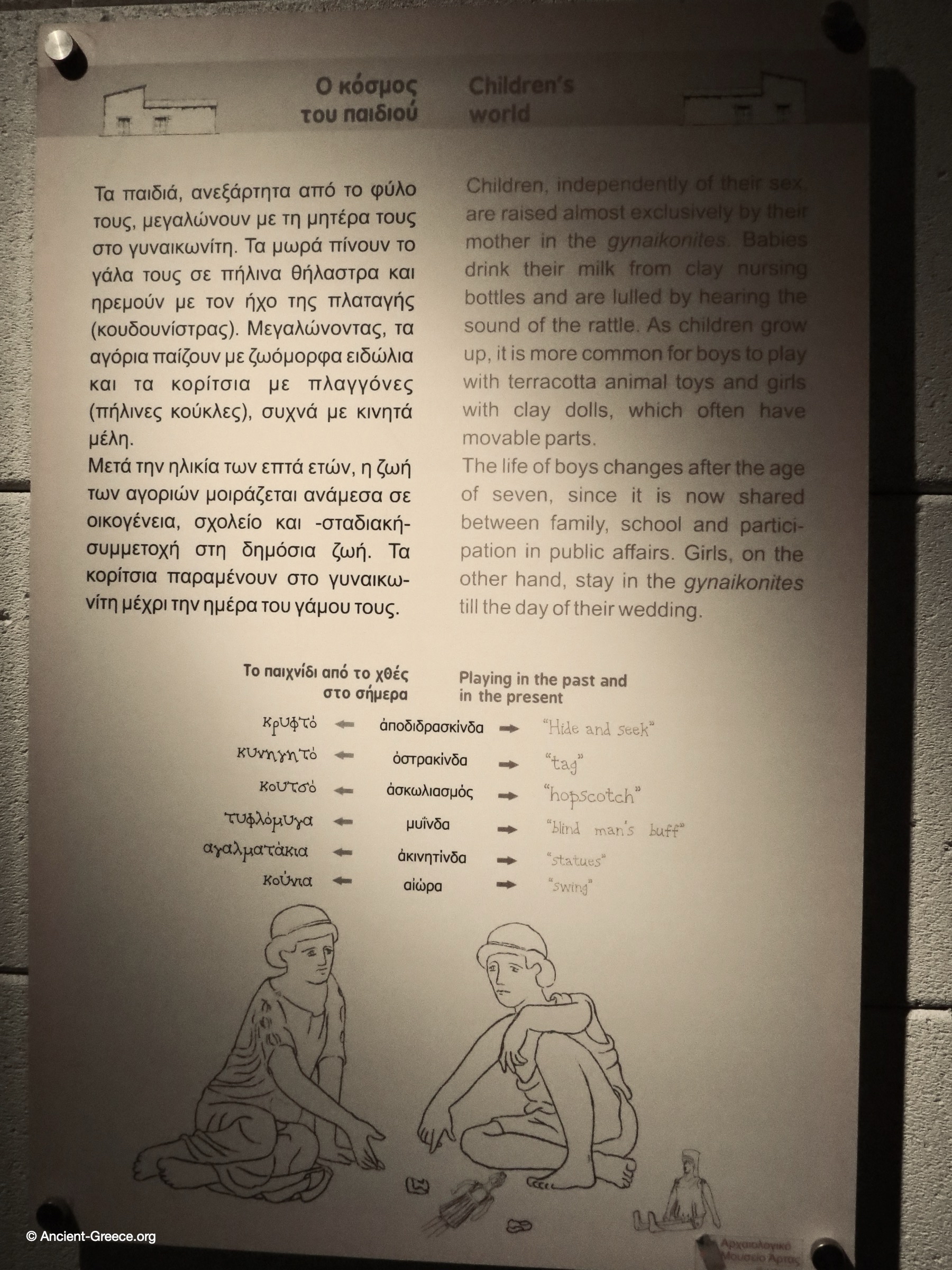
Children in Ambracia were raised in the gynaikonites by their mothers, regardless of gender, during their early years. Infants were fed with clay nursing bottles and entertained with rattles, while older children played with terracotta animals and articulated dolls (plangones). At age seven, paths diverged: boys began their formal education and prepared for public life, while girls remained in the women's quarters until marriage. Many ancient games bear a striking resemblance to those played today, including versions of "hide and seek," "tag," and various ball and dice games (pessoi), highlighting the enduring nature of childhood play across the millennia.
◈ ◈ ◈
Ο Κόσμος του Παιδιού: Ζωή και Παιχνίδι
Οικίες της Αμβρακίας
6ος–2ος αι. π.Χ.
Μουσειακή Πινακίδα
Καθημερινή Ζωή / Εκπαίδευση
Τα παιδιά στην Αμβρακία μεγάλωναν στον γυναικωνίτη με τη μητέρα τους, ανεξαρτήτως φύλου, κατά τα πρώτα τους χρόνια. Τα βρέφη τρέφονταν με πήλινα θήλαστρα και ηρεμούσαν με τον ήχο της πλαταγής (κουδουνίστρας), ενώ τα μεγαλύτερα παιδιά έπαιζαν με ζωόμορφα ειδώλια και πλαγγόνες (πήλινες κούκλες με κινητά μέλη). Μετά την ηλικία των επτά ετών, οι δρόμοι τους χώριζαν: τα αγόρια ξεκινούσαν την εκπαίδευσή τους και την προετοιμασία για τη δημόσια ζωή, ενώ τα κορίτσια παρέμεναν στον γυναικωνίτη μέχρι τον γάμο τους. Πολλά αρχαία παιχνίδια παρουσιάζουν εντυπωσιακή ομοιότητα με τα σημερινά, όπως η «αποδιδρασκίνδα» (κρυφτό), το «οστρακίνδα» (κυνηγητό) και διάφορα παιχνίδια με σφαίρες ή πεσσούς.
Photographed in the Archaeological Museum of Arta, Epirus, Greece. - Αρχαιολογικό Μουσείο Άρτας, Ἠπειρος, Ελλάς - 2014