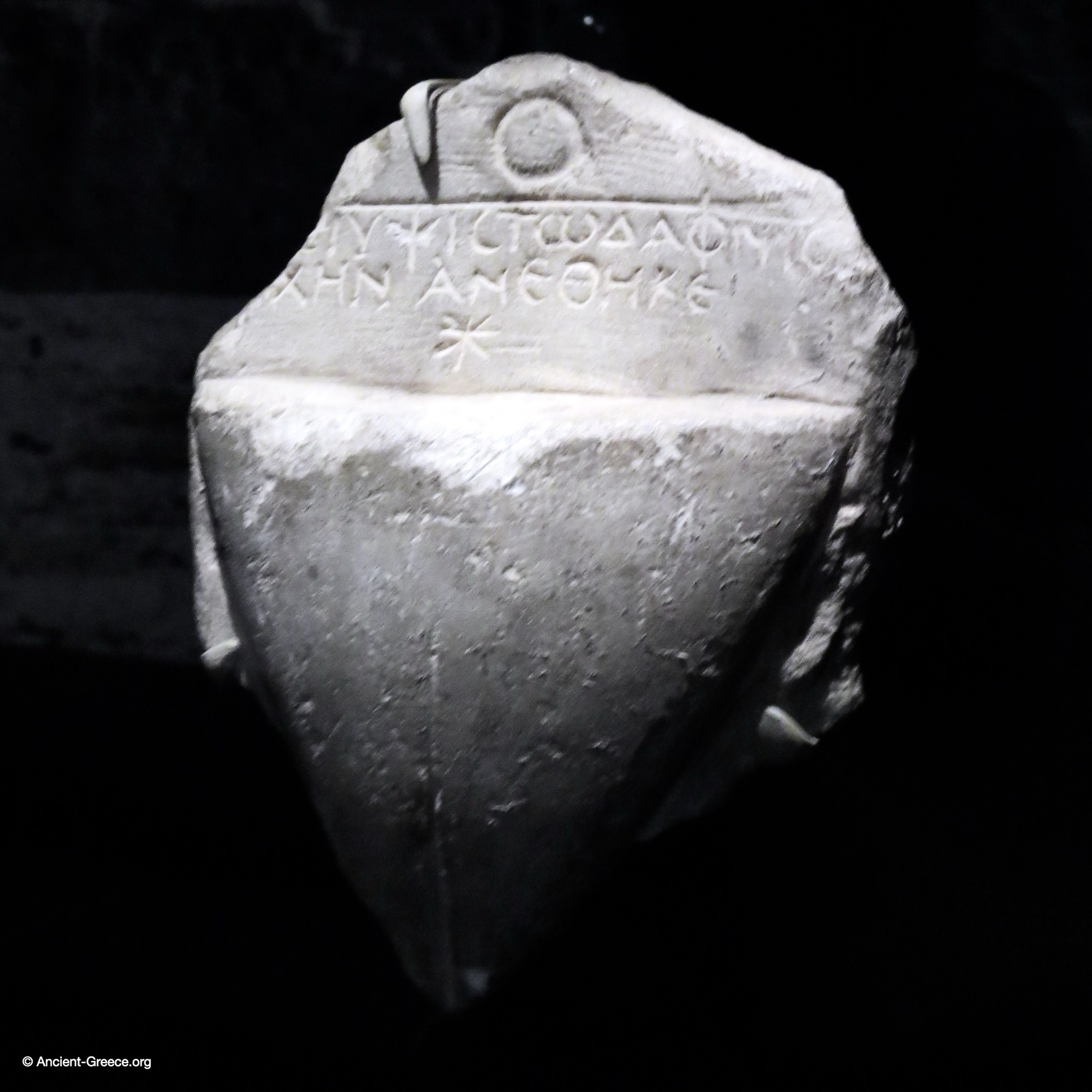
Anatomical Votive of Female Genitalia
Athens, Greece
2nd-3rd century CE (Roman)
Marble
Anatomical votive, Zeus Hypsistos
This anatomical votive was dedicated by a woman named Daphnis to Zeus Hypsistos (Most High), likely in gratitude for healing an illness or resolving infertility. The artifact originates from an outdoor healing shrine dedicated to Zeus on the Pnyx hill in Athens, where numerous similar anatomical offerings have been excavated. The dedication of such votives predominantly by women constitutes a distinct local characteristic of this specific cult.
◈
Ανατομικό ανάθημα γυναικείων γεννητικών οργάνων
Αθήνα, Ελλάδα
2ος-3ος αιώνας μ.Χ. (Ρωμαϊκή)
Μάρμαρο
Ανατομικό ανάθημα, Ζεύς Ύψιστος
Αυτό το ανατομικό ανάθημα αφιερώθηκε από μια γυναίκα με το όνομα Δάφνις στον Ύψιστο Δία, πιθανότατα ως ένδειξη ευγνωμοσύνης για τη θεραπεία κάποιας ασθένειας ή την αντιμετώπιση της υπογονιμότητας. Το τεχνούργημα προέρχεται από ένα υπαίθριο θεραπευτικό ιερό αφιερωμένο στον Δία στον λόφο της Πνύκας στην Αθήνα, όπου έχουν ανασκαφεί πολυάριθμες παρόμοιες ανατομικές προσφορές. Η αφιέρωση τέτοιων αναθημάτων κυρίως από γυναίκες αποτελεί ένα ξεχωριστό τοπικό χαρακτηριστικό αυτής της συγκεκριμένης λατρείας.
At the Boston Museum of Fine Arts. Boston, USA. 2026
Votive in the shape of female genitalia Greek, Roman Imperial period, 2nd-3rd century CE
Inscribed To Zeus Hypsistos Dophnis dedicated [this in fulfillment of] a vow
Marble
A woman, Daphnis, offered this votive to Zeus Hypsistos (Most High) in thanks for his aid, probably for curing some illness or overcoming infertility.
Zeus was worshipped as a healing god at an outdoor shrine on the Phyx, a hill in Athens (see mural behind you). Dozens of anatomical votives featuring breasts, eyes, lower face, arms, and feet were discovered there.
Most were dedicated by women, an unusual local feature of this cult.
-Boston museum label
◈
Στο Μουσείο Καλών Τεχνών της Βοστώνης. Βοστώνη, ΗΠΑ. 2026.
Art Athens Boston Museum of Fine Arts Inscriptions Marble Medicine Museum Collection Original Photo Roman Sculpture USA