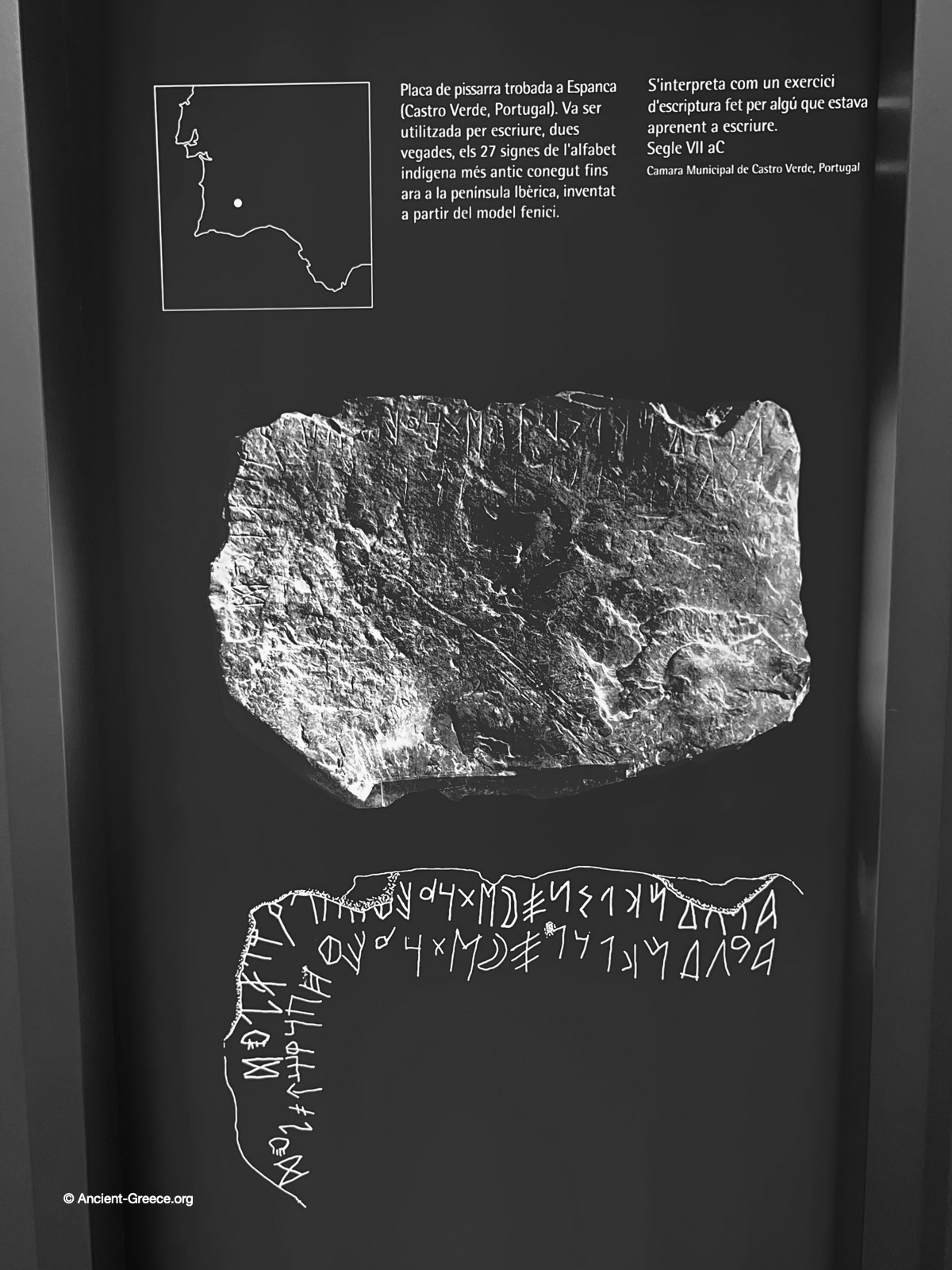
Slate tablet the 27 signs of the oldest indigenous alphabet known so far in the Iberian Peninsula based on the Phoenician model. 7th century BCE.
Slate tablet found in Espanca (Castro Verde, Portugal). It was used to write, twice, the 27 signs of the oldest indigenous alphabet known so far in the Iberian Peninsula, invented based on the Phoenician model.
It is interpreted as a writing exercise done by someone who was learning to write.
7th century BCE.
The Phoenicians in Catalonia
During the 7th century BC, the Phoenicians frequented the Valencian and Catalan coasts, especially the territories formed by the final course of the Ebro River. They went in search of raw or processed metals, which they exchanged for products they brought from other places. Proof of the importance of this trade is the high proportion of Phoenician amphorae found in sites such as Aldovesta (Ribera d'Ebre) or Sant Jaume - Mas d'en Serrà
(Montsià). These ceramic containers extend upstream, reaching the regions of Terra Alta and Matarranya, today's province of Teruel. Phoenician trade has a decisive impact on indigenous societies. At first, they are formations with a slightly stratified structure, governed by chieftains who are supported by family ties and by the function of redistributors of goods.
When trade with the Phoenicians appears, the situation changes. Elites arise from the production of surpluses, whose authority is justified by mythical genealogies, are imposed. Parity redistribution disappears and its place is occupied by a new type of aristocratic society, which has been called the
"ancient period of Iberian culture". Trade serves to reinforce the prestige of these elites.
Between 600 and 575 BC, the Phoenician presence is extinguished. From that moment on, the Phocian Greeks of Empúries will be the ones who take over in the
trade.
Exhibited at the Catalan Museum of Archaeology, Barcelona, Spain. Museu d'Arqueologia de Catalunya (MAC).
Barcelona Catalan Museum of Archaeology - Museu d Arqueologia de Catalunya (MAC) Catalonia Iberian Inscriptions Original Photo Phoenician Spain