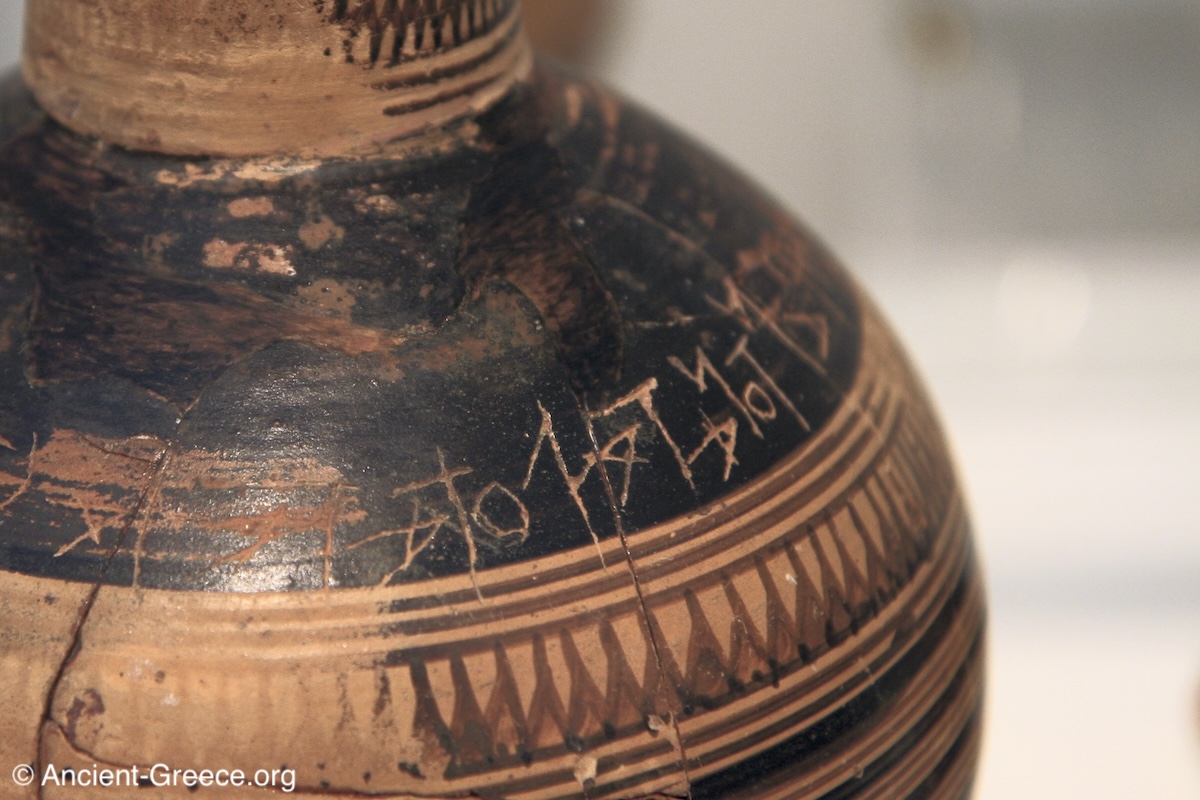
The inscription on the Dipylon oenochoe closeup. It is the earliest known sample of the Greek Alphabet, incised on the jar in its early form, right to left. Circa 740 BCE
The inscription says roughly something to the effect: "whoever dances the best, will receive this jar"
Transcription:
"ΗΟΣΝΥΝΟΡΧΕΣΤΟΝΠΑΝΤΟΝΑΤΑΛΟΤΑΤΑΠΑΙΖΕΙΤΟΤΟΔΕΚΛ[?]ΜΙ[?]Ν
In modern scholarly editions, this is sometimes transcribed as:
ὸς νῦν ὀρχεστôν πάντον ἀταλότατα παίζει,
τô τόδε κλμιν[...]
This corresponds to the following in the later classical orthography in Greek (using the Ionian form of the Greek alphabet), with the metric feet of the hexameter indicated:
ὃς νῦν | ὀρχη|στῶν πάν|των ἀτα|λώτατα | παίζει
τοῦ τόδε ...
Literal translation:
Whoever of all these dancers now plays most delicately,
of him this (sc. pot)..." (https://en.wikipedia.org/wiki/Dipylon_inscription. 26 Apr. 2025)
Exhibited at the National Archaeological Museum, Athens, Greece.