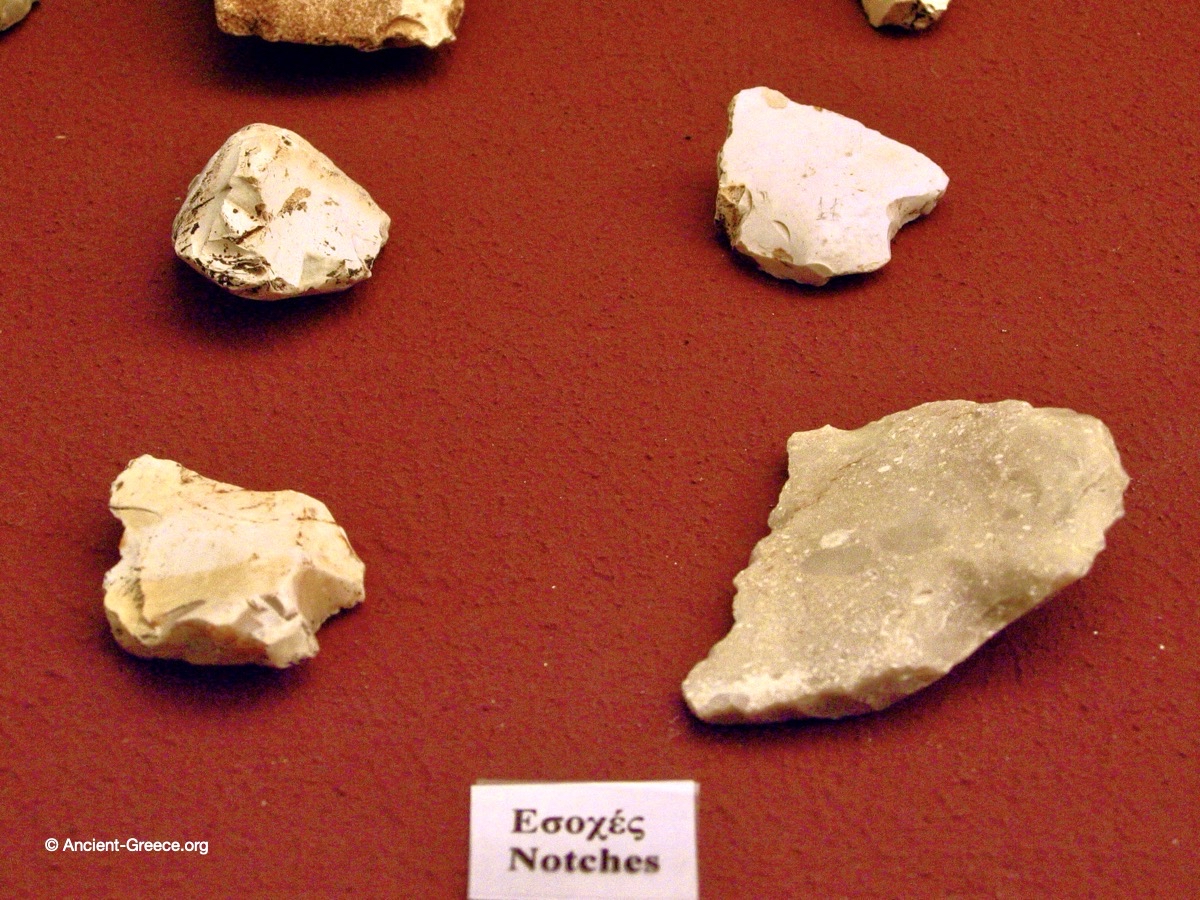
A collection of flint notches (Εσοχές) dating to the Middle or Upper Paleolithic period (c. 50,000–10,000 BCE).
These tools feature intentional, semi-circular indentations worked into the edge of a flake. For the early hunter-gatherers of Kefalonia, these functioned as specialized "spokeshaves," used for smoothing wooden shafts for spears or arrows and for stripping bark or sinew. These lithic artifacts were part of the foundational prehistoric display in Room I of the Archaeological Museum of Argostoli.
Συλλογή από εσοχές (notches) από πυριτόλιθο, που χρονολογούνται στη Μέση ή Ανώτερη Παλαιολιθική περίοδο (περ. 50.000–10.000 π.Χ.). Τα εργαλεία αυτά διαθέτουν σκόπιμα δουλεμένες ημικυκλικές εγκοπές στην ακμή τους. Για τους παλαιολιθικούς ανθρώπους της Κεφαλονιάς, οι εσοχές λειτουργούσαν ως εξειδικευμένες ξύστρες για τη λείανση ξύλινων στελεχών για δόρατα ή βέλη, καθώς και για την αφαίρεση φλοιών ή νεύρων.
-- Exhibited in the Argostoli Archaeological Museum, Kefalonia island, before it closed down due to ear quake damage in 2014.
Argostoli Archaeological Museum Ionian Sea Kefalonia Original Photo Stone Stone Age Tools and Resources