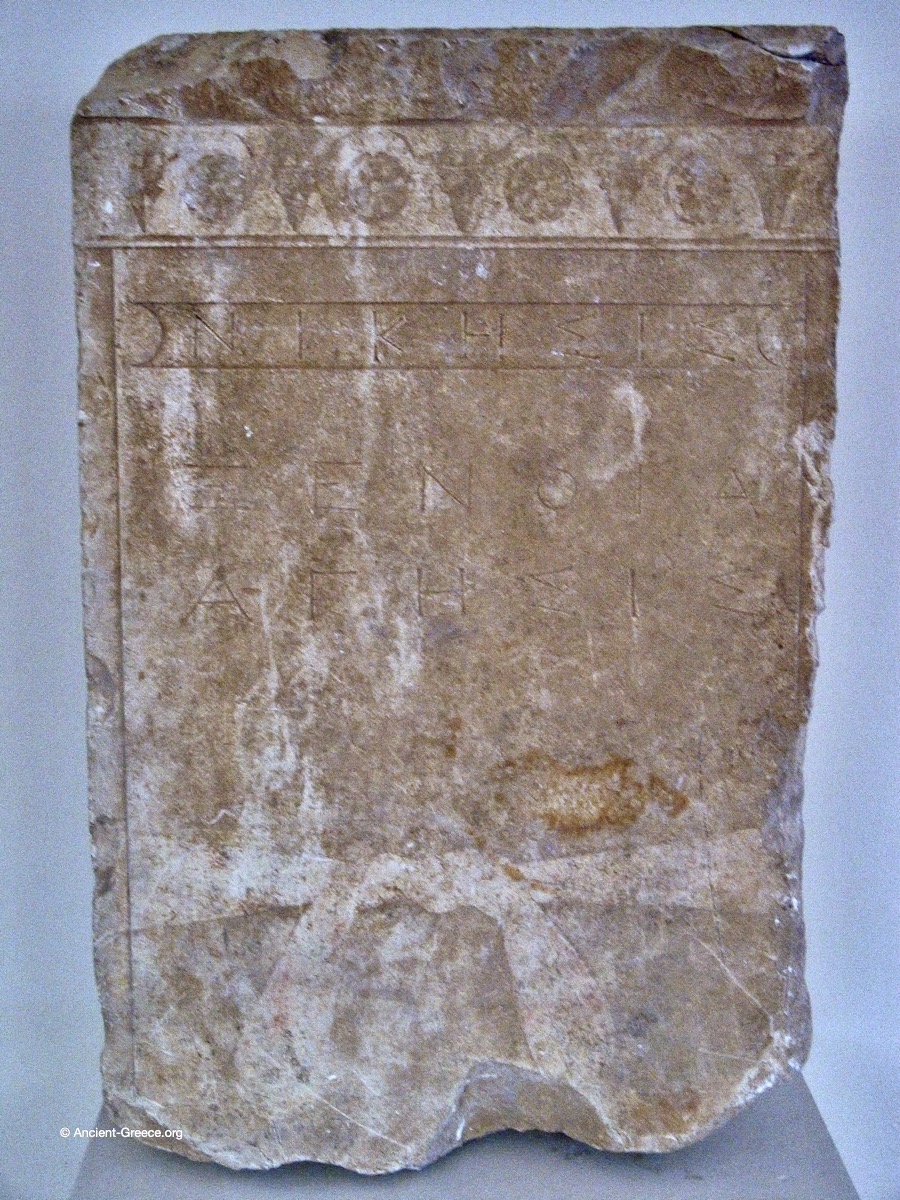
A limestone funerary stele featuring a Greek inscription, likely dating to the Hellenistic or early Roman period (c. 2nd century BCE – 1st century CE).
The inscription appears to list names, with the clear text ΝΙΚΗΣΙΟΣ (Nikesios) at the top, followed by ΞΕΝΟΙΑ and ΑΓΗΣΙΣ. These types of grave markers were common throughout the Cephallenian Tetrapolis and provide valuable epigraphic evidence of the island's ancient inhabitants. It was displayed in Room III of the Archaeological Museum of Argostoli until the 2014 earthquake.
---
Λίθινη επιτύμβια στήλη με ελληνική επιγραφή, που χρονολογείται πιθανότατα στην Ελληνιστική ή πρώιμη Ρωμαϊκή περίοδο (περ. 2ος αι. π.Χ. – 1ος αι. μ.Χ.). Η επιγραφή αναγράφει ονόματα, με ευδιάκριτο το όνομα ΝΙΚΗΣΙΟΣ στην κορυφή, ακολουθούμενο από τα ΞΕΝΟΙΑ και ΑΓΗΣΙΣ. + Αυτού του είδους τα ταφικά μνημεία ήταν κοινά στις πόλεις της Κεφαλληνιακής Τετράπολης και αποτελούν πολύτιμες επιγραφικές μαρτυρίες για τους αρχαίους κατοίκους του νησιού. + Εκτίθετο στην Αίθουσα ΙΙΙ του Αρχαιολογικού Μουσείου Αργοστολίου μέχρι τον σεισμό του 2014.
-- Exhibited in the Argostoli Archaeological Museum, Kefalonia island, before it closed down due to ear quake damage in 2014.-
Animals Argostoli Archaeological Museum Art Color and Polychromy Floral Fresco Funerary Ionian Sea Kefalonia Original Photo Roman Stele