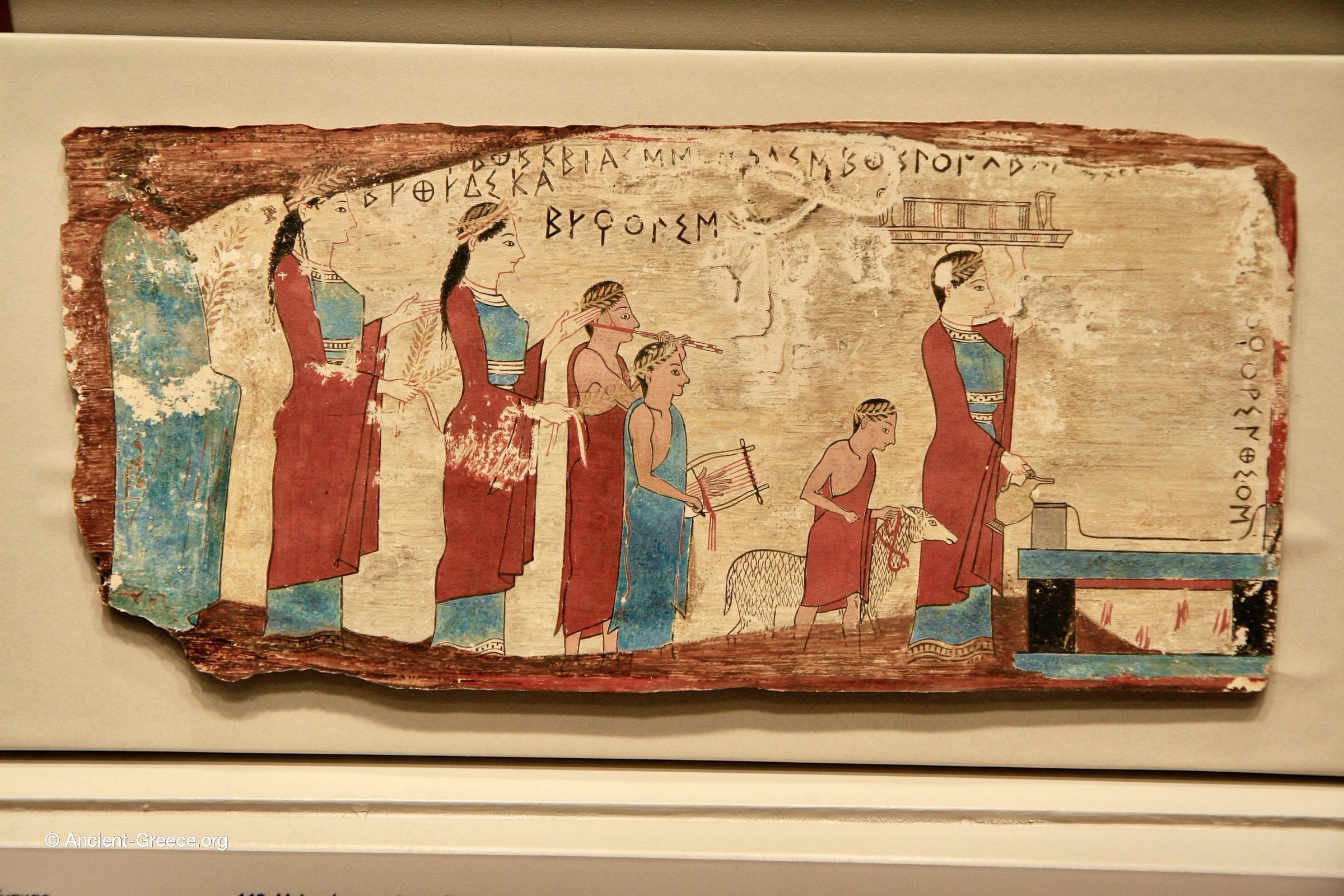
One of the four wooden plaques from Pitsa, Corninthia. 540 - 530 BCE.
One of the four wooden plaques from Pitsa, Corninthia.
16464. Procession to an altar to sacrifice a lamb, accompanied by the flute and lyre. The dedication to the Charites (Graces) can be read, along with the names Euthydika, Eukolis, Etheloncha and, at the side, the name of the painter or dedicator, of which only the place of origin survives: 'Corinthian'. 540-530 BC.
Exhibited in the National Archaeological Museum in Athens, Greece. THE WOODEN PLAQUES OF PITSA
The four wooden plaques (16464-67) were found in 1934 near ancient Sikyon, in a cave above the village of Pitsa in Corinthia. The inscriptions reveal that they were dedicated to the Nymphs, the local fertility deities, who were worshipped in the cave.
Painted wooden panels were amongst the most popular forms of cheap dedications in the sanctuaries of the gods. Although they are humble small works, the Pitsa plaques are of great value as the only examples of Corinthian large-scale painting. They are executed in the xerography technique, using mineral pigments. Within the clear black or red outlines of the figures, white, red, blue, yellow, violet, brown, green and black colours were applied solid, with no gradations. The inscriptions recording dedications and names are written in the Corinthian alphabet.
540-530 BC.
16466. Fragment of a large plaque with the richly draped himation of a figure facing right and holding a large necklace. Illegible inscription.
Last quarter of the 6th c. BC.
16467. Complete plaque with a small part of the original representation. Women's circle dance. Of the inscriptions at the side, the name Telesoio can clearly be read. Late 6th c. BC.
16465. Fragment of a large plaque with the lower part of three female figures and a feline. Dedication: ...dedicated to the Nymphs'.
Altar Animals Archaic Art Athens Attica Color and Polychromy Featured Inscriptions Museum Collection Music National Archaeological Museum Original Photo Painting