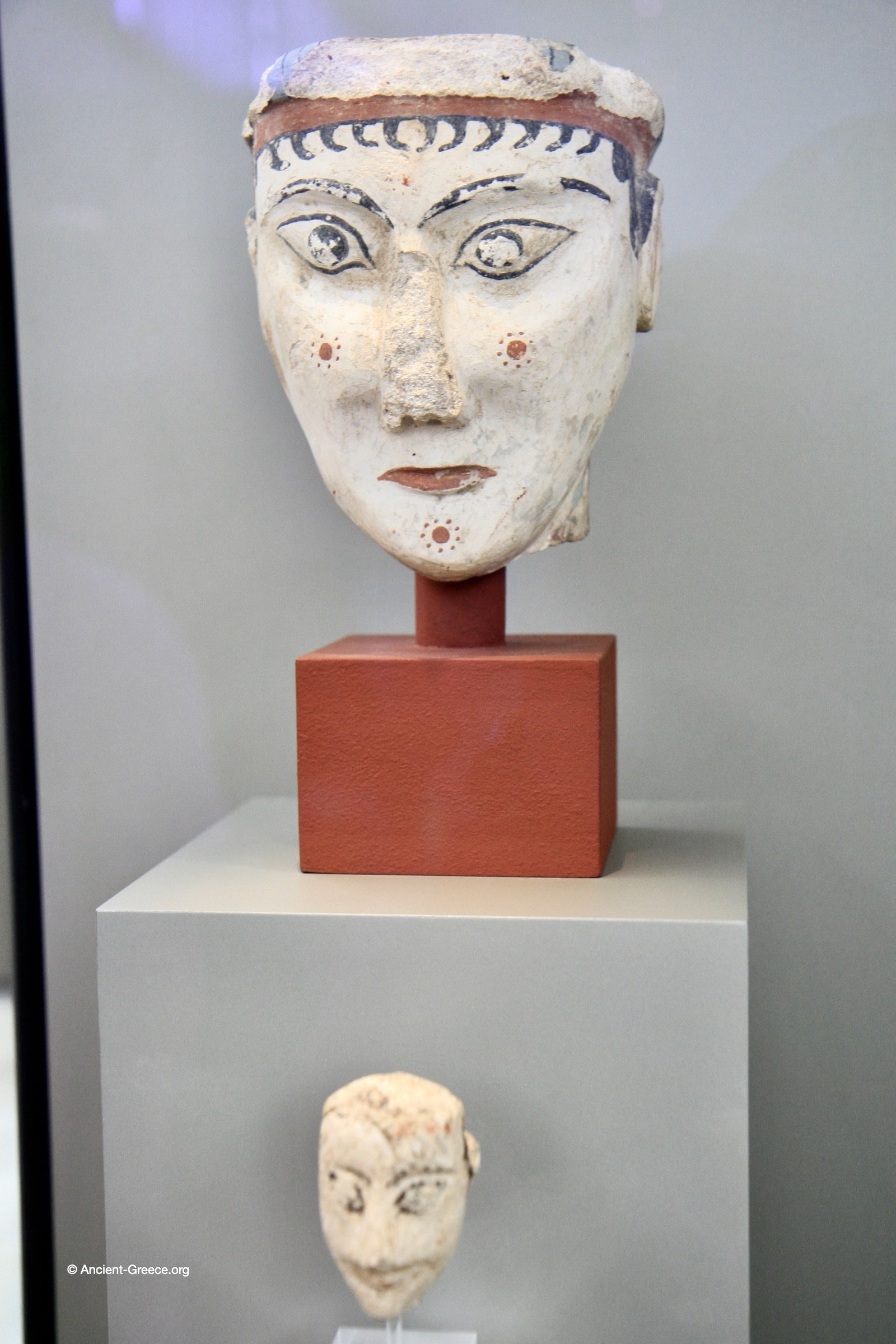
A plaster head of a woman and a small plaster head of a bearded man. 15th - 13th century BCE. Mycenaean Era.
A unique plaster head of a woman, possibly a goddess or a sphinx, one of the very few examples of monumental Mycenaean plastic art. The facial features, with their severe expression, are accentuated by touches of bright red and black paint, while dotted rosettes brighten up the cheeks and chin. The hair falls in small curls along the forehead under a polos (cylindrical cap).
From the area of the Cult Centre on the acropolis at Mycenae.
13th century BC.
Small plaster head of a bearded man. The plastic rendering of the facial features is accentuated with colour. A hole at the neck probably served to attach the head onto a (?wooden) body. Mycenae acropolis, palace area.
15th-14th centuries BC.
Source: National Archaeological Museum in Athens, Greece
Athens Attica Bronze Age Color and Polychromy Mycenae Mycenaean National Archaeological Museum Original Photo Sculpture