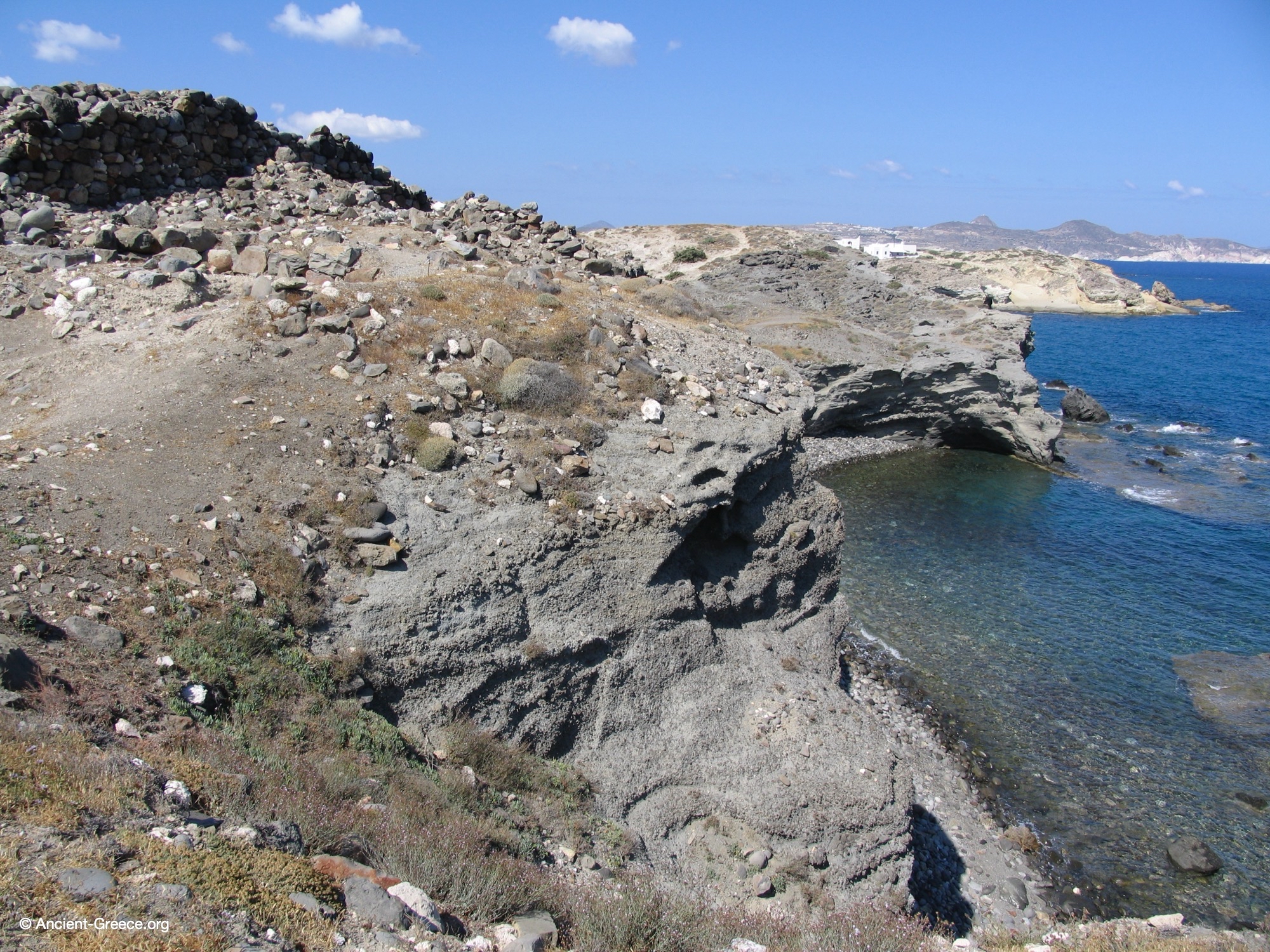
Eroded Fortifications at Phylakopi
Phylakopi, Milos
1400–1100 BCE (Late Helladic)
Volcanic Stone and Earth
Fortification Walls
The northern perimeter of Phylakopi is defined by a dramatic precipice where the ancient Megalithic walls now stand at the very edge of a sudden drop to the Aegean Sea [1]. Significant portions of the settlement, including the northern extension of the fortification system and numerous domestic blocks, have been lost over millennia due to the relentless marine erosion of the soft volcanic tuff [2]. Colin Renfrew notes that this "encroachment of the sea" has consumed a substantial part of the prehistoric town, leaving the remaining ruins perched precariously above the coastline [1].
◈ ◈ ◈
Διαβρωμένα Τείχη στη Φυλακωπή
Φυλακωπή, Μήλος
1400–1100 π.Χ. (Υστεροελλαδική)
Ηφαιστειακός Λίθος και Χώμα
Οχυρωματικά Τείχη
Η βόρεια περίμετρος της Φυλακωπής ορίζεται από έναν απότομο γκρεμό, όπου τα αρχαία μεγαλιθικά τείχη στέκονται πλέον στην άκρη μιας απότομης πτώσης προς το Αιγαίο Πέλαγος [1]. Σημαντικά τμήματα του οικισμού, συμπεριλαμβανομένης της βόρειας επέκτασης του οχυρωματικού συστήματος και πολυάριθμων οικιστικών τετραγώνων, έχουν χαθεί στο πέρασμα των χιλιετιών λόγω της ασταμάτητης θαλάσσιας διάβρωσης του μαλακού ηφαιστειακού τόφφου [2]. Ο Colin Renfrew σημειώνει ότι αυτή η «επέλαση της θάλασσας» έχει καταπιεί ένα μεγάλο μέρος της προϊστορικής πόλης, αφήνοντας τα εναπομείναντα ερείπια να στέκονται μετέωρα πάνω από την ακτογραμμή [1].
———
Bibliography
[1] C. Renfrew, The Archaeology of Cult: The Sanctuary at Phylakopi, British School at Athens, 1985, pp. 375-378.
[2] R. L. N. Barber, The Cyclades in the Bronze Age, University of Iowa Press, 1987, pp. 62-64.
Phylakopi Archaeological Site, Milos Island, Greece ◈ Αρχαιολογικός Χώρος Φυλακωπής, Μήλος, Ελλάδα 2004
Aegean Architecture Bronze Age Cyclades Cycladic Martial Milos Mycenaean Original Photo Phylakopi Urban Ruins