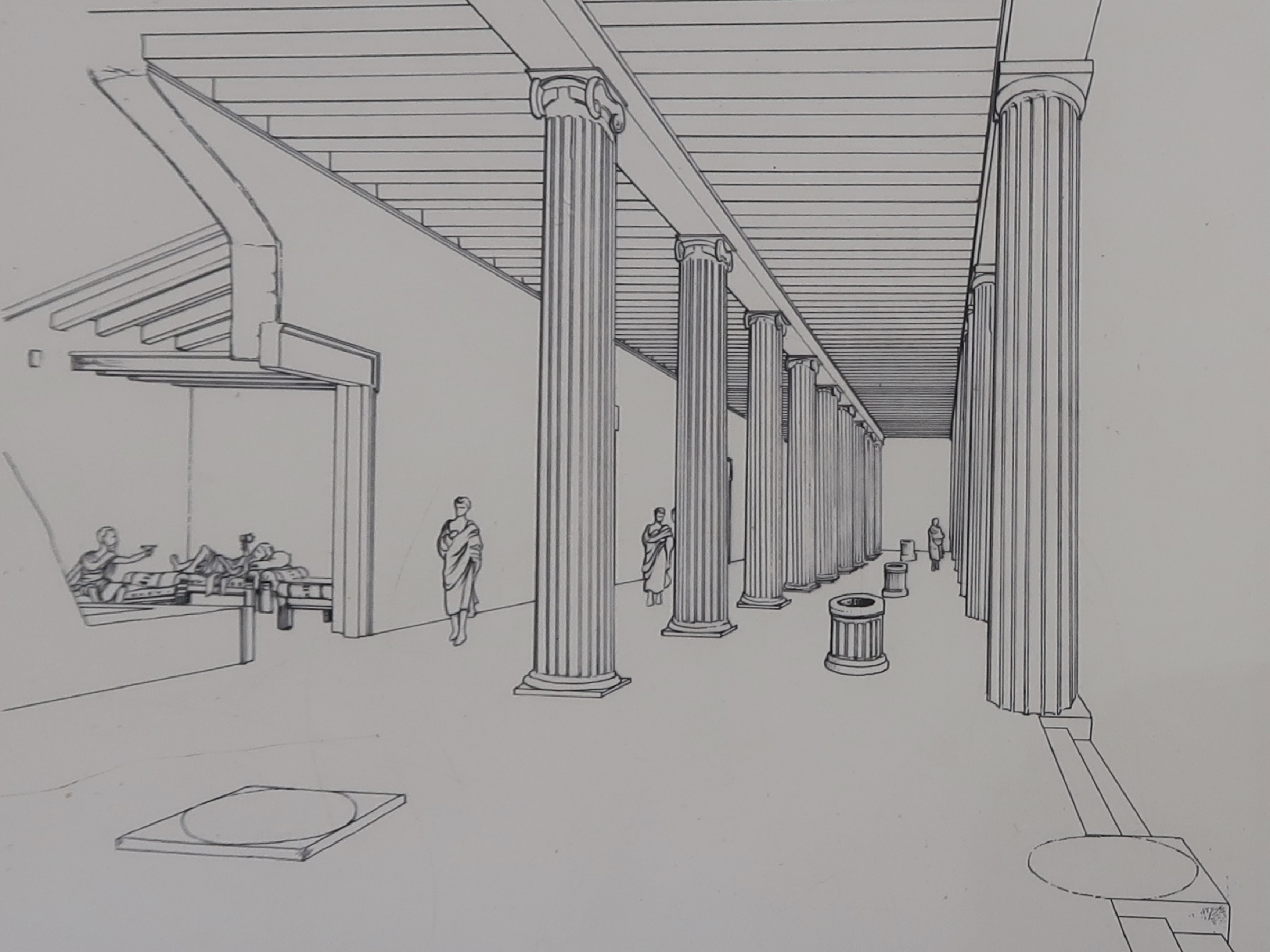
The Stoa reconstruction drawing at the Emporion archeological site, Catalonia, Spain.
The sign reads: The stoa of Emporion
In the 2nd century BC the ancient Greek city of Emporion experienced significant urban renewal as a result of a particularly prosperous period thanks to intense trade and the Roman military presence. During this period, the new public centre made up of the agora and the stoa was also built.
The square of the agora was dominated to the north by the great building of the stoa, 52 m. long and 14 m. wide. Entry was through an open front with steps that gave way to a monumental portico formed by a double row of twelve columns and, in the background, a number of rooms that could be use for trading and civic celebrations. Four large vaulted cisterns were constructed below ground level to collect rainwater channelled down from the roofs.
The abandonment of the Neapolis during the Roman imperial period led to the despoilment of the construction materials of the stoa. No elements, therefore, have been preserved that could reveal the order and style of its colonnades, and we only can see the large blocks of stone that formed the foundations. However, the remains allow the structure of the building to be restituted. The presentation of this monument includes the reconstruction the walkway of the stoa at its western end, while the rest of the building is shown at the level corresponding to the foundations.