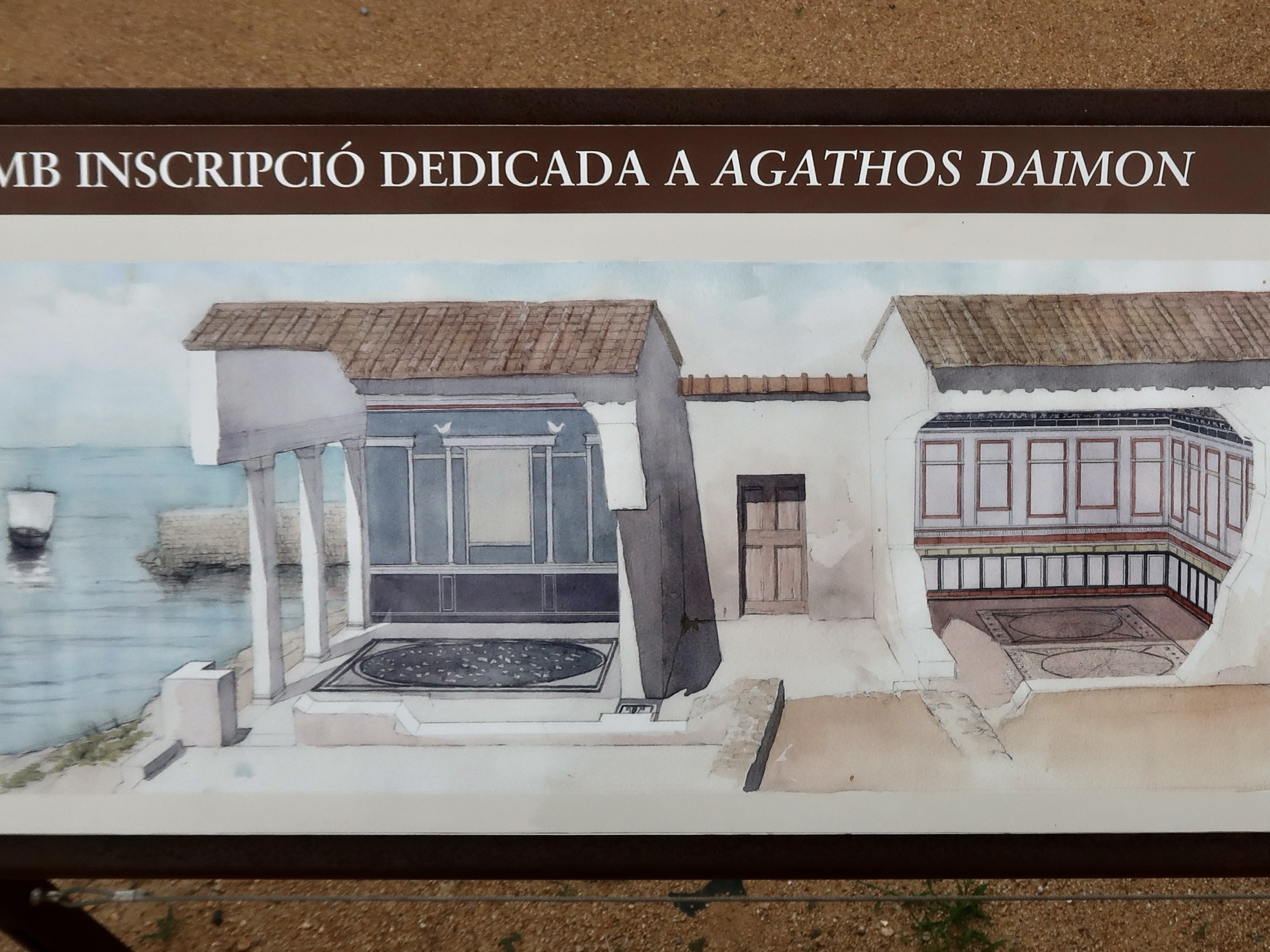
Reconstruction of the House of the mosaic with an inscription dedicated to Agathos Daimon. The mosaic is in the typical of the high end style in the Hellenistic era in the 2nd century BCE. The mosaics were made of crushed tile/pottery mixed with lime mortar to create the red base, often with white marble tesserae forming patterns.
The sign at the archaeological site of Emporion, Catalonia, Spain reads:
House of the mosaic with an inscription dedicated to Agathos Daimon
This is a domestic building that was constructed during the important transformation of the Greek city that took place in the 2nd and 1st centuries BC, and which continued in use until the beginning of the Roman imperial era. It was built in a privileged location, in direct contact with the port area.
The house was accessed through a corridor, which led to an inner court. The main room of the house, used as a banquet hall, preserves a pavement that shows a greeting inscription in Greek at the entrance with the legend
ХАРЕ АГА00 AAIMSN, invoking the protective genius or Agathos Daimon. The decoration of the pavement, made with tesserae, defined the distribution of a triclinium inside. Further north, there was another room paved in mosaic tiling, forming a central black circle with marble inlays. The back wall must have had an
open porch or window with views of the port and the bay.