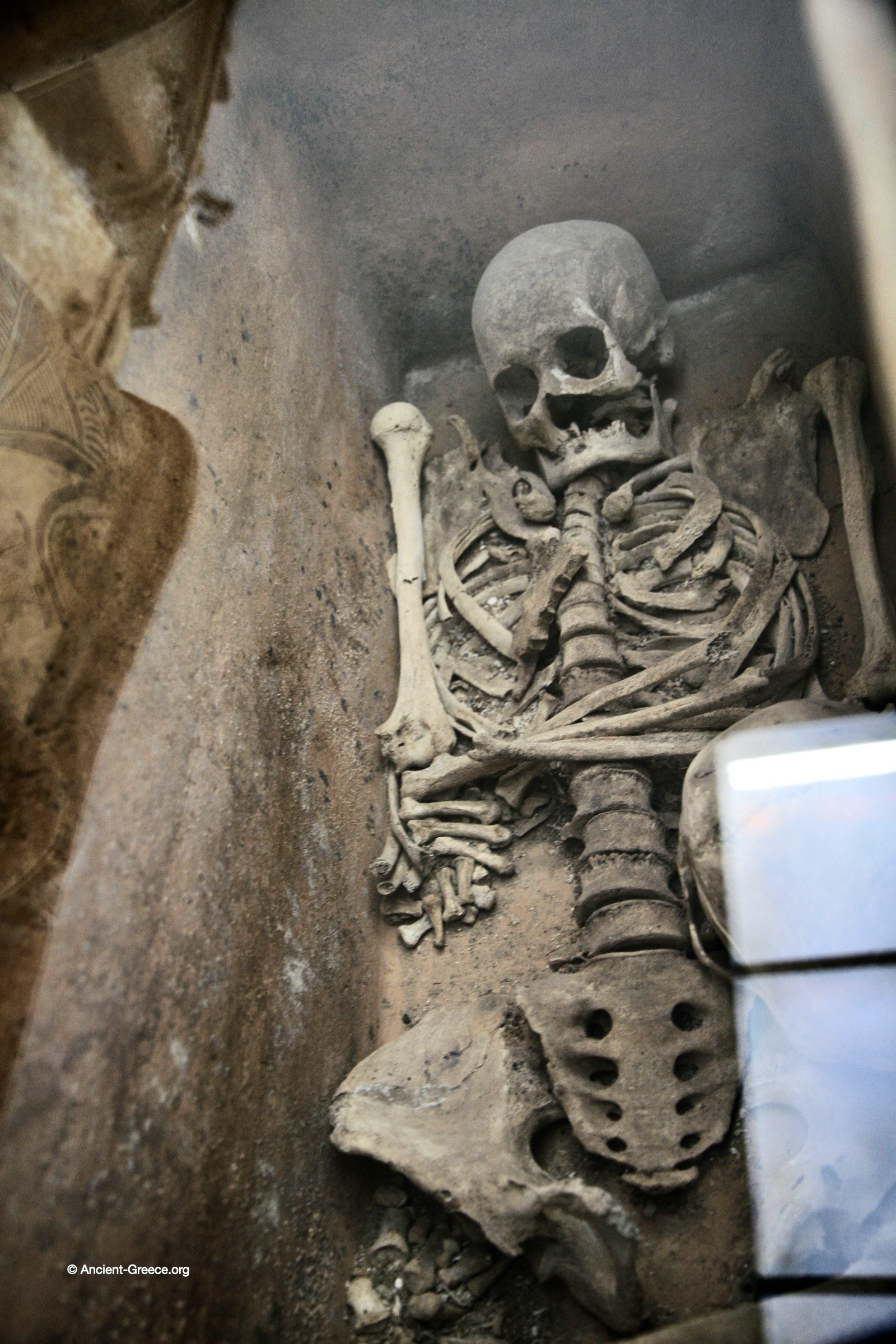
Museum exhibit of human skeleton buried in a larnax in Minoan Crete. Bronze Age, 2200 - 2100 BCE.
The use of larnakes (clay coffins) is first recognized on Crete in the Early Minoan Ill period (2200-2100 B.C.) and they continue to be used throughout the Minoan Bronze Age. The earliest are relatively small and have an elliptical outline.
They are undecorated or carry simple linear decoration. The deceased was placed inside in a fetal position with feet drawn up to the chest.
During the Late Minoan Ill period (1440-1050 B.C.) two types of larnakes were used. The first takes the shape of a bathtub with a hole at the bottom for emptying the water and perhaps was used like ours modern examples. The second type, the chest larnax, is rectangular in shape with four legs and a gabled or flat lid. The shape suggests an origin or connection with the wooden chest of household furniture used for storing clothes and textiles. Both coffin types were usually painted with either abstract designs or more naturalistic decorative elements: flowers, trees, birds, fish, octopuses, bulls, goats and other animals, ships, sacred symbols (e.g., the bull's head, horns of consecration, and double axes) and more rarely human figures.
-- Exhibited in the Agions Nikolaos Archaeological Museum
Agios Nikolaos Archaeological Museum Animals Bronze Bronze Age Crete Funerary Larnax Minoan Original Photo