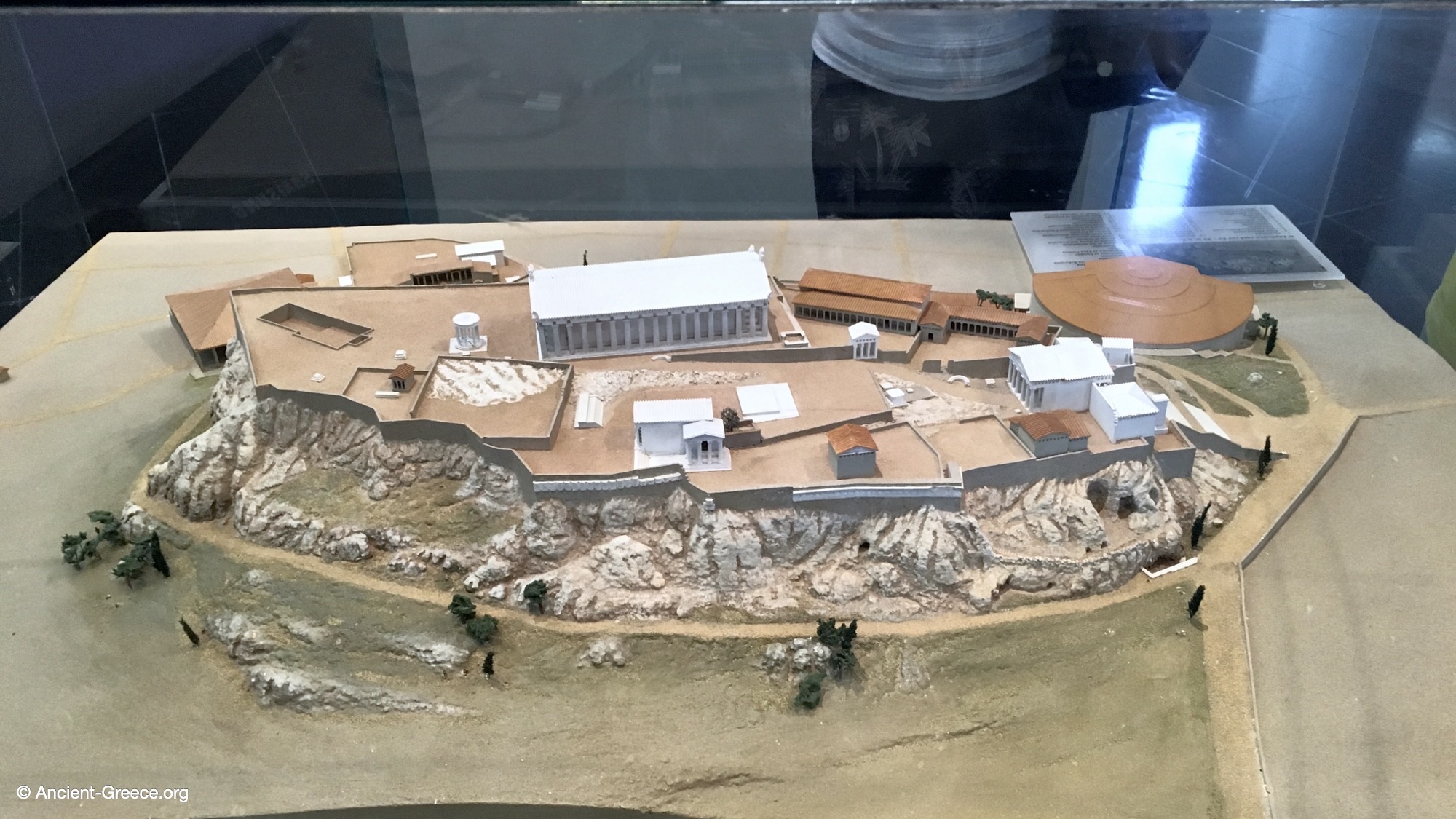
Model of the Acropolis in the 2nd–3rd Century CE (View from the North)
Topographical scale model
The Acropolis of Athens
Acropolis Museum, Athens | 2nd–3rd Century CE (Roman Period)
Viewed from the north, this perspective of the topographical scale model illustrates the Acropolis of Athens as it appeared during the second and third centuries CE under Roman rule. The composition highlights the steep northern cliffs in the foreground, with the intricate multi-level architecture of the Erechtheion prominently positioned on the near side of the plateau. To the right (west), the monumental Propylaia serves as the primary gateway to the sanctuary, while the grand Parthenon dominates the center of the rock. In the background along the southern slope, extensive Roman-era developments are clearly visible, most notably the massive, semi-circular roofed structure of the Odeion of Herodes Atticus and the elongated Stoa of Eumenes stretching toward the east.
◈
Πρόπλασμα της Ακρόπολης τον 2ο–3ο αιώνα μ.Χ. (Όψη από τα Βόρεια)
Τοπογραφικό πρόπλασμα
Η Ακρόπολη των Αθηνών
Μουσείο Ακρόπολης, Αθήνα | 2ος–3ος αιώνας μ.Χ. (Ρωμαϊκή Περίοδος)
Θεαμένη από τα βόρεια, αυτή η οπτική γωνία του τοπογραφικού προπλάσματος απεικονίζει την Ακρόπολη των Αθηνών όπως εμφανιζόταν κατά τον δεύτερο και τρίτο αιώνα μ.Χ. υπό ρωμαϊκή κυριαρχία. Η σύνθεση αναδεικνύει τους απόκρημνους βόρειους βράχους στο προσκήνιο, με την περίτεχνη πολυεπίπεδη αρχιτεκτονική του Ερεχθείου να κατέχει εξέχουσα θέση στην κοντινή πλευρά του οροπεδίου. Στα δεξιά (δυτικά), τα μνημειακά Προπύλαια λειτουργούν ως η κύρια πύλη προς το ιερό, ενώ ο μεγαλειώδης Παρθενώνας κυριαρχεί στο κέντρο του βράχου. Στο βάθος, κατά μήκος της νότιας κλιτύος, είναι σαφώς ορατές οι εκτεταμένες διαμορφώσεις της ρωμαϊκής εποχής, με κυριότερες την ογκώδη, ημικυκλική στεγασμένη κατασκευή του Ωδείου του Ηρώδου Αττικού και την επιμήκη Στοά του Ευμένους που εκτείνεται προς τα ανατολικά.
Acropolis Museum, Athens, Greece. 2009.
◈
Μουσείο Ακρόπολης, Αθήνα, Ελλάδα. 2009.
Acropolis Acropolis Museum Architecture Athens Attica Classical Doric Museum Collection Original Photo Parthenon Reconstructions and Plans