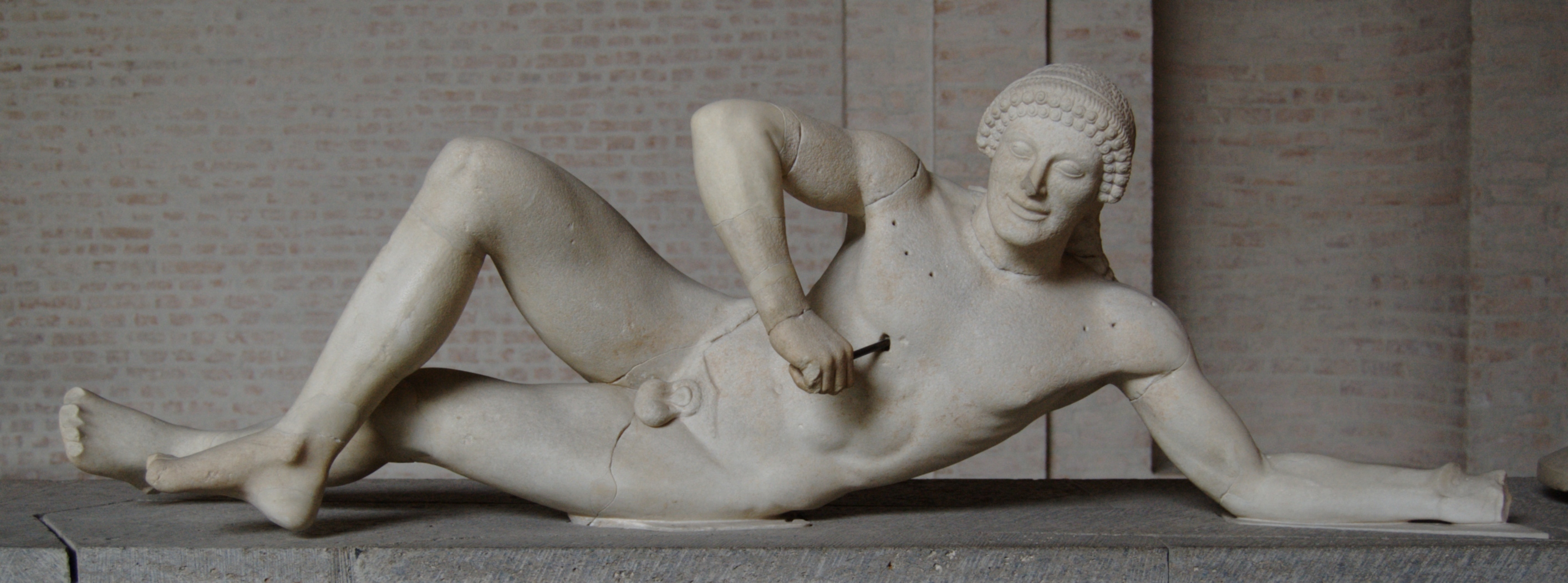
A dying warrior from the west pediment of the Temple of Aphaia (c. 500–490 BCE)
, currently housed in the Glyptothek in Munich. This figure is a masterpiece of the Late Archaic style, characterized by the famous "Archaic smile" and a somewhat stiff, theatrical pose despite the fatal arrow wound to the chest. The sculpture represents the first generation of Aeginetan heroes who fought at Troy, showcasing the transition in Greek art toward a more realistic rendering of human anatomy and the physical struggle of combat.
Ένας ετοιμοθάνατος πολεμιστής από το δυτικό αέτωμα του Ναού της Αφαίας (περ. 500–490 π.Χ.), ο οποίος φυλάσσεται σήμερα στη Γλυπτοθήκη του Μονάχου. Αυτή η μορφή αποτελεί αριστούργημα του Ύστερου Αρχαϊκού ρυθμού, και χαρακτηρίζεται από το περίφημο «αρχαϊκό μειδίαμα» και μια κάπως στημένη, θεατρική στάση παρά το θανάσιμο τραύμα από βέλος στο στήθος. Το γλυπτό αναπαριστά την πρώτη γενιά των Αιγινητών ηρώων που πολέμησαν στην Τροία, αναδεικνύοντας τη μετάβαση της ελληνικής τέχνης προς μια πιο ρεαλιστική απόδοση της ανθρώπινης ανατομίας και της φυσικής πάλης της μάχης. -- Image Source: Creative Commons Wikipedia.