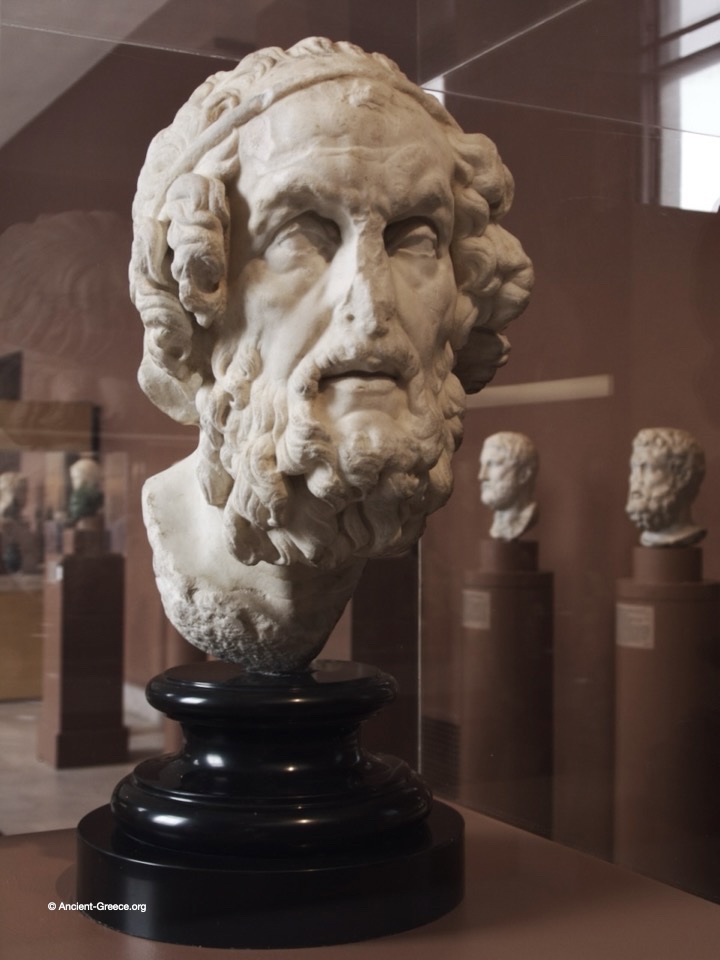
Homer. Late 1st century BCE or 1st century CE.
This Roman marble portrait, dating from the late 1st century BCE to the 1st century CE, represents a masterful Hellenistic-style reimagining of the legendary poet Homer, the venerable author of the Iliad and the Odyssey. The head’s deep, intricate carving and furrowed features evoke the expressive "baroque" style of Pergamon, utilizing the iconography of advanced age—a balding pate, sinewy neck, and wrinkled skin—to underscore the poet’s wisdom and his connection to Greece’s distant heroic age.
This idealized portrait portrays Homer's character through the poetic fillet (headband) signifying his prowess and deeply lidded eyes that denote his legendary blindness, a trait often associated with the spiritual insight of ancient seers. Likely originally part of a life-size seated statue within a civic or private library, this work serves as an enduring tribute to the man who served as the cultural and literary foundation of the Greek world.
Exhibited at the Boston Museum of Fine Arts. Boston, USA.