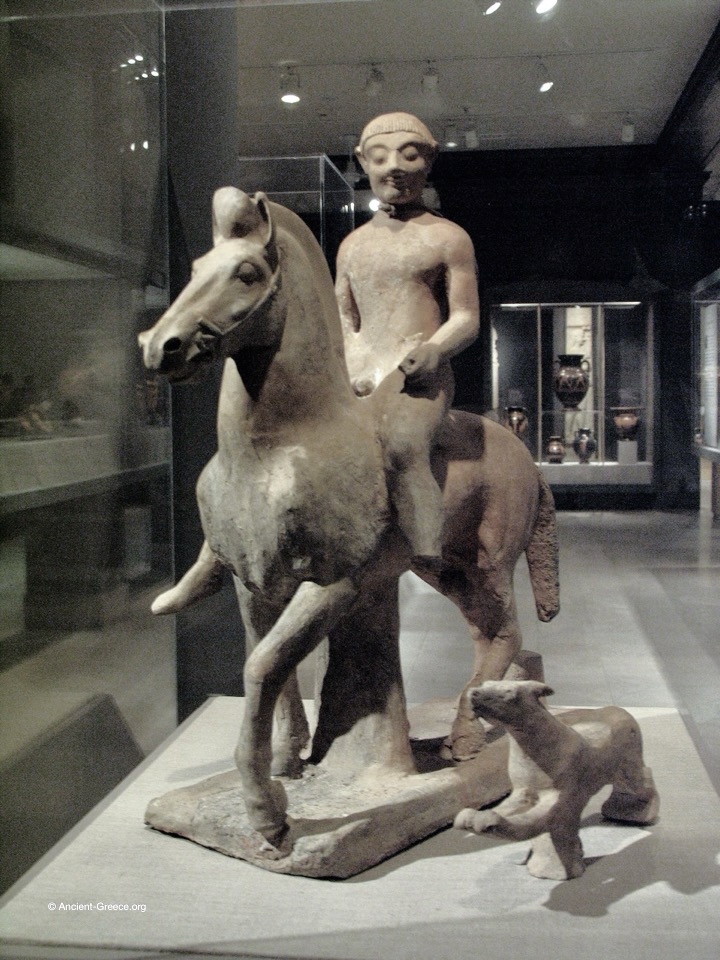
Young hunter on horseback and running dog. Clay statuette from Sicily. Circa 510 BCE.
Large scale terracotta figure of a nude youth riding a horse. The horse and youth are accompanied by a dog (65.464), which may have originally been attached to the same base, though its precise location in relation to the horse is uncertain. The presence of the dog identifies the figure as a hunter. A petasos (traveling hat) was found with the figures, but is too small for the rider’s head, so it may have been worn on his back, looped around the neck with a cord.
Condition: Missing left foot, part of horse’s tail, and part of bridle. Some reconstruction, including horse’s mane. Hands and horse’s mouth pierced for reins in another material, now missing. Traces of white on surface may be undercoat for painting. The figure was handmade and the surface has been roughly smoothed.
Unlike mainland Greece and the Aegean islands, the Greek colonies in Sicily did not have easy access to good sculpting marbles. Thus, they developed a tradition of large-scale terracotta sculpture instead. Though other horse and rider figures have been found as temple akroteria, this free standing hunter is unusual.
The Hound: Terracotta figure of a running hound (companion to the horse and rider, 65.463) extended in a gallop, ears back and nose in the air. Rests on hind feet, with support under stomach. The dog may have originally been attached to the same base as the horse and rider, though its precise location in relation to the horse is uncertain. The presence of the dog identifies the rider as a hunter.
Exhibited at the Boston Museum of Fine Arts. Boston, USA.
Animals Archaic Art Boston Museum of Fine Arts Ceramics Clay Color and Polychromy Original Photo Sculpture Statuettes USA