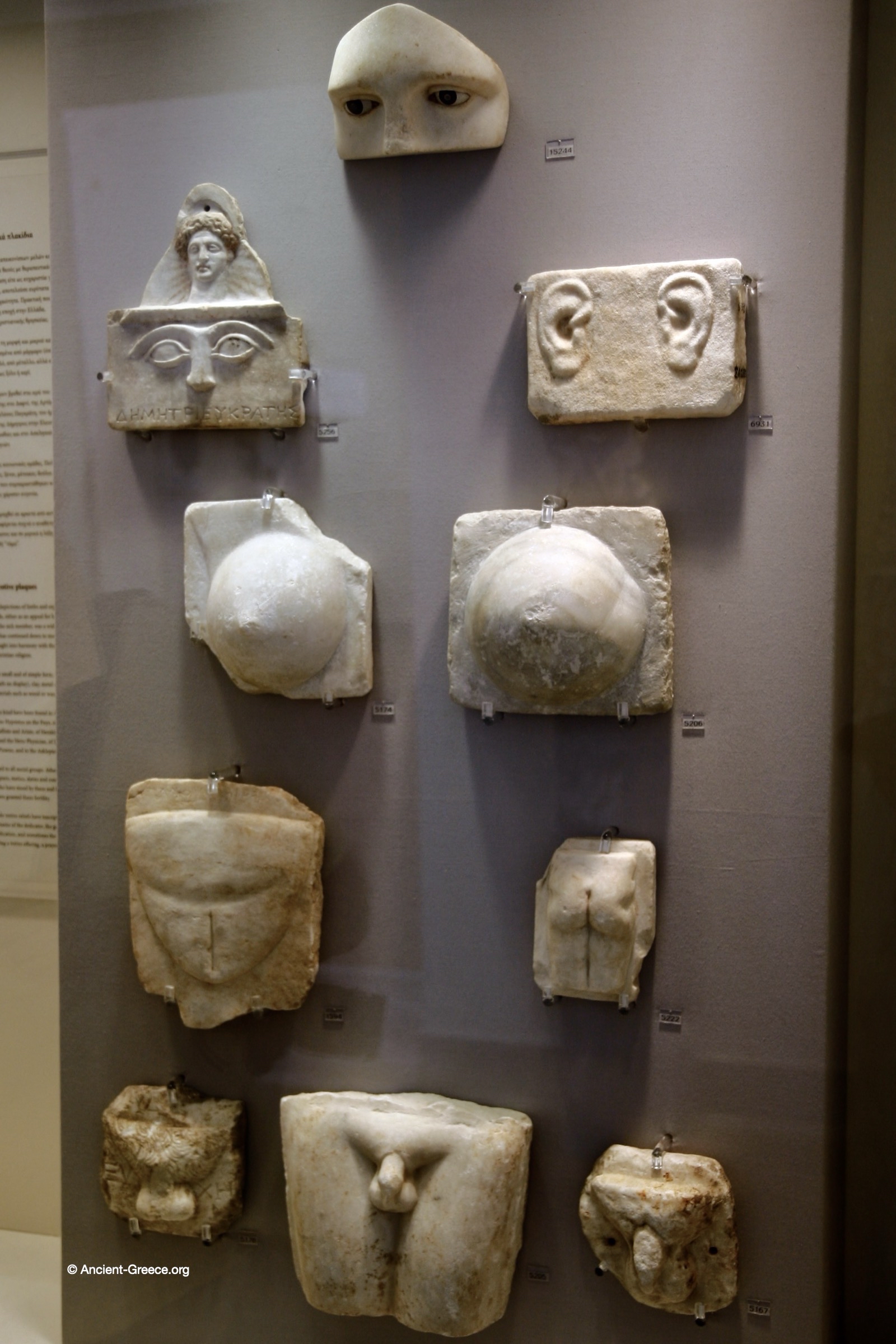
Marble votive plaques.
The dedication of models or depictions of limbs and organs of the human body to healing gods, either as an appeal for healing or in thanks for the cure of the sick member, was a widespread practice in ancient times. It has continued down to modern times in Greece, having been brought into harmony with the principles of Christian religion.
These dedications, usually small and of simple form, were made of marble (like the reliefs on display), clay, metal and also perishable materials such as wood or wax.
Dedications of this kind have been found in Attica in the sanctuaries of Zeus Hypsistos on the Pnyx, of Aphrodite at Daphni, of Artemis Kalliste and Ariste, of Herakles Pankrates, of the hero Amynos and the Hero-Physician, of Demeter at Eleusis, of Asklepios in Piraeus, and in the Asklepieion in Athens.
The dedicators belonged to all social groups. Athenian citizens, women and men, foreigners, metics, slaves and courtesans all give thanks to the gods who have stood by them and healed them, or have granted them fertility.
Several of these marble votive reliefs have inscriptions on them, which contain the name of the dedicator, the god who is the recipient of the dedication, and sometimes the word EYXH, meaning a votive offering, a prayer.
Exhibited in the National Archaeological Museum in Athens, Greece