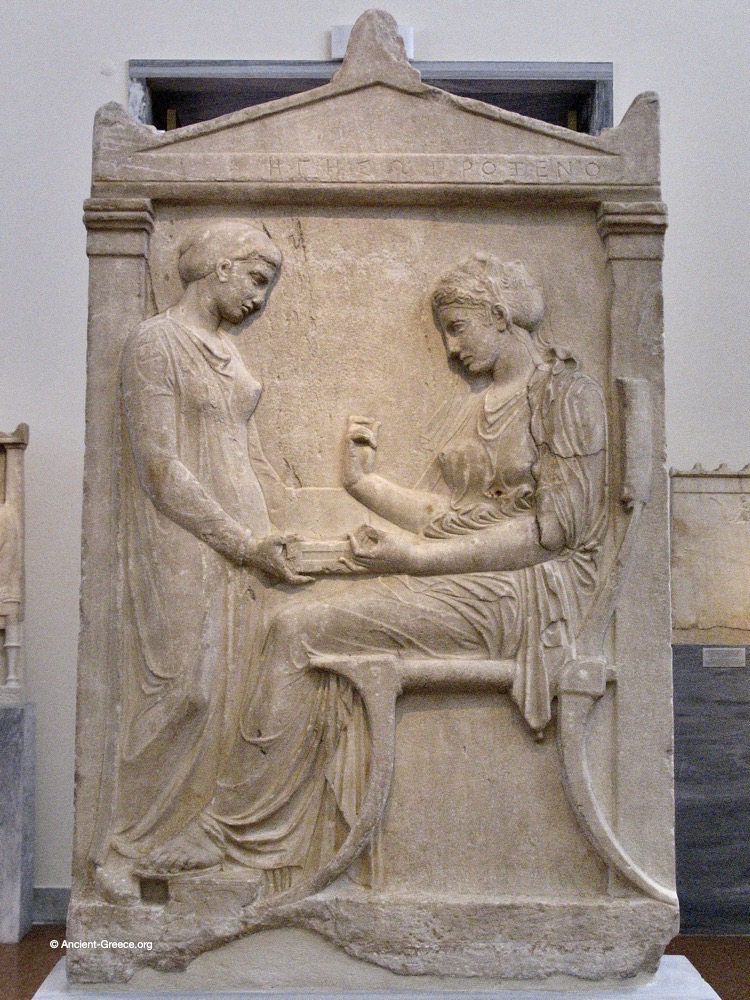
The Grave Stele of Hegeso (c.410–400 BCE).
The Grave Stele of Hegeso (c.410–400 BC) is one of the best surviving examples of Attic grave stelae. From around 450, Athenian funerary monuments increasingly depicted women, as their civic importance increased. The main shows a mature Athenian woman (Hegeso) wearing a chiton (costume) and himation, seated on a chair with her feet resting on an elaborate footstool. In her left hand, she holds an open cista, and in her right she holds a piece of (missing) jewelry that was originally painted, at which she is directing her gaze. Opposite her, on the left, stands a maidservant wearing a tunic and a headdress described as either a snood or sakkos. The maidservant is presenting the pyxis, on the knees of Hegeso. On the epistyle there is an epitaph, ΗΓΗΣΩ ΠΡΟΞΕΝΟ, stating that the deceased is Hegeso, daughter of Proxenios.
In general, stelae can be seen as a retrospective funerary art, that typically articulate a society's ideals of social living through their depiction of a domestic sphere.[2] Compared to other non-civic art of the oikos (home), such as non-funerary red-figure painted pottery, stelae were obviously more fixed/permanent monuments, displayed outdoors for public viewing, and are constructed by a family for a specific person, making them far more expensive and exclusive than pottery.[2] While their medium, context, and style associate stelae with the polis (city), their iconography is of the oikos. This paradox, as well as the prominence of women on gravestones, has led many scholars to focus on an analysis of the virtues designated to different genders on the stelae. -https://en.wikipedia.org/wiki/Grave_Stele_of_Hegeso.
Exhibited in the National Archaeological Museum in Athens, Greece.
Art Athens Attica Classical Funerary Kerameikos Marble National Archaeological Museum Original Photo Relief Sculpture Stele