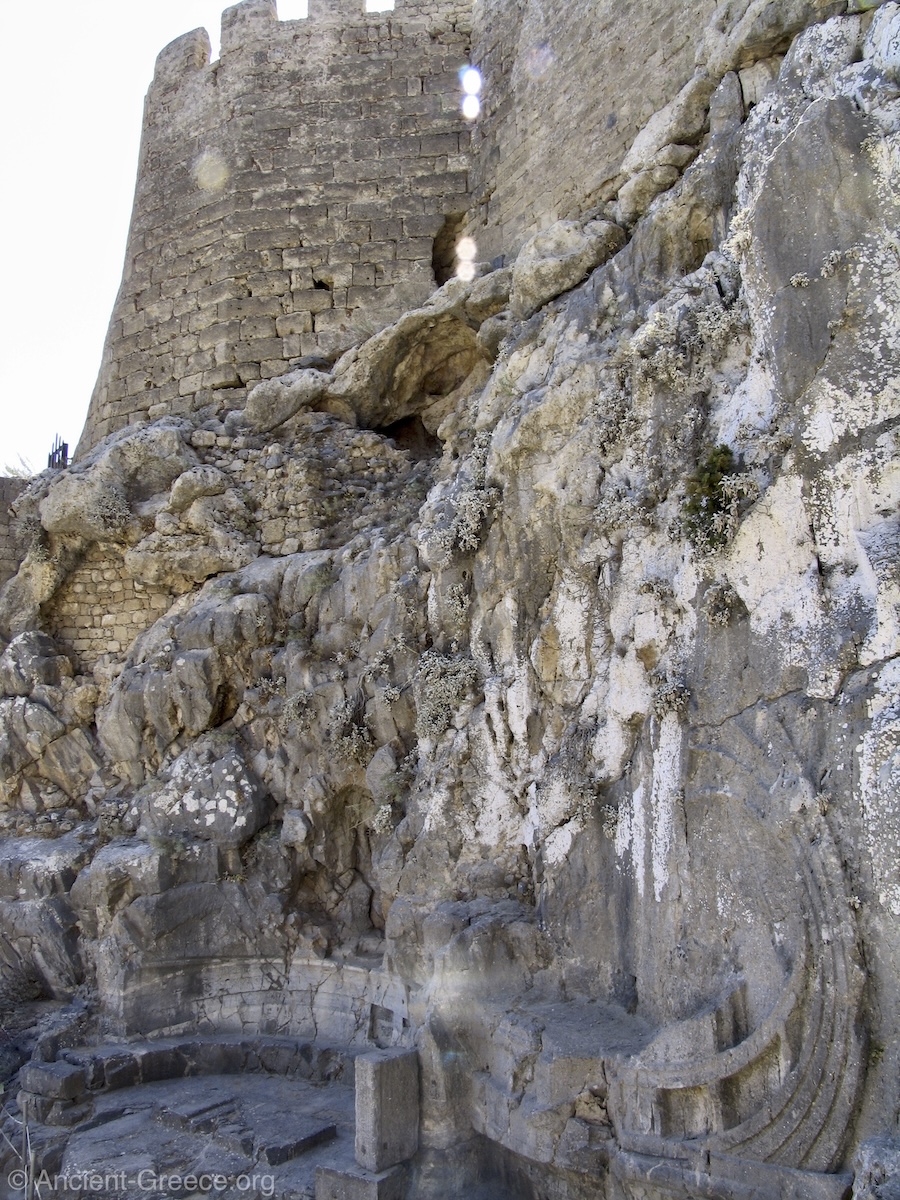
Relief Sculpture of Thihemiolia in the Acropolis of Lindos, Rhodes. Greece. 2nd c. BCE.
The trihemiolia (Greek: τριημιολία [ναῦς]) first appears in accounts of the Siege of Rhodes by Demetrius Poliorcetes in 304 BC, where a squadron of trihemioliai was sent out as commerce raiders.
The type was one of the chief vessels of the Rhodian navy, and it is very likely that it was also invented there, as a counter to the pirates' swift hemioliai.So great was the attachment of the Rhodians to this type of vessel, that for a century after their navy was abolished by Gaius Cassius Longinus in 46 BC, they kept a few as ceremonial vessels.
The type was classed with the trireme, and had two and a half files of oarsmen on each side. Judging from the Lindos relief and the famous Nike of Samothrace, both of which are thought to represent trihemioliai,[51] the two upper files would have been accommodated in an oarbox, with the half-file located beneath them in the classic thalamitai position of the trireme.
The Lindos relief also includes a list of the crews of two trihemioliai, allowing us to deduce that each was crewed by 144 men, 120 of whom were rowers (hence a full file numbered 24).Reconstruction based on the above sculptures shows that the ship was relatively low, with a boxed-in superstructure, a displacement of c. 40 tonnes, and capable of reaching speeds comparable with those of a full trireme. The trihemiolia was a very successful design, and was adopted by the navies of Ptolemaic Egypt and Athens among others. Despite being classed as lighter warships, they were sometimes employed in a first-line role, for instance at the Battle of Chios. (from Wikipedia: https://en.wikipedia.org/wiki/Hellenistic-era_warships)