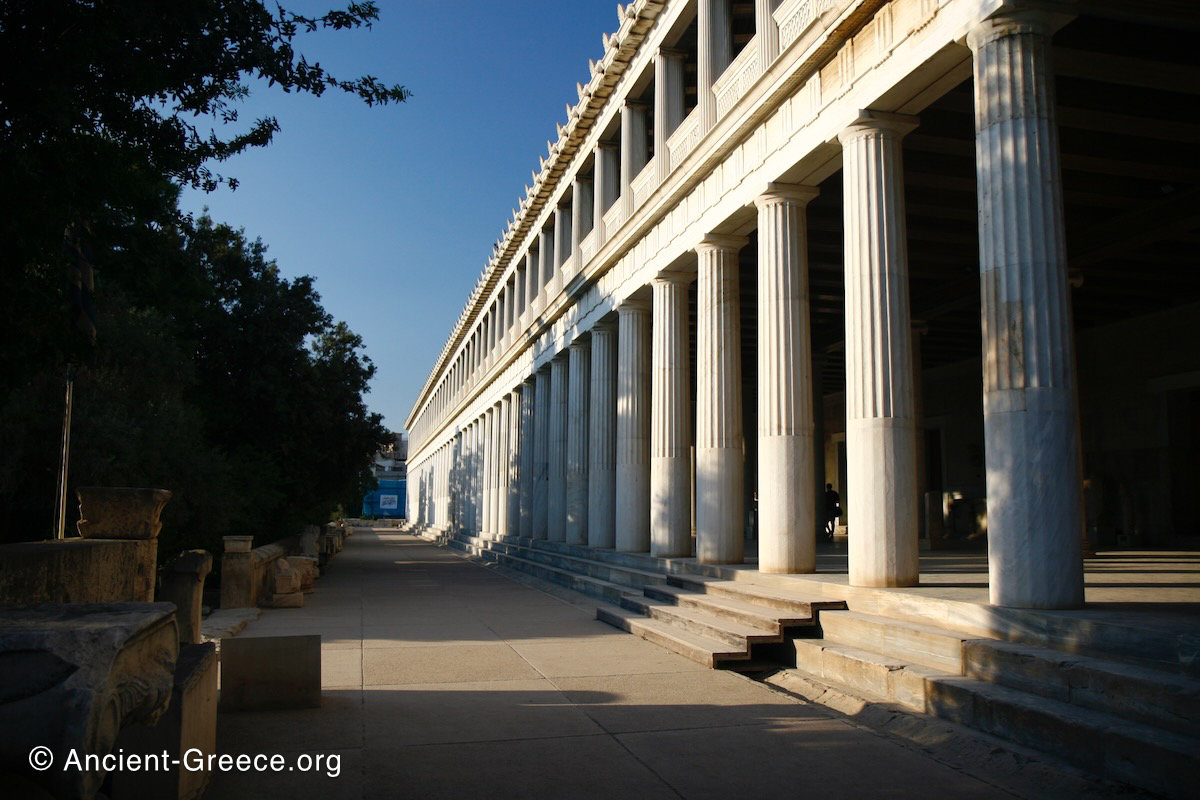
The Stoa of Attalos colonnade. The ancient stoa doubles as the Agora Archaeological Museum today. Athens, Attica, Greece.
The Stoa of Attalos is the most striking building in the Agora. It houses the Agora Museum.
The original Stoa was funded in 159-138 BCE by the King of Pergamon, Attalos II.
It was completely destroyed by the Heruli in 267 CE, but it was rebuilt in the 20th century (1953-6) and houses the Agora Museum.
The Archaeological Museum of the ancient Agora of Athens (Αρχαιολογικό Μουσείο Αρχαίας Αγοράς Αθηνών) is hosted in the Hellenistic Stoa of Atallos, which is inside the Agora archaeological site.
The Stoa of Attalos was rebuilt in the 1950’s from the ground up with the purpose of storing the artifacts unearthed in the Agora excavations, and to house the museum where the most important items can be exhibited.
The museum’s portico is a beautiful area that gives visitors insight on how an ancient Athenian would feel in its shelter. In Ancient Greece, this part of the stoa would be busy with merchants bartering with buyers behind their benches among the hustle and bustle of a busy marketplace. Today, the stoa’s portico is a peaceful area where visitors find refuse from the sun and relax among statues from the Greco-Roman era.
Η Στοά του Αττάλου είναι το πιο εντυπωσιακό κτίριο στην Αγορά. Στεγάζει το Μουσείο της Αγοράς.
Η αρχική Στοά χρηματοδοτήθηκε την περίοδο 159-138 π.Χ. από τον βασιλιά της Περγάμου, Άτταλο Β'.
Καταστράφηκε ολοσχερώς από τους Ερούλους το 267 μ.Χ., αλλά ανακατασκευάστηκε τον 20ό αιώνα (1953-1956) και στεγάζει το Μουσείο της Αγοράς.