
On this page:
Ελληνικά
Περιεχόμενα:
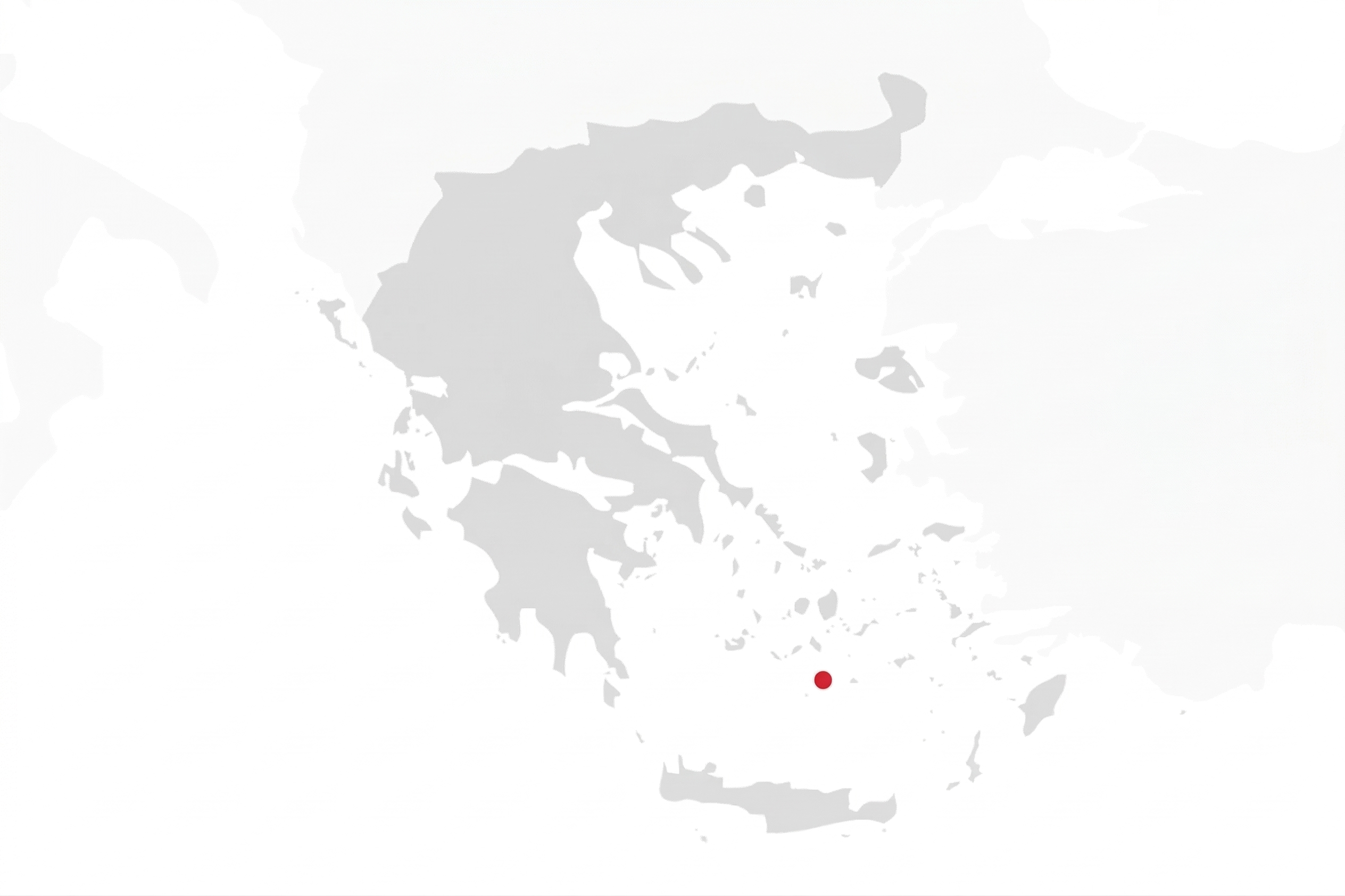
Ακρωτήρι Θήρας
Ο αρχαιολογικός χώρος στο Ακρωτήρι αποτελεί έναν από τους σημαντικότερους οικισμούς του Αιγαίου (3000 ~ 1100 π.Χ.) κατά την Εποχή του Χαλκού. Η πόλη θάφτηκε κάτω από παχιά στρώματα ηφαιστειακής τέφρας κατά τη μεγάλη έκρηξη του ηφαιστείου της Θήρας τον 17ο αιώνα π.Χ., γεγονός που επέτρεψε την εξαιρετική διατήρηση των κτιρίων, των δρόμων και των τοιχογραφιών της.
Ξεστή 3
Η Ξεστή 3 είναι ένα επιβλητικό τριώροφο οικοδόμημα με τοίχους από μεγάλους ξεστούς λίθους. Το κτίριο διαθέτει πολύθυρα και μια «δεξαμενή καθαρμού», στοιχεία που παραπέμπουν σε δημόσια χρήση και την τέλεση τελετουργιών. Το εικονογραφικό πρόγραμμα των τοιχογραφιών, όπως οι Κροκοσυλλέκτριες, ενισχύει την άποψη ότι το κτίριο προοριζόταν για τελετές ενηλικίωσης των νέων μελών της κοινωνίας.
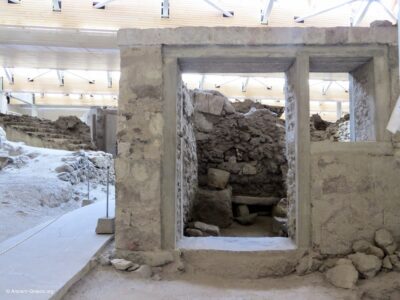
Ένα επιβλητικό τριώροφο οικοδόμημα που δέσποζε στην είσοδο της πόλης από το δυτικό λιμάνι. Πολλά από τα δωμάτιά του, σε όλους τους ορόφους, επικοινωνούσαν μεταξύ τους με τη βοήθεια πολυθύρων, δημιουργώντας ευρύχωρες αίθουσες. Στη βορειοανατολική γωνία του κτιρίου υπήρχε μια κατασκευή γνωστή από την κρητική αρχιτεκτονική, η οποία συμβατικά αποκαλείται «Δεξαμενή Καθαρμού». Τα περισσότερα από τα διαμερίσματα της Ξεστής 3 ήταν διακοσμημένα με τοιχογραφίες.
Καλύπτοντας έκταση δεκάδων τετραγωνικών μέτρων, αυτές αποτελούν το μεγαλύτερο γνωστό σύνολο τοιχογραφιών στο προϊστορικό Αιγαίο. Η εντυπωσιακή έλλειψη σκευών οικιακής χρήσης και το πλήθος αντικειμένων με τελετουργικό χαρακτήρα οδήγησαν στην ερμηνεία της Ξεστής 3 ως δημόσιου κτιρίου αφιερωμένου σε τελετουργίες. Το εικονογραφικό πρόγραμμα των τοιχογραφιών και ο διαχωρισμός κατά φύλο των συμμετεχόντων στα απεικονιζόμενα τελετουργικά δρώμενα συνηγορούν στην άποψη ότι το κτίριο αποτελούσε χώρο για τελετές μετάβασης των νεαρών μελών της θηραϊκής κοινωνίας.
Πλατεία των Διπλών Κεράτων και Συγκρότημα Δ
Η Πλατεία των Διπλών Κεράτων ονομάστηκε έτσι από τα λίθινα κέρατα καθοσιώσεως που κοσμούσαν την πρόσοψη του Συγκροτήματος Δ.
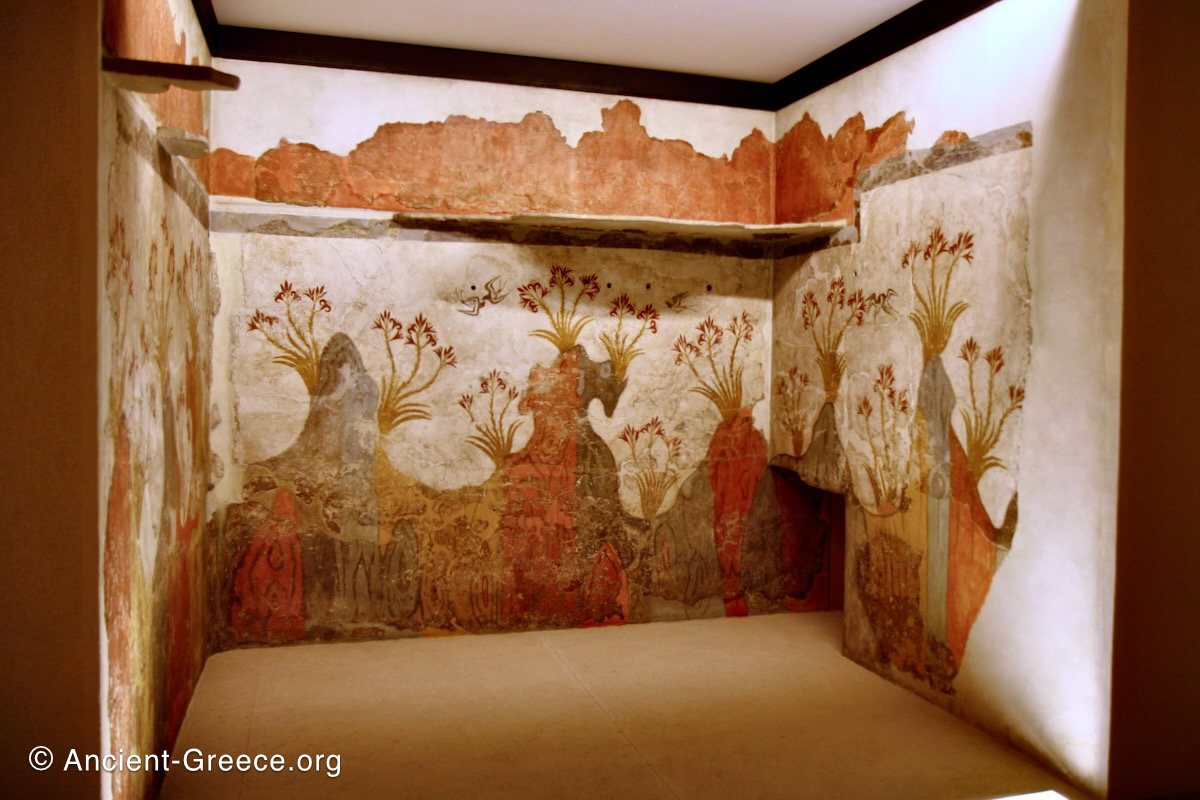
Στο κτίριο αυτό βρέθηκε η περίφημη Τοιχογραφία της Άνοιξης με τα κρίνα και τα χελιδόνια, καθώς και αποτυπώματα ξύλινων επίπλων που μας επιτρέπουν να ανασυνθέσουμε την καθημερινή ζωή των κατοίκων.
Δυτική Οικία και Πλατεία Τριγώνου
Η Δυτική Οικία αποτελεί χαρακτηριστικό δείγμα πλούσιας κατοικίας με οργανωμένο αποχετευτικό σύστημα και χώρους παραγωγής. Στον πρώτο όροφο βρέθηκαν οι εμβληματικές τοιχογραφίες των Ψαράδων, της Νηοπομπής και της Νεαρής Ιέρειας. Η παρουσία πολυάριθμων υφαντικών βαρών μαρτυρεί την έντονη ενασχόληση με την υφαντουργία.
Αποθήκη των Πίθων και Πλατεία του Μύλου
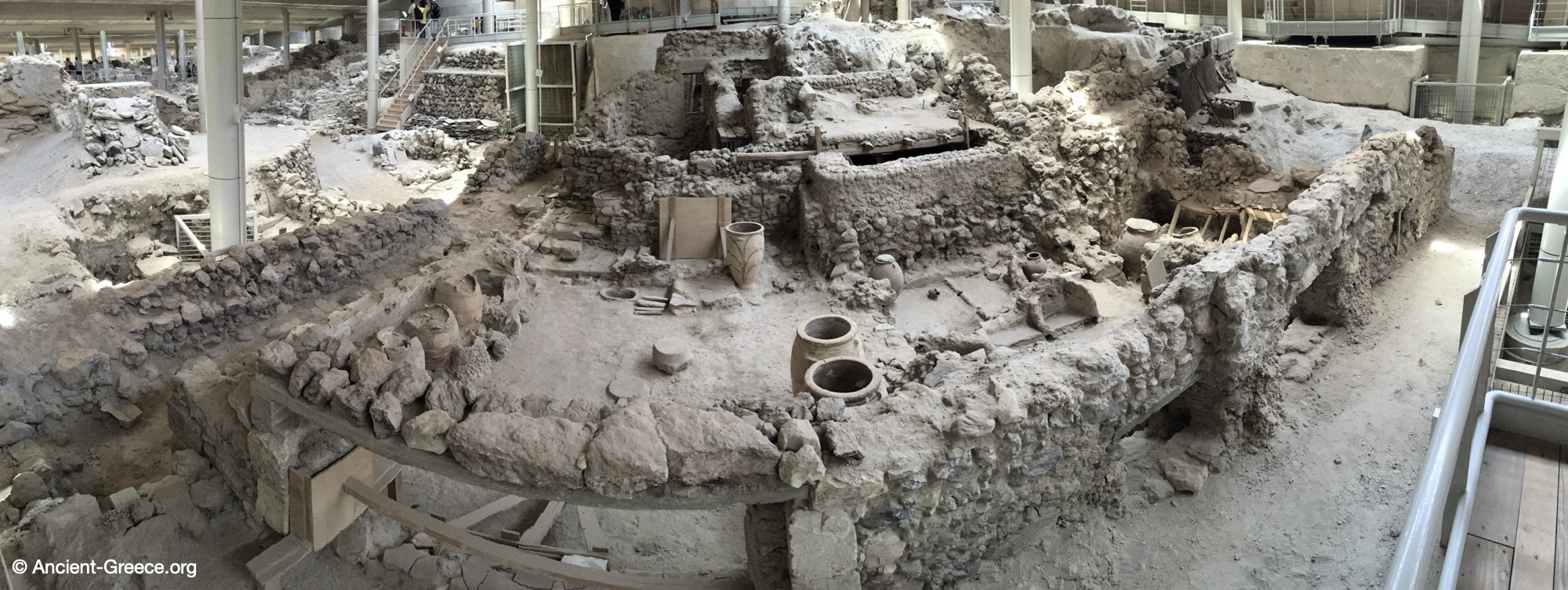
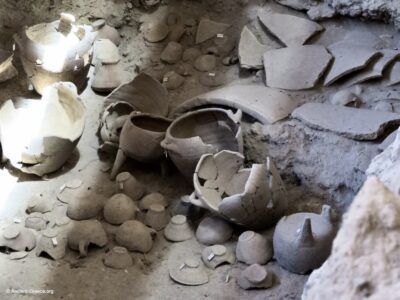
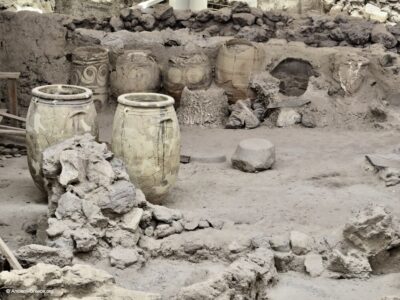
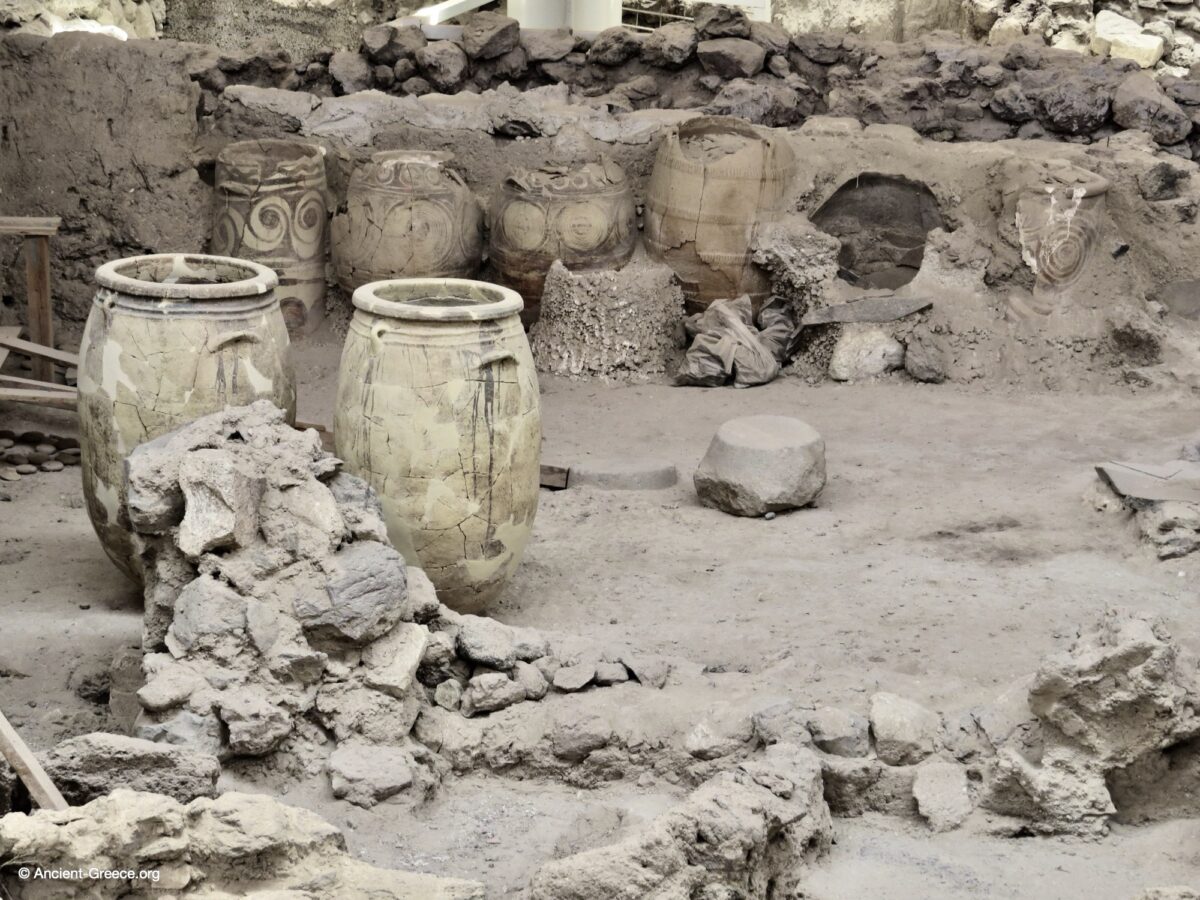
Η Αποθήκη των Πίθων περιείχε μεγάλα αποθηκευτικά αγγεία με υπολείμματα τροφών, όπως κριθάρι και σπόρους. Στην Πλατεία του Μύλου, κοντά στην οδό Τελχινών, σώζεται μια μυλωνική εγκατάσταση, αναδεικνύοντας τις παραγωγικές δραστηριότητες και την οικονομική αυτονομία του οικισμού πριν από την καταστροφή.
Οικία των Γυναικών
Η Οικία των Γυναικών είναι ένα μεγάλο τριώροφο κτίριο που πήρε το όνομά του από τις τοιχογραφίες που απεικονίζουν γυναικείες μορφές. Το κτίριο διαθέτει φωταγωγό, ένα σπάνιο αρχιτεκτονικό στοιχείο για το Ακρωτήρι, και οι χώροι του συνδυάζουν αποθηκευτικές χρήσεις στο ισόγειο με πολυτελείς χώρους διαβίωσης στους ορόφους.
Akrotiri (Greek: Ακρωτήρι) represents one of the most significant archaeological sites in the Aegean, offering an unparalleled view of Bronze Age (3000 ~ 1100 BCE) urban life.
Located on the island of Thera (Santorini), this settlement was buried under layers of volcanic ash during the massive eruption in the 17th century BCE. This cataclysmic event acted as a preservative, encasing the town and freezing its architecture, narrow streets, and sophisticated internal systems in a state of remarkable conservation.
Unlike many contemporaneous sites where only foundations remain, the multi-storey buildings of Akrotiri stand several meters high, still containing the pithoi (storage jars) and celebrated frescoes that once decorated their interiors.
The Settlement of Akrotiri
General Overview
The site reveals a highly organized urban plan with paved streets, an advanced drainage system, and complex architecture that suggests a wealthy, maritime-oriented society. The inhabitants of Thera were deeply integrated into the wider Cycladic and Minoan trade networks, as evidenced by the presence of imported materials and the stylistic influence of Cretan art.
The town was not merely a residential outpost but a bustling center for production, including weaving and pottery.
Xeste 3 and Public Ritual
Architecture and Function
Xeste 3 is an imposing three-storey building that dominated the entrance to the city from the west harbour. Its construction features large ashlar blocks on the outer walls and a sophisticated interior layout. The building is characterized by polythyra (pier-and-door partitions) which allowed for the flexible creation of large, light-filled halls. A notable architectural feature is the Lustral Basin, a sunken room typical of religious or ceremonial spaces.
An imposing three-storey building that dominated the entrance to the city from the west harbour. Many of its rooms, on all storeys, were interconnected with the help of pier-and-door partitions (polythyra), forming spacious halls. In the northeast corner of the building was a construction known from Cretan architecture and called conventionally a ‘Lustral Basin’. Most of the apartments of Xeste 3 were decorated with wall-paintings.
Covering scores of square metres in area, these constitute the largest known wall-painting ensemble in the prehistoric Aegean.
The striking lack of vessels for domestic use and the host of objects of ceremonial/ritual character led to the interpretation of Xeste 3 as a public building dedicated to rituals. The iconographic programme of the frescoes and the separation by gender of the participants in the ritual enactments depicted advocate the view that the building was a venue for rites of passage of the young members of Theran society.
Iconography and Purpose
Because of the scarcity of domestic vessels and the abundance of ritual objects, scholars interpret Xeste 3 as a public venue for community rites. The building’s extensive wall paintings, including the Crocus Gatherers, represent the largest prehistoric Aegean fresco ensemble. The iconographic program suggests these spaces were used for rites of passage, specifically for the maturation of younger members of society.
Double Horns Square and Complex Delta
The East Unit and the Spring Fresco
Centrally located within the city, Double Horns Square takes its name from the carved horns of consecration—a prominent religious symbol—that once crowned the facade of Complex Delta. This unit is a conglomerate of independent buildings that grew over time.
In Room A2, a layer of protective mud preserved the famous Spring Fresco, which depicts lilies and swallows.
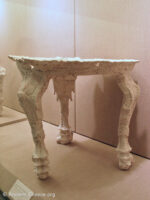
This room also yielded plaster casts of wooden furniture and vessels, providing a rare look at the organic materials of the Bronze Age.
The West House and Triangle Square
Urban Residences and Maritime Art
The West House stands as a typical example of a wealthy residence, overlooking Triangle Square. The building consists of a ground floor and two upper storeys, with a highly developed sanitary installation and drainage system in the southwest corner. The first floor served as the formal apartment, decorated with some of the site’s most iconic imagery: the Fishermen, the Flotilla (or Miniature Frieze), and the Young Priestess. The presence of hundreds of loom-weights indicates that high-level textile production occurred alongside these formal living spaces.
Domestic Storage and Economy
Pithoi Storeroom and Mill-House Square
The Pithoi Storeroom was the first structure excavated in 1967. It contained numerous large storage jars, some still holding remains of barley and flour. The building functioned as a central distribution or storage point for the community.
Nearby, Mill-House Square served as a small clearing off Telchines Road, featuring a functional mill installation (Room 15) and providing clear views of the volcanic stratigraphy that eventually consumed the city.
House of the Ladies
Female Imagery and Refined Architecture
The House of the Ladies is a large, three-storey structure named for the frescoes found in its upper levels. These paintings depict female figures in Theran scale, wearing austere garments and minimal jewelry. The building is unique for its internal light-well, which provided illumination to the central rooms. While the ground floors were utilized as storerooms for foodstuffs, the upper storeys were dedicated to refined living and symbolic activities, possibly related to female maturation.
Photographs – Φωτογραφίες
More photos ◈ ◈ ◈ Περισσότερες Φωτογραφίες …
Bibliography
Bibliography
- Angelakis, A. N., & Spyridakis, S. V. (1996). “The Status of Water Resources in Minoan Times: A Preliminary Study.” Water Science and Technology.
- Archaeological Site Information Boards, Akrotiri, Thera.
- Archaeological Society of Athens. (2012). The New Shelter of the Archaeological Site of Akrotiri, Thera. Athens.
- Broodbank, C. (2000). An Island Archaeology of the Early Cyclades. Cambridge: Cambridge University Press.
- Dickinson, O. (2006). The Aegean from Bronze Age to Iron Age. London: Routledge.
- Doumas, C. (1983). Thera: Pompeii of the Ancient Aegean. London: Thames & Hudson.
- Doumas, C. (1992). The Wall-Paintings of Thera. Athens: The Thera Foundation.
- Hardy, D. A., ed. (1990). Thera and the Aegean World III. London: The Thera Foundation.
- Marinatos, N. (1984). Art and Religion in Thera: Reconstructing a Bronze Age Society. Athens: I. Mathioulakis & Co.
- Marinatos, S. (1968-1976). Excavations at Thera I-VII. Athens: Archaeological Society of Athens.
- Ministry of Culture and Sports. Archaeological Site of Akrotiri, Thera. [Online] Available at: https://cyclades.culture.gov.gr/
- National Archaeological Museum. (2026). Exhibition Guide: The Minoan Civilization and Thera. Athens.
- Palyvou, C. (1986). “Notes on Proxemics: Aspects of Space Organization in Ancient Greek Architecture.” Architecture & Comportement, 3(1), 5-21.
- Palyvou, C. (2005). Akrotiri Thera: An Architecture of Affluence 3,500 Years Old. Philadelphia: INSTAP Academic Press.
- Sbonias, K. (1999). “Social Development, External Relations and Ideology in Early Cycladic Society.” American Journal of Archaeology, 103(1), 120-125.
- Schofield, E. (1982). “The Town Plan of Akrotiri.” Bulletin of the Institute of Classical Studies, 29, 145-147.
- Shaw, J. W. (2009). Minoan Architecture: Materials and Techniques. Padova: Bottega d’Erasmo.
- Thera Prehistoric Museum. (2026). Geological and Archaeological Records of the Akrotiri Settlement. Santorini.
Βιβλιογραφία
- Angelakis, A. N., & Spyridakis, S. V. (1996). “The Status of Water Resources in Minoan Times: A Preliminary Study.” Water Science and Technology.
- Broodbank, C. (2000). An Island Archaeology of the Early Cyclades. Cambridge: Cambridge University Press.
- Dickinson, O. (2006). The Aegean from Bronze Age to Iron Age. London: Routledge.
- Hardy, D. A., επιμ. (1990). Thera and the Aegean World III. London: The Thera Foundation.
- Sbonias, K. (1999). “Social Development, External Relations and Ideology in Early Cycladic Society.” American Journal of Archaeology, 103(1), 120-125.
- Schofield, E. (1982). “The Town Plan of Akrotiri.” Bulletin of the Institute of Classical Studies, 29, 145-147.
- Shaw, J. W. (2009). Minoan Architecture: Materials and Techniques. Padova: Bottega d’Erasmo.
- Εθνικό Αρχαιολογικό Μουσείο. (2026). Οδηγός Έκθεσης: Ο Μινωικός Πολιτισμός και η Θήρα. Αθήνα.
- Η εν Αθήναις Αρχαιολογική Εταιρεία. (2012). Το Νέο Στέγαστρο του Αρχαιολογικού Χώρου Ακρωτηρίου Θήρας. Αθήνα.
- Μαρινάτου, Ν. (1984). Art and Religion in Thera: Reconstructing a Bronze Age Society. Αθήνα: Ι. Μαθιουλάκης & Σία.
- Μαρινάτος, Σ. (1968-1976). Excavations at Thera I-VII. Αθήνα: Η εν Αθήναις Αρχαιολογική Εταιρεία.
- Μουσείο Προϊστορικής Θήρας. (2026). Γεωλογικά και Αρχαιολογικά Αρχεία του Οικισμού του Ακρωτηρίου. Σαντορίνη.
- Ντούμας, Χ. (1983). Thera: Pompeii of the Ancient Aegean. Λονδίνο: Thames & Hudson.
- Ντούμας, Χ. (1992). Οι Τοιχογραφίες της Θήρας. Αθήνα: Ίδρυμα Θήρας.
- Παλυβού, Κ. (1986). “Notes on Proxemics: Aspects of Space Organization in Ancient Greek Architecture.” Architecture & Comportement, 3(1), 5-21.
- Παλυβού, Κ. (2005). Ακρωτήρι Θήρας: Η Αρχιτεκτονική μιας Πολιτείας 3.500 Ετών. Αθήνα: Η εν Αθήναις Αρχαιολογική Εταιρεία.
- Πινακίδες Πληροφόρησης Αρχαιολογικού Χώρου, Ακρωτήρι, Θήρα.
- Υπουργείο Πολιτισμού και Αθλητισμού. Αρχαιολογικός Χώρος Ακρωτηρίου Θήρας. [Διαδικτυακή πηγή] Διαθέσιμο στο: https://cyclades.culture.gov.gr/