
On this page | Περιεχόμενα:
Ελληνικά
Περιεχόμενα:
Ακρωτήρι Θήρας
Ο αρχαιολογικός χώρος στο Ακρωτήρι αποτελεί έναν από τους σημαντικότερους οικισμούς του Αιγαίου (3000 ~ 1100 π.Χ.) κατά την Εποχή του Χαλκού. Η πόλη θάφτηκε κάτω από παχιά στρώματα ηφαιστειακής τέφρας κατά τη μεγάλη έκρηξη του ηφαιστείου της Θήρας τον 17ο αιώνα π.Χ., γεγονός που επέτρεψε την εξαιρετική διατήρηση των κτιρίων, των δρόμων και των τοιχογραφιών της.
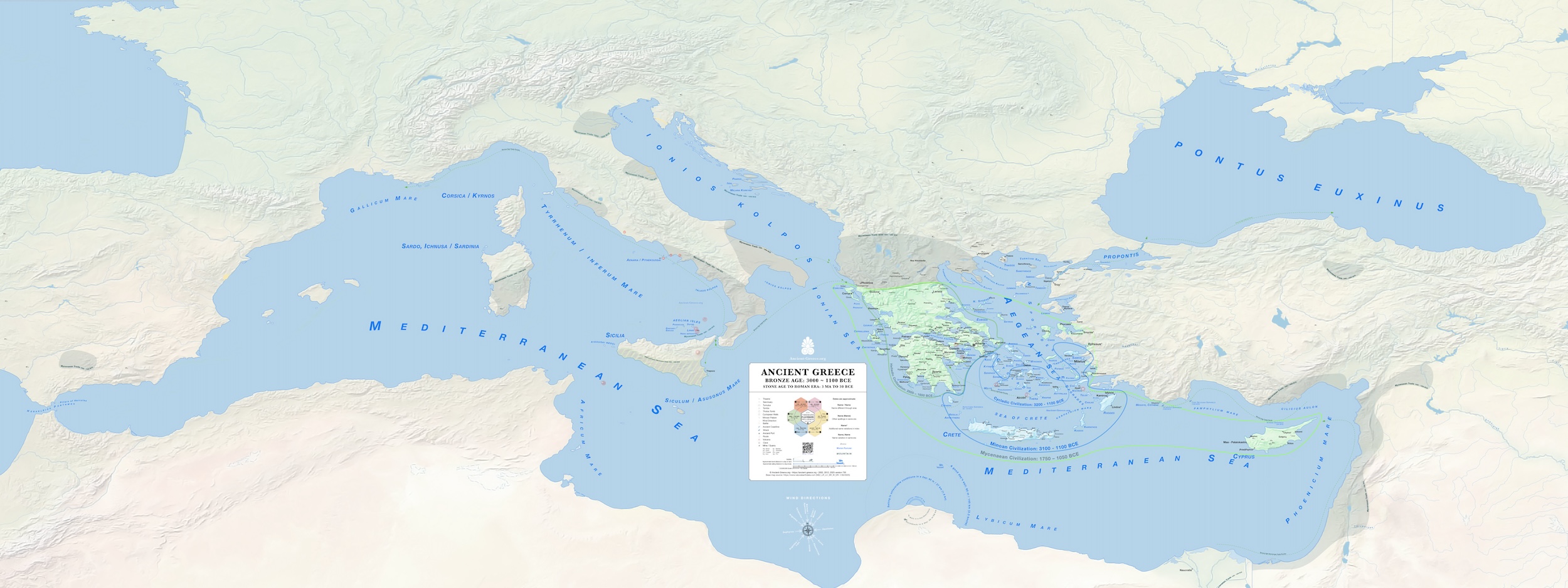
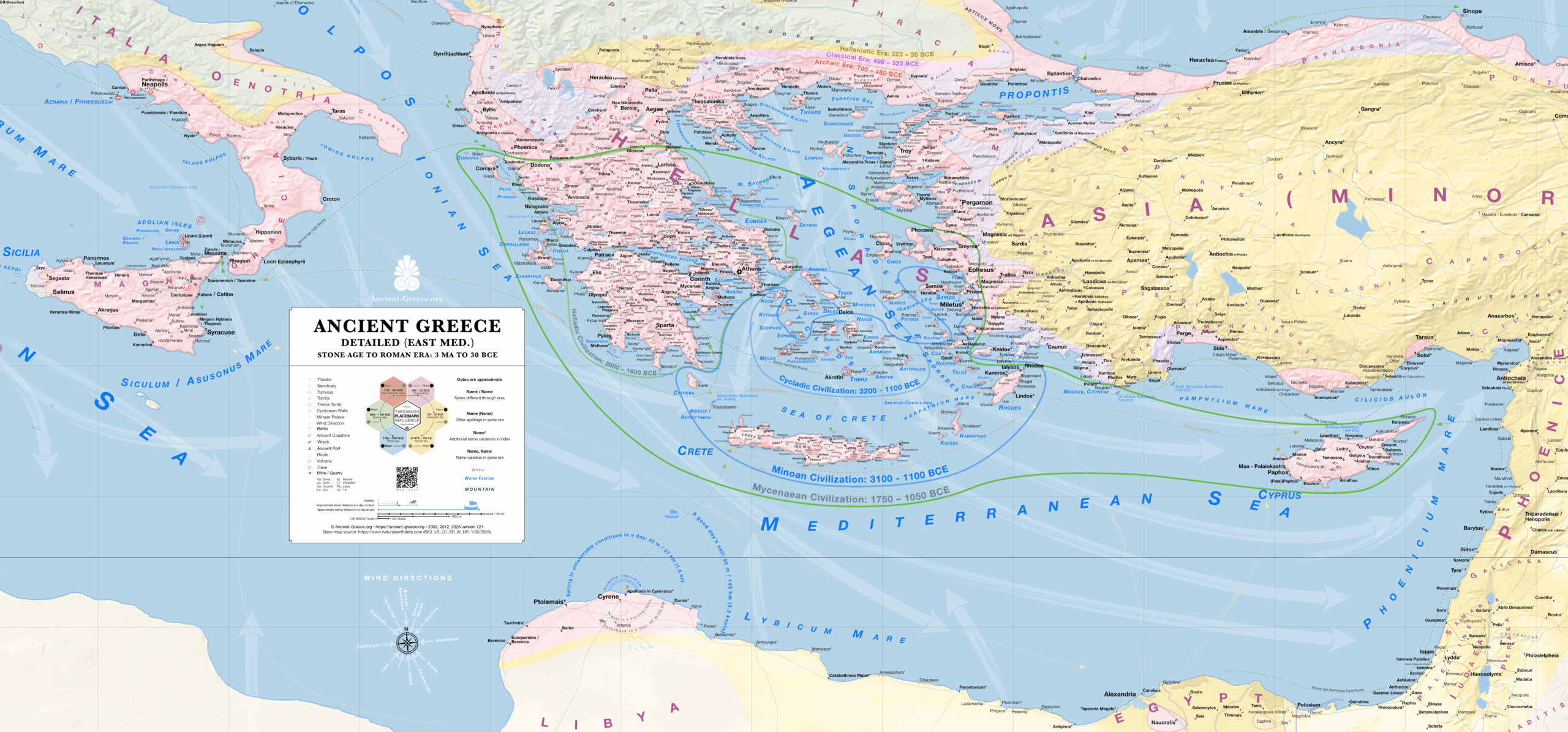
Ο χάρτης αυτός αποτυπώνει την κεντρική θέση που κατείχε το Ακρωτήρι στα σύνθετα εμπορικά δίκτυα του Αιγαίου κατά την Εποχή του Χαλκού. Ο οικισμός λειτουργούσε ως κομβικό ναυτιλιακό κέντρο, διευκολύνοντας το εμπόριο και τις πολιτισμικές ανταλλαγές μεταξύ των Κυκλάδων, της Μινωικής Κρήτης και της Μυκηναϊκής ηπειρωτικής Ελλάδας.
Συνοπτική περιγραφή του αρχαιολογικού χώρου:
Ξεστή 3
Η Ξεστή 3 είναι ένα επιβλητικό τριώροφο οικοδόμημα με τοίχους από μεγάλους ξεστούς λίθους. Το κτίριο διαθέτει πολύθυρα και μια «δεξαμενή καθαρμού», στοιχεία που παραπέμπουν σε δημόσια χρήση και την τέλεση τελετουργιών. Το εικονογραφικό πρόγραμμα των τοιχογραφιών, όπως οι Κροκοσυλλέκτριες, ενισχύει την άποψη ότι το κτίριο προοριζόταν για τελετές ενηλικίωσης των νέων μελών της κοινωνίας.
Ένα επιβλητικό τριώροφο οικοδόμημα που δέσποζε στην είσοδο της πόλης από το δυτικό λιμάνι. Πολλά από τα δωμάτιά του, σε όλους τους ορόφους, επικοινωνούσαν μεταξύ τους με τη βοήθεια πολυθύρων, δημιουργώντας ευρύχωρες αίθουσες. Στη βορειοανατολική γωνία του κτιρίου υπήρχε μια κατασκευή γνωστή από την κρητική αρχιτεκτονική, η οποία συμβατικά αποκαλείται «Δεξαμενή Καθαρμού». Τα περισσότερα από τα διαμερίσματα της Ξεστής 3 ήταν διακοσμημένα με τοιχογραφίες. Καλύπτοντας έκταση δεκάδων τετραγωνικών μέτρων, αυτές αποτελούν το μεγαλύτερο γνωστό σύνολο τοιχογραφιών στο προϊστορικό Αιγαίο.
Η εντυπωσιακή έλλειψη σκευών οικιακής χρήσης και το πλήθος αντικειμένων με τελετουργικό χαρακτήρα οδήγησαν στην ερμηνεία της Ξεστής 3 ως δημόσιου κτιρίου αφιερωμένου σε τελετουργίες. Το εικονογραφικό πρόγραμμα των τοιχογραφιών και ο διαχωρισμός κατά φύλο των συμμετεχόντων στα απεικονιζόμενα τελετουργικά δρώμενα συνηγορούν στην άποψη ότι το κτίριο αποτελούσε χώρο για τελετές μετάβασης των νεαρών μελών της θηραϊκής κοινωνίας.
Πλατεία των Διπλών Κεράτων και Συγκρότημα Δ
Η Πλατεία των Διπλών Κεράτων ονομάστηκε έτσι από τα λίθινα κέρατα καθοσιώσεως που κοσμούσαν την πρόσοψη του Συγκροτήματος Δ.
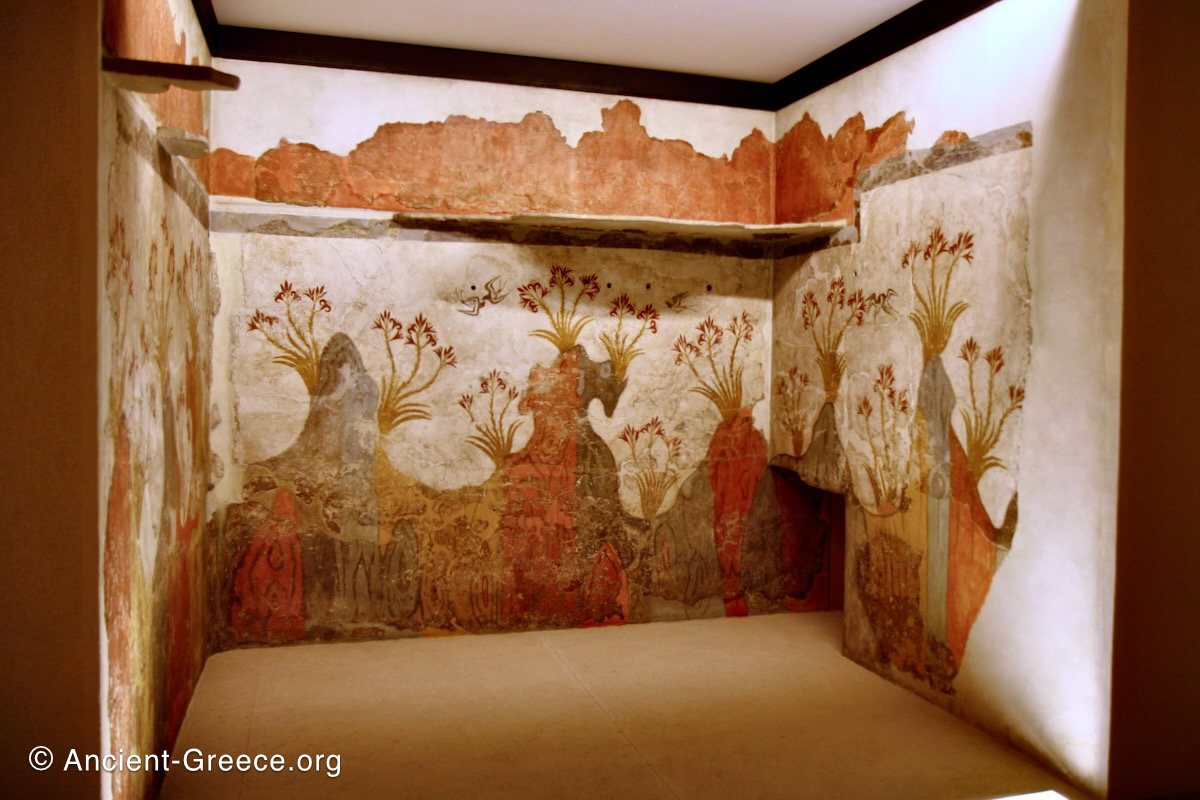
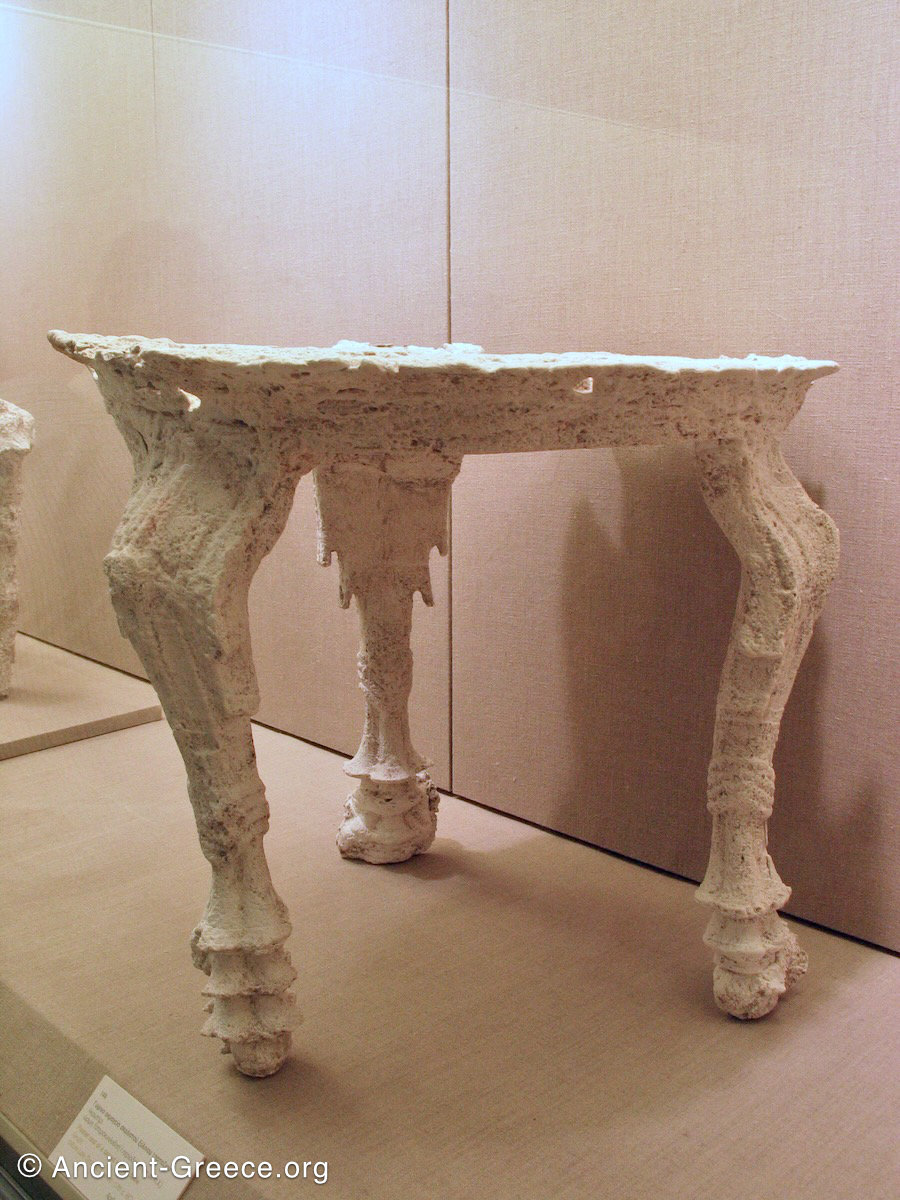
Στο κτίριο αυτό βρέθηκε η περίφημη Τοιχογραφία της Άνοιξης με τα κρίνα και τα χελιδόνια, καθώς και αποτυπώματα ξύλινων επίπλων που μας επιτρέπουν να ανασυνθέσουμε την καθημερινή ζωή των κατοίκων.
Δυτική Οικία και Πλατεία Τριγώνου
Η Δυτική Οικία αποτελεί χαρακτηριστικό δείγμα πλούσιας κατοικίας με οργανωμένο αποχετευτικό σύστημα και χώρους παραγωγής. Στον πρώτο όροφο βρέθηκαν οι εμβληματικές τοιχογραφίες των Ψαράδων, της Νηοπομπής και της Νεαρής Ιέρειας. Η παρουσία πολυάριθμων υφαντικών βαρών μαρτυρεί την έντονη ενασχόληση με την υφαντουργία.
Αποθήκη των Πίθων και Πλατεία του Μύλου
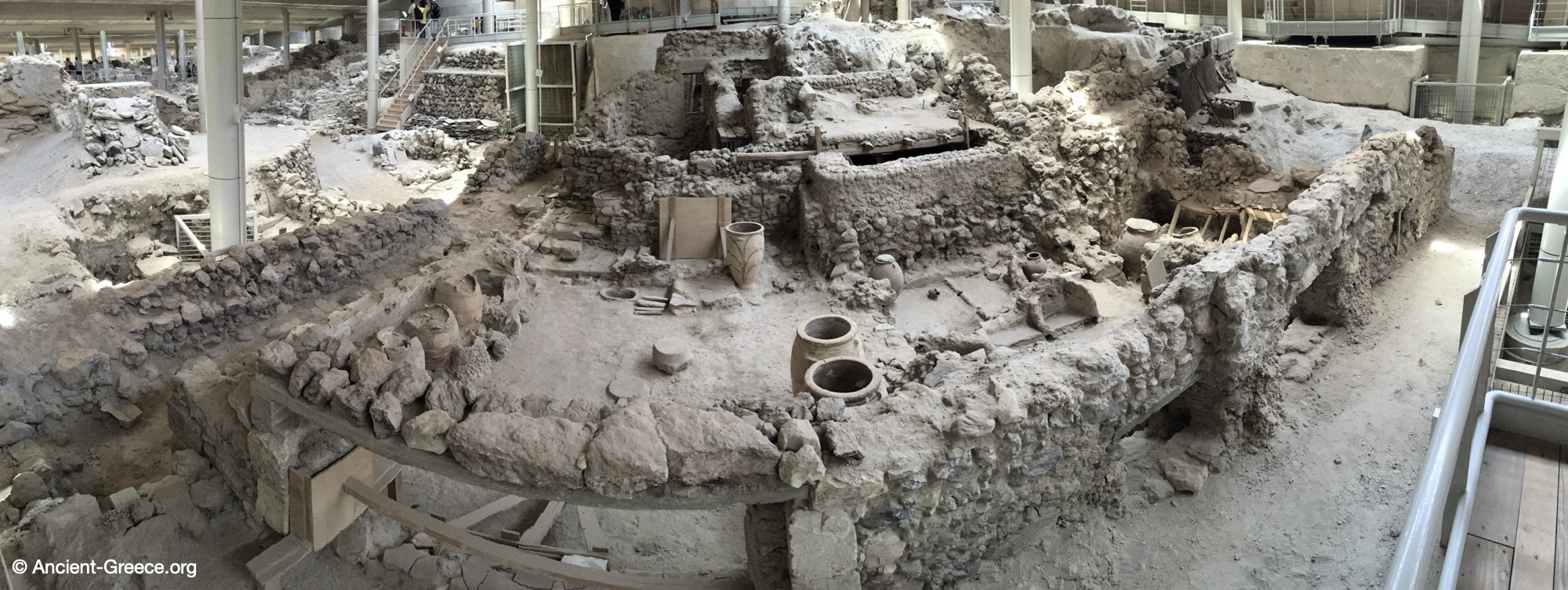
Η Αποθήκη των Πίθων περιείχε μεγάλα αποθηκευτικά αγγεία με υπολείμματα τροφών, όπως κριθάρι και σπόρους. Στην Πλατεία του Μύλου, κοντά στην οδό Τελχινών, σώζεται μια μυλωνική εγκατάσταση, αναδεικνύοντας τις παραγωγικές δραστηριότητες και την οικονομική αυτονομία του οικισμού πριν από την καταστροφή.
Οικία των Γυναικών
Η Οικία των Γυναικών είναι ένα μεγάλο τριώροφο κτίριο που πήρε το όνομά του από τις τοιχογραφίες που απεικονίζουν γυναικείες μορφές. Το κτίριο διαθέτει φωταγωγό, ένα σπάνιο αρχιτεκτονικό στοιχείο για το Ακρωτήρι, και οι χώροι του συνδυάζουν αποθηκευτικές χρήσεις στο ισόγειο με πολυτελείς χώρους διαβίωσης στους ορόφους.
Akrotiri (Greek: Ακρωτήρι) represents one of the most significant archaeological sites in the Aegean, offering an unparalleled view of Bronze Age (3000 ~ 1100 BCE) urban life.
Located on the island of Thera (Santorini), this settlement was buried under layers of volcanic ash during the massive eruption in the 17th century BCE. This cataclysmic event acted as a preservative, encasing the town and freezing its architecture, narrow streets, and sophisticated internal systems in a state of remarkable conservation.
Unlike many contemporaneous sites where only foundations remain, the multi-storey buildings of Akrotiri stand several meters high, still containing the pithoi (storage jars) and celebrated frescoes that once decorated their interiors.
This map illustrates the central position of Akrotiri within the complex commercial networks of the Aegean during the Bronze Age. The settlement served as a primary maritime hub, facilitating trade and cultural exchange between the Cycladic islands, Minoan Crete, and the Mycenaean mainland. The cartographic data highlights the synchronous development of the Cycladic, Minoan, and Helladic civilizations during the Bronze Age. By situating Akrotiri within the wider Mediterranean context, the map emphasizes the site’s role as a strategic link in the distribution of raw materials and finished goods across the region.
The Settlement of Akrotiri
General Overview
The site reveals a highly organized urban plan with paved streets, an advanced drainage system, and complex architecture that suggests a wealthy, maritime-oriented society. The inhabitants of Thera were deeply integrated into the wider Cycladic and Minoan trade networks, as evidenced by the presence of imported materials and the stylistic influence of Cretan art.
The town was not merely a residential outpost but a bustling center for production, including weaving and pottery.
Some highlights with brief descriptions of the Archaeological site of Akrotiri:
Double Horns Square and Complex Delta
The East Unit and the Spring Fresco
Centrally located within the city, Double Horns Square takes its name from the carved horns of consecration—a prominent religious symbol—that once crowned the facade of Complex Delta. This unit is a conglomerate of independent buildings that grew over time.
Akrotiri, Thera
17th Century BCE
Cycladic
Volcanic stone and ashlar masonry
Architecture
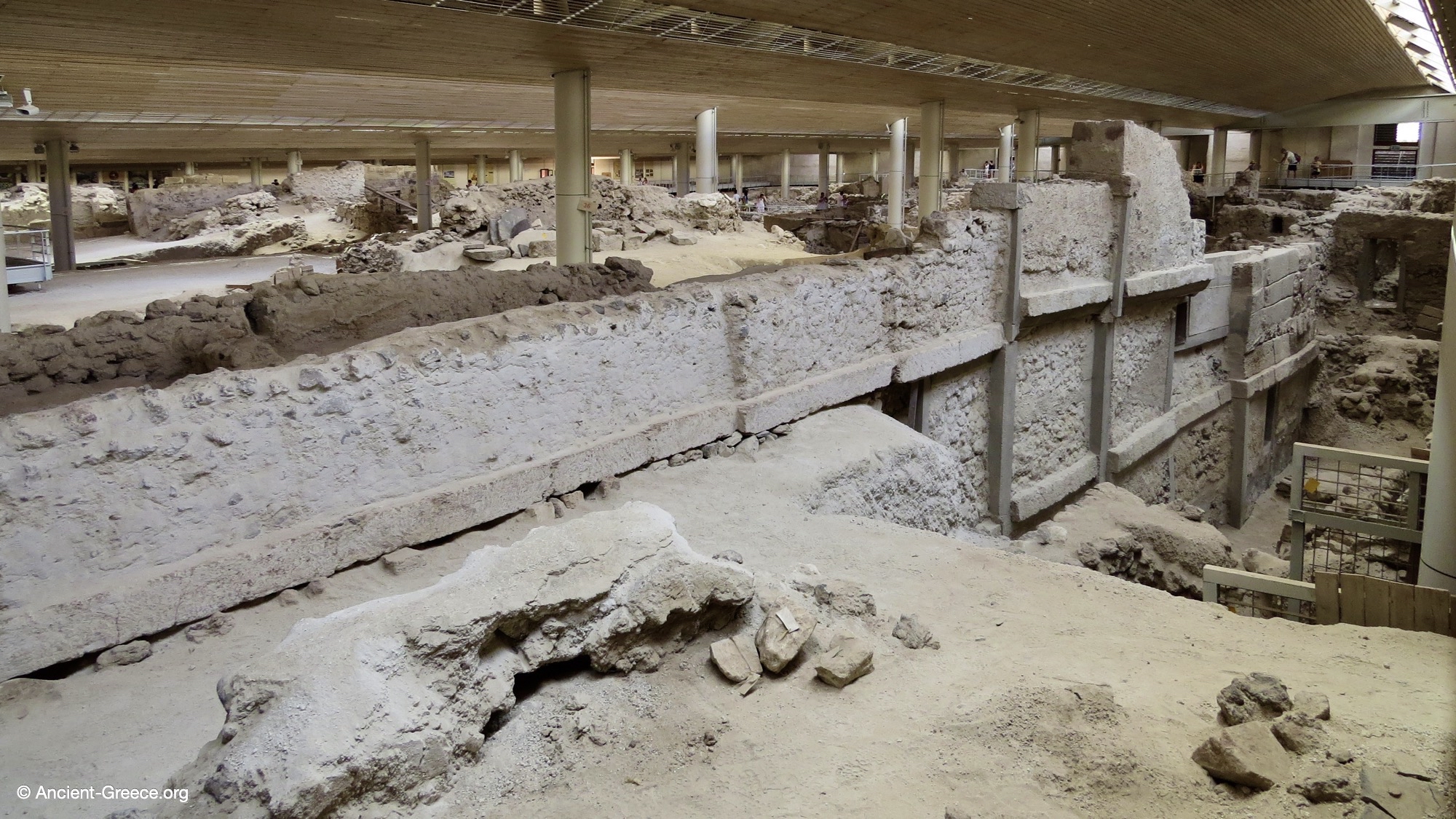
The Archaeological Site of Akrotiri preserves the remains of Xesti 2, an impressive three-story edifice notable for its sophisticated construction. The northern elevation illustrates the use of ashlar masonry where precisely carved volcanic stones are laid in regular courses. A defining characteristic of the building’s architecture is the projection of these stones at the floor levels of the upper stories, creating a clear horizontal articulation on the facade. This structural technique not only reinforced the masonry but also served as a prominent aesthetic feature of the Cycladic urban landscape. The preservation of such details provides critical evidence regarding the engineering capabilities and urban planning at Akrotiri during the late Bronze Age.
◈ ◈ ◈
Ξεστή 2, Βόρεια Όψη
Ακρωτήρι, Θήρα
17ος αιώνας π.Χ.
Κυκλαδική
Ηφαιστειακός λίθος και ξεστή λιθοδομή
Αρχιτεκτονική
Ο Αρχαιολογικός Χώρος Ακρωτηρίου διατηρεί τα κατάλοιπα της Ξεστής 2, ενός εντυπωσιακού τριώροφου οικοδομήματος που διακρίνεται για την εξελιγμένη κατασκευή του. Η βόρεια όψη αναδεικνύει τη χρήση της ξεστής λιθοδομής, όπου ακριβώς λαξευμένοι ηφαιστειακοί λίθοι είναι τοποθετημένοι σε κανονικές σειρές. Ένα καθοριστικό χαρακτηριστικό της αρχιτεκτονικής του κτηρίου είναι η προεξοχή αυτών των λίθων στις στάθμες των δαπέδων των ορόφων, δημιουργώντας μια σαφή οριζόντια διάρθρωση στην πρόσοψη. Αυτή η δομική τεχνική δεν ενίσχυε μόνο την τοιχοποιία, αλλά λειτουργούσε και ως προεξέχον αισθητικό στοιχείο του Κυκλαδικού αστικού τοπίου. Η διατήρηση τέτοιων λεπτομερειών παρέχει κρίσιμα στοιχεία για τις μηχανικές δυνατότητες και τον πολεοδομικό σχεδιασμό στο Ακρωτήρι κατά την ύστερη εποχή του Χαλκού.
In Room A2, a layer of protective mud preserved the famous Spring Fresco, which depicts lilies and swallows.
This room also yielded plaster casts of wooden furniture and vessels, providing a rare look at the organic materials of the Bronze Age.
The West House and Triangle Square
Urban Residences and Maritime Art
Akrotiri, Thera (Santorini)
17th Century BCE (Cycladic)
Stone, Earth, and Timber
Architecture
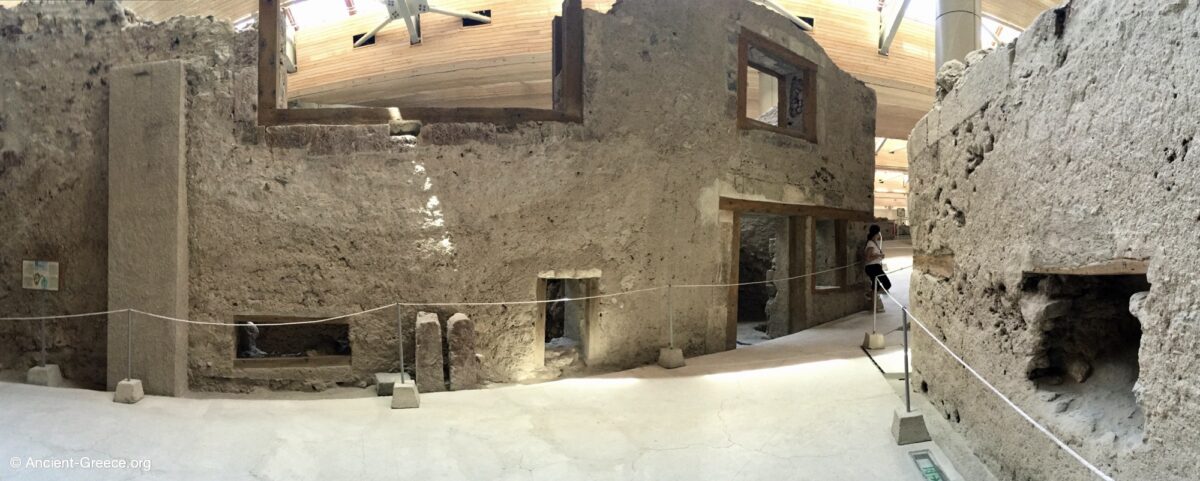
Triangle Square (Πλατεία Τριγώνου) functions as a pivotal urban node at the junction of major arteries within the Aegean settlement of Akrotiri. This view, facing northeast along Telchines Street, highlights the spatial organization of the prehistoric town, where the broad thoroughfare opens into a public plaza. The West House dominates the northern perimeter of the square, featuring a prominent large window on its upper floor designed to facilitate both illumination and social observation of the public space below. This integration of residential Architecture with civic open areas demonstrates a sophisticated level of town planning. Triangle Square served as a focal point for communal interaction and economic activity long before the formalization of the Agora in the Archaic period.
◈ ◈ ◈
Πλατεία Τριγώνου, Ακρωτήρι
Ακρωτήρι, Θήρα (Σαντορίνη)
17ος αιώνας π.Χ. (Κυκλαδική)
Λίθος, Πηλός και Ξυλεία
Αρχιτεκτονική
Η Πλατεία Τριγώνου λειτουργεί ως κομβικό αστικό σημείο στη συμβολή κύριων αρτηριών εντός του οικισμού στο Ακρωτήρι. Αυτή η άποψη, με κατεύθυνση βορειοανατολικά κατά μήκος της Οδού Τελχινών, αναδεικνύει τη χωρική οργάνωση της προϊστορικής πόλης, όπου ο ευρύς δρόμος καταλήγει σε μια δημόσια πλατεία. Η Δυτική Οικία δεσπόζει στη βόρεια πλευρά της πλατείας, διαθέτοντας ένα μεγάλο παράθυρο στον όροφο, σχεδιασμένο για να διευκολύνει τόσο τον φωτισμό όσο και την κοινωνική παρατήρηση του δημόσιου χώρου. Αυτή η ενσωμάτωση της οικιστικής Αρχιτεκτονικής με τους κοινόχρηστους χώρους καταδεικνύει ένα εξελιγμένο επίπεδο πολεοδομικού σχεδιασμού. Η Πλατεία Τριγώνου αποτελούσε επίκεντρο κοινωνικής αλληλεπίδρασης και οικονομικής δραστηριότητας πολύ πριν από την οριστικοποίηση της Αγοράς κατά την Αρχαϊκή περίοδο.
Akrotiri Archaeological Site, Santorini
17th Century BCE
Bronze Age
Stone, Masonry, Stucco, and Wood (Remnants)
Architectural view
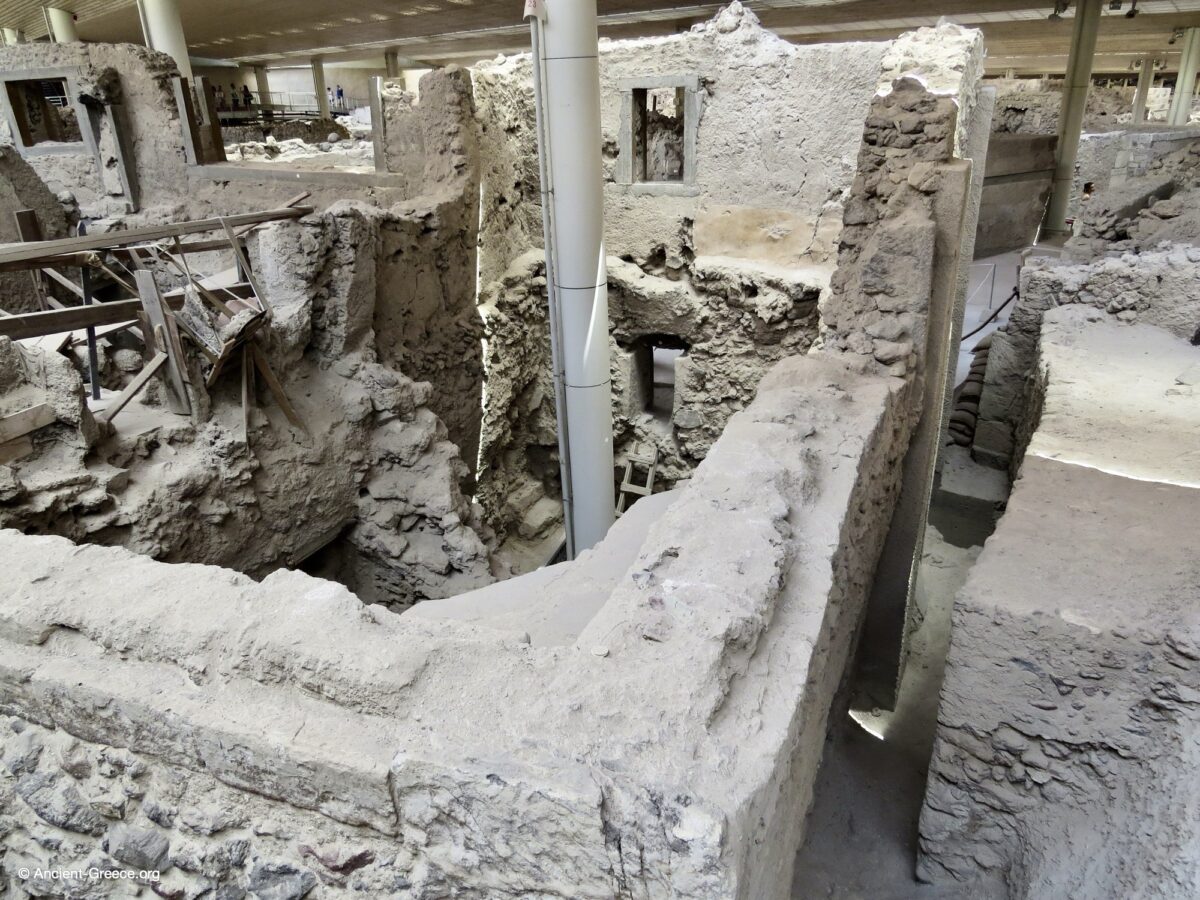
The West House at the Akrotiri Archaeological Site is a prominent structure of the Aegean Bronze Age, notable for its preservation and complex architectural features. This perspective from the west top corner examines the ruin interior, illustrating the sophisticated multi-story construction typical of Cycladic settlements. The Architecture includes a large central window flanked by two smaller openings on the third floor, designed to maximize light and ventilation. Significant structural details are visible in the masonry, specifically the distinct holes where wooden beams were once inserted to provide seismic reinforcement and support for upper levels. Traces of stucco on the internal walls suggest the original decorative finish of the rooms. Adjacent to the southwest wall, a narrow alleyway exemplifies the dense urban plan of the site.
◈ ◈ ◈
Δυτική Οικία, Ακρωτήρι
Αρχαιολογικός Χώρος Ακρωτηρίου, Σαντορίνη
17ος αιώνας π.Χ.
Εποχή του Χαλκού
Λίθος, Τοιχοποιία, Κονίαμα και Ξύλο (Κατάλοιπα)
Αρχιτεκτονική άποψη
Η Δυτική Οικία στον Αρχαιολογικό Χώρο Ακρωτηρίου αποτελεί ένα από τα σημαντικότερα κτίρια του προϊστορικού οικισμού στο Αιγαίο. Η άποψη από τη δυτική γωνία αποκαλύπτει την εσωτερική διάταξη του κτίσματος, αναδεικνύοντας την προηγμένη Αρχιτεκτονική της περιόδου που χαρακτηρίζει τους Κυκλαδικούς οικισμούς. Στο ανώτερο επίπεδο διακρίνεται ένα μεγάλο κεντρικό παράθυρο με δύο πλαισιωτά μικρότερα ανοίγματα, τα οποία εξυπηρετούσαν τον φωτισμό και τον αερισμό των δωματίων. Στην τοιχοποιία διατηρούνται οι οπές για τις ξύλινες δοκούς που ενίσχυαν τη στατική επάρκεια του κτιρίου, ενώ τα κατάλοιπα από κονίαμα υποδεικνύουν την επιμέλεια της εσωτερικής διακόσμησης. Το στενό δρομάκι στη νοτιοδυτική πλευρά αντικατοπτρίζει τον πυκνό πολεοδομικό ιστό του Ακρωτηρίου.
Akrotiri Archaeological Site, Santorini
17th Century BCE
Bronze Age
Stone, Masonry, Stucco
Architectural view
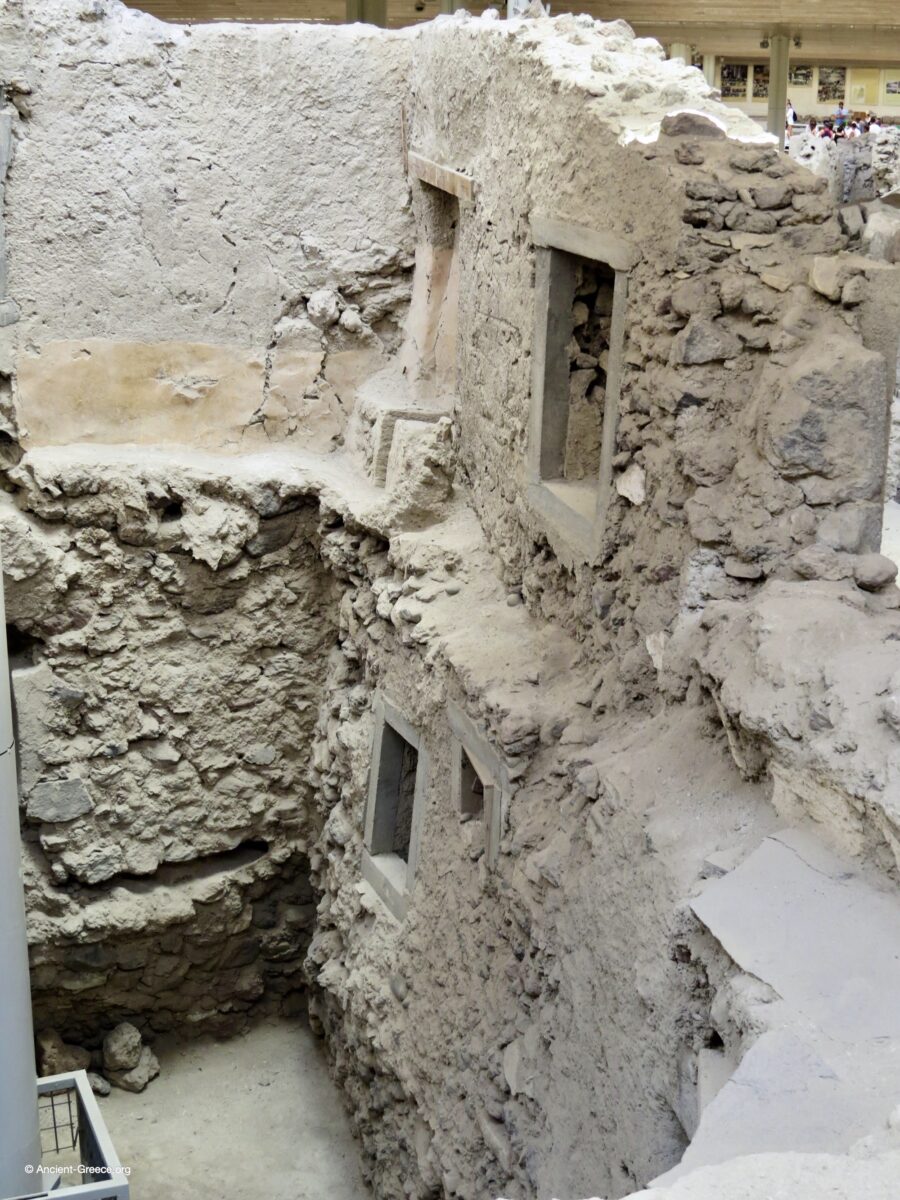
The interior of the West House at the Akrotiri Archaeological Site provides a sectional view of Aegean Bronze Age domestic Architecture. This perspective of the south corner reveals the sophisticated vertical development of the structure, encompassing three distinct levels. Visible within the masonry are the precise notches designed to receive wooden beams for floor rafters, a characteristic feature of Cycladic building techniques. The windows on the second and third floors, now reinforced with cement to replace the original organic material, demonstrate the systematic placement of openings for environmental control. On the third floor, under the far window there is a bench with a slit in the middle which connected by a vertical pipe to a drainage system. On the uppermost floor, the wall thickness is reduced by half, a structural adjustment to lighten the load on the lower levels. Significant remnants of internal stucco are preserved on this level, featuring a distinct honey-colored pigment that suggests the decorative quality of the ruin in antiquity.
◈ ◈ ◈
Δυτική Οικία, Ακρωτήρι
Αρχαιολογικός Χώρος Ακρωτηρίου, Σαντορίνη
17ος αιώνας π.Χ.
Εποχή του Χαλκού
Λίθος, Τοιχοποιία, Κονίαμα
Αρχιτεκτονική άποψη
Η εσωτερική άποψη της Δυτικής Οικίας στον Αρχαιολογικό Χώρο Ακρωτηρίου προσφέρει μια τομή της οικιστικής Αρχιτεκτονικής της Εποχής του Χαλκού στο Αιγαίο. Η εστίαση στη νότια γωνία αποκαλύπτει την κατακόρυφη ανάπτυξη του κτιρίου σε τρία επίπεδα. Στην τοιχοποιία διακρίνονται με σαφήνεια οι εγκοπές για την έδραση των ξύλινων δοκών των οροφών, στοιχείο τυπικό της Κυκλαδικής οικοδομικής παράδοσης. Τα παράθυρα του πρώτου και του δεύτερου ορόφου, όπου το ξύλο έχει αντικατασταθεί από τσιμέντο για λόγους συντήρησης, αναδεικνύουν την οργάνωση των προσόψεων. Στον ανώτατο όροφο, το πάχος του τοίχου μειώνεται στο μισό για τον περιορισμό του φορτίου στις υποδομές. Στο επίπεδο αυτό διατηρούνται ίχνη από κονίαμα με χρωστική σε μελιχρό τόνο, που μαρτυρούν την αισθητική επιμέλεια του χώρου πριν την καταστροφή.
17th Century BCE
Bronze Age
Stone, Masonry, Stucco, and Wood (Remnants)
Architectural view
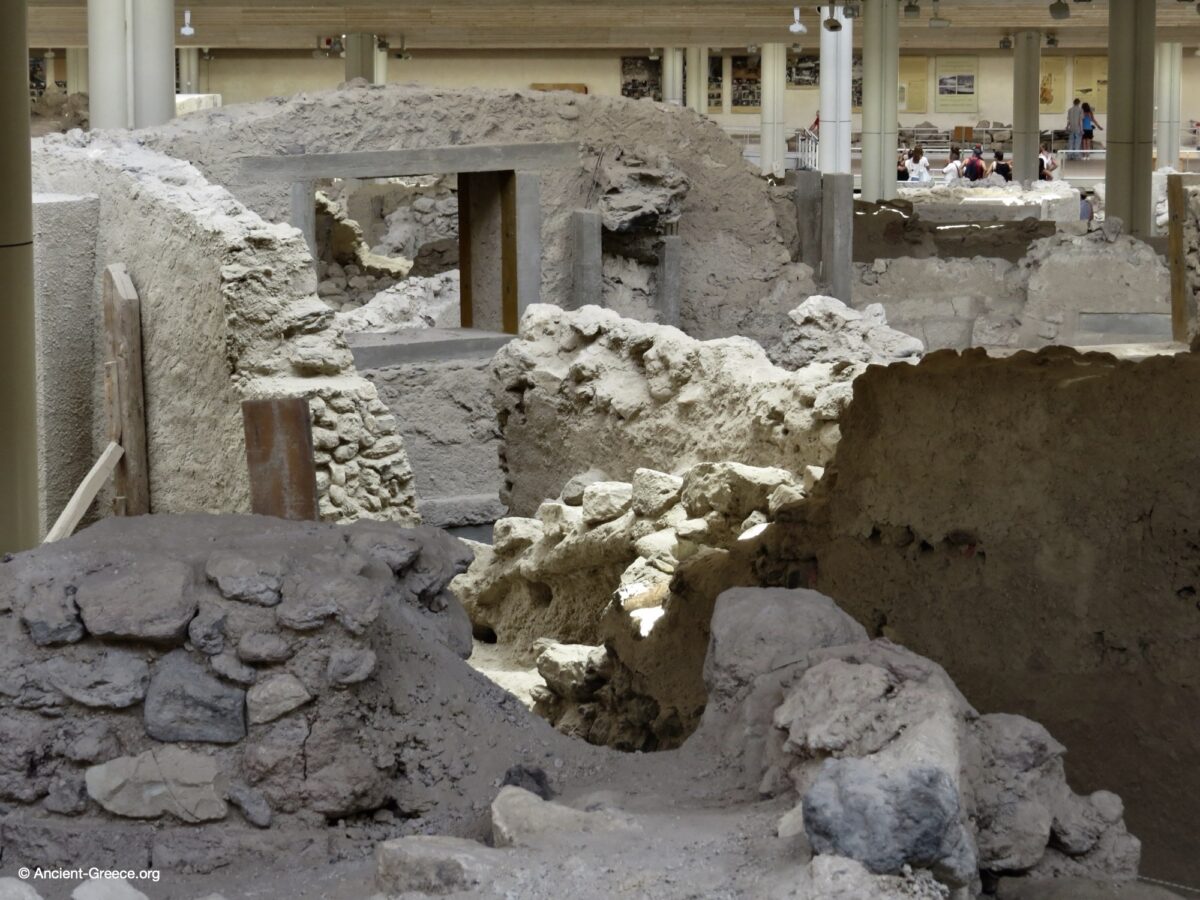
The interior of the West House at the Akrotiri Archaeological Site exhibits the complex vertical circulation patterns of Cycladic Bronze Age Architecture. This view focuses on the staircase landing of the third floor, where a window provided essential illumination for the transit areas of the home.
◈ ◈ ◈
Δυτική Οικία, Ακρωτήρι
Αρχαιολογικός Χώρος Ακρωτηρίου, Σαντορίνη
17ος αιώνας π.Χ.
Εποχή του Χαλκού
Λίθος, Τοιχοποιία, Κονίαμα και Ξύλο (Κατάλοιπα)
Αρχιτεκτονική άποψη
Το εσωτερικό της Δυτικής Οικίας στον Αρχαιολογικό Χώρο Ακρωτηρίου αναδεικνύει την περίπλοκη κατακόρυφη οργάνωση της Κυκλαδικής οικιστικής Αρχιτεκτονικής της Εποχής του Χαλκού. Η συγκεκριμένη άποψη εστιάζει στο πλατύσκαλο του κλιμακοστασίου του δευτέρου ορόφου, όπου ένα παράθυρο εξασφάλιζε τον απαραίτητο φωτισμό στους χώρους κυκλοφορίας.

Akrotiri, Thera (Santorini)
17th Century BCE (Cycladic)
Stone and Tuff
Architecture
Telchines Street and Triangle Square
This panoramic view, recorded in 2003, documents the central urban junction of Akrotiri prior to significant modern infrastructural interventions. The image captures the intersection of Telchines Street and Triangle Square, showing the original support columns and the previous roofing system that protected the ruins of the Aegean Bronze Age settlement. From this perspective, the West House is visible with its characteristic large windows overlooking the public square, serving as a primary example of wealthy domestic Architecture.
◈ ◈ ◈
Οδός Τελχινών και Πλατεία Τριγώνου, Ακρωτήρι
Ακρωτήρι, Θήρα (Σαντορίνη)
17ος αιώνας π.Χ. (Κυκλαδική)
Λίθος και Θηραϊκή Γη
Αρχιτεκτονική
Οδός Τελχινών και Πλατεία Τριγώνου
Αυτή η πανοραμική άποψη, που καταγράφηκε το 2003, τεκμηριώνει την κεντρική αστική συμβολή στο Ακρωτήρι πριν από τις σημαντικές σύγχρονες υποδομικές παρεμβάσεις. Η εικόνα αποτυπώνει τη διασταύρωση της Οδού Τελχινών και της Πλατείας Τριγώνου, παρουσιάζοντας τις παλαιές κολώνες στήριξης και το προηγούμενο σύστημα στέγασης που προστάτευε τα ερείπια του οικισμού της Εποχής του Χαλκού στο Αιγαίο. Από αυτή την οπτική γωνία, η Δυτική Οικία διακρίνεται με τα χαρακτηριστικά μεγάλα παράθυρά της που βλέπουν στη δημόσια πλατεία, αποτελώντας κύριο παράδειγμα εύπορης οικιστικής Αρχιτεκτονικής.
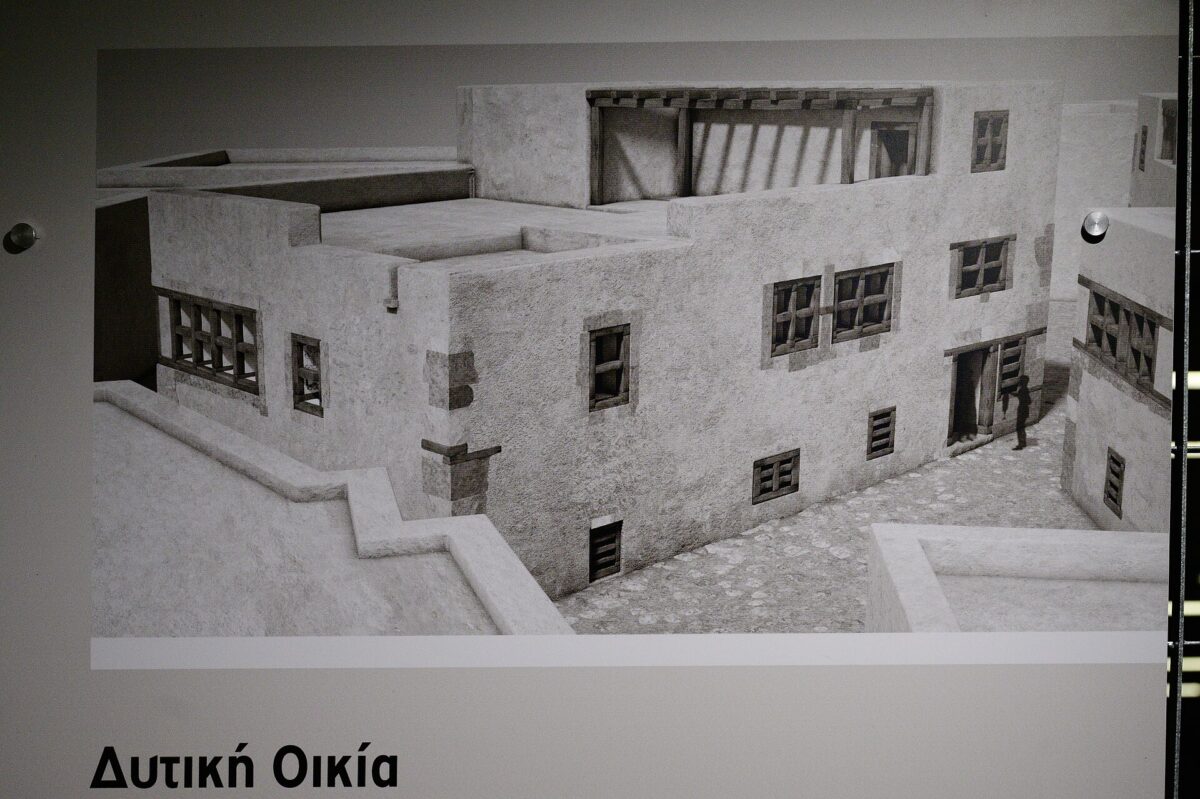
17th Century BCE (Cycladic)
Stone, Earth, and Timber
Architecture
The West House at Akrotiri constitutes a premier example of a detached, multi-story urban residence within the Aegean Bronze Age. Comprising a ground floor and at least two upper storeys in its east wing, the Architecture reflects a history of adaptation; the rise in street levels due to debris necessitated the adjustment of entrances and converted original ground-floor rooms into semi-basements. A spacious room on the first floor, illuminated by a large window overlooking Triangle Square, functioned as a weaving workshop, as evidenced by the discovery of hundreds of loom-weights. The west wing served as the building’s formal apartments, where thin mud partition walls divided the space into specialized rooms. Notable features include a sophisticated sanitary installation and walls adorned with significant frescoes, including the Miniature Frieze, the Ikria, and depictions of young fishermen and a priestess. These elements underscore the socio-economic status of the Akrotiri inhabitants prior to the Archaic period.
Primary Tags: Akrotiri, Aegae Archaeological Site, Aegean, Architecture, Archaic
◈ ◈ ◈
Δυτική Οικία, Ακρωτήρι
Ακρωτήρι, Θήρα (Σαντορίνη)
17ος αιώνας π.Χ. (Κυκλαδική)
Λίθος, Πηλός και Ξυλεία
Αρχιτεκτονική
Η Δυτική Οικία στο Ακρωτήρι αποτελεί κορυφαίο παράδειγμα αυτόνομης, πολυώροφης αστικής κατοικίας της Εποχής του Χαλκού στο Αιγαίο. Αποτελούμενη από ισόγειο και τουλάχιστον δύο ορόφους στην ανατολική της πτέρυγα, η Αρχιτεκτονική της αντανακλά μια ιστορία προσαρμογών· η άνοδος της στάθμης των δρόμων λόγω συσσώρευσης ερειπίων επέβαλε τη μετατόπιση των εισόδων και μετέτρεψε τα αρχικά ισόγεια δωμάτια σε ημιυπόγεια. Ένα ευρύχωρο δωμάτιο στον πρώτο όροφο, το οποίο φωτιζόταν από μεγάλο παράθυρο προς την Πλατεία του Τριγώνου, λειτουργούσε ως εργαστήριο υφαντικής, όπως μαρτυρούν τα εκατοντάδες πήλινα βάρη αργαλειού που βρέθηκαν εκεί. Η δυτική πτέρυγα στέγαζε τα επίσημα διαμερίσματα του κτιρίου, όπου λεπτά χωρίσματα από πηλό διέκριναν τον χώρο σε εξειδικευμένες αίθουσες. Στα αξιοσημείωτα χαρακτηριστικά περιλαμβάνονται μια εξελιγμένη υγειονομική εγκατάσταση και τοίχοι διακοσμημένοι με σημαντικές τοιχογραφίες, όπως η Μικρογραφική Ζωφόρος, τα Ικρία, και οι απεικονίσεις των Ψαράδων και της Νεαρής Ιέρειας. Τα στοιχεία αυτά υπογραμμίζουν την κοινωνικοοικονομική κατάσταση των κατοίκων στο Ακρωτήρι πριν από την Αρχαϊκή περίοδο.
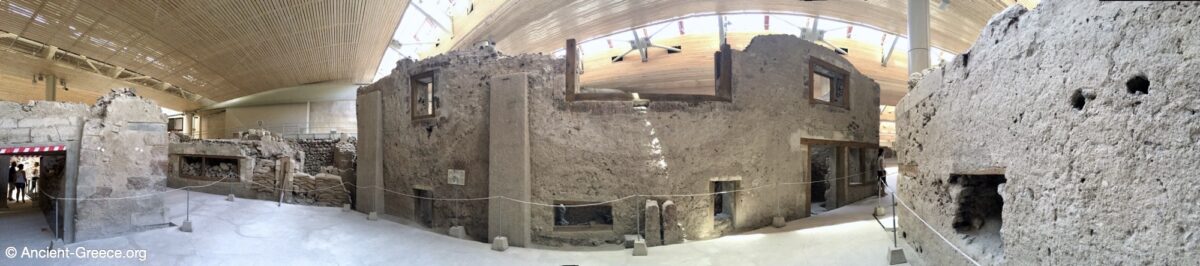
Akrotiri, Thera (Santorini)
17th Century BCE (Cycladic)
Stone and Tuff
Architecture
Telchines Street and Triangle Square
This panoramic view captures the central urban junction of Akrotiri, where the major northeast-to-southwest thoroughfare of Telchines Street intersects with Triangle Square. The distortion of the panorama allows for a simultaneous view of the street as it skirts the House of the Anchor to the northeast and continues toward the southwest past the West House. The Architecture of the West House is particularly prominent, featuring large upper-story windows designed to overlook the public square, a feature that underscores the sophisticated social and spatial organization of the Aegean Bronze Age.
◈ ◈ ◈
Οδός Τελχινών και Πλατεία Τριγώνου, Ακρωτήρι
Ακρωτήρι, Θήρα (Σαντορίνη)
17ος αιώνας π.Χ. (Κυκλαδική)
Λίθος και Θηραϊκή Γη
Αρχιτεκτονική
Οδός Τελχινών και Πλατεία Τριγώνου
Αυτή η πανοραμική άποψη αποτυπώνει την κεντρική αστική συμβολή στο Ακρωτήρι, όπου η κύρια αρτηρία της Οδού Τελχινών, με κατεύθυνση από τα βορειοανατολικά προς τα νοτιοδυτικά, συναντά την Πλατεία Τριγώνου. Η παραμόρφωση του πανοράματος επιτρέπει την ταυτόχρονη θέαση του δρόμου καθώς παρακάμπτει την Οικία της Αγκύρας στα βορειοανατολικά και συνεχίζει προς τα νοτιοδυτικά μπροστά από τη Δυτική Οικία. Η Αρχιτεκτονική της Δυτικής Οικίας είναι ιδιαίτερα εμφανής, διαθέτοντας μεγάλα παράθυρα στον όροφο σχεδιασμένα για να επιβλέπουν τη δημόσια πλατεία, ένα χαρακτηριστικό που υπογραμμίζει την εξελιγμένη κοινωνική και χωρική οργάνωση της Εποχής του Χαλκού στο Αιγαίο.
The West House stands as a typical example of a wealthy residence, overlooking Triangle Square. The building consists of a ground floor and two upper storeys, with a highly developed sanitary installation and drainage system in the southwest corner. The first floor served as the formal apartment, decorated with some of the site’s most iconic imagery: the Fishermen, the Flotilla (or Miniature Frieze), and the Young Priestess.

The presence of hundreds of loom-weights indicates that high-level textile production occurred alongside these formal living spaces.
Domestic Storage and Economy
Pithoi Storeroom and Mill-House Square
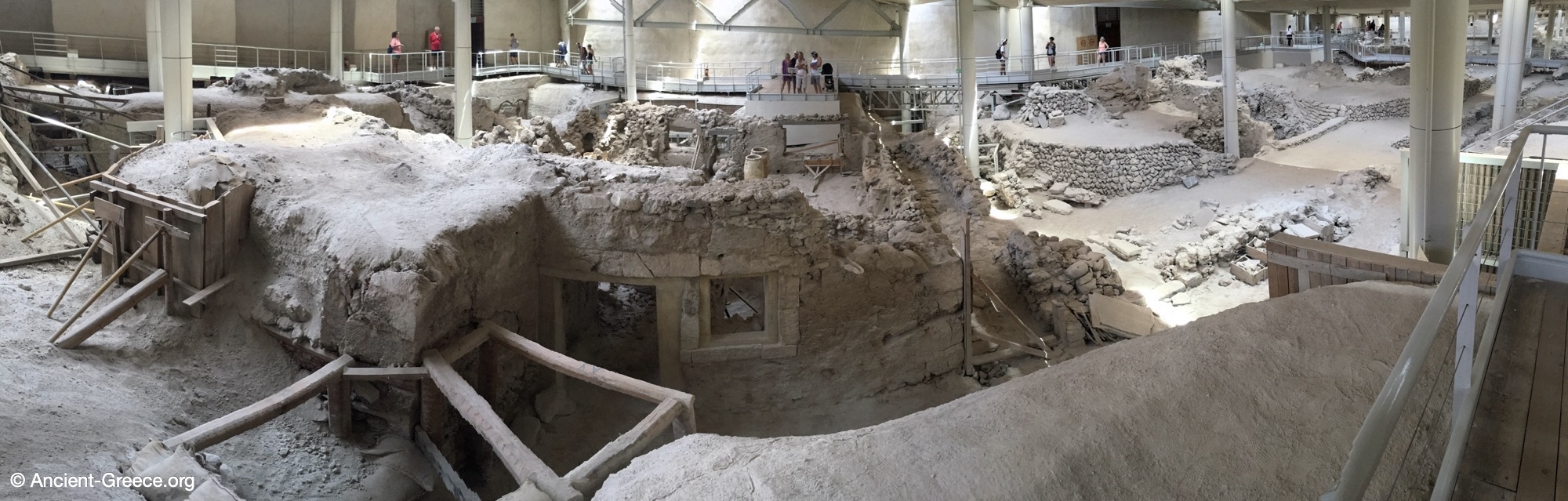
Akrotiri Archaeological Site, Santorini
17th Century BCE
Bronze Age
Stone, Masonry, Stucco, and Wood (Remnants)
Architectural view
This panoramic view captures the Pithoi Storeroom, the first significant structure unearthed at the Akrotiri Archaeological Site in 1967 by Professor Spyridon Marinatos. It was named for the numerous large storage jars (pithoi) found in situ within Room 1, which, along with stored foodstuffs, led to its interpretation as a centralized supply depot for production activities. Modern conservation efforts are evident in the ruin, with contemporary wooden beams supporting the walls and concrete replacing the original timber of door and window frames. The main masonry demonstrates sophisticated construction, featuring well-dressed stones (ashlar) around the large window and the door lintel. Notches in the wall demarcate where wooden beams, now perished, would have been inserted to reinforce the structure and support the upper stories. Marinatos determined that weaving activities occurred on the upper floor, directly above the storeroom, based on the discovery of numerous loom weights that had fallen from the level above into the space in front of the large window.
◈ ◈ ◈
Αποθήκη των Πίθων, Ακρωτήρι
Αρχαιολογικός Χώρος Ακρωτηρίου, Σαντορίνη
17ος αιώνας π.Χ.
Εποχή του Χαλκού
Λίθος, Τοιχοποιία, Κονίαμα και Ξύλο (Κατάλοιπα)
Αρχιτεκτονική άποψη
Η πανοραμική αυτή άποψη αποτυπώνει την Αποθήκη των Πίθων, το πρώτο σημαντικό κτίσμα που έφερε στο φως η ανασκαφή του Καθηγητή Σπυρίδωνα Μαρινάτου το 1967 στον Αρχαιολογικό Χώρο Ακρωτηρίου. Το όνομα της οφείλεται στους πολυάριθμους μεγάλους αποθηκευτικούς πίθους που βρέθηκαν in situ στο Δωμάτιο 1, οι οποίοι, σε συνδυασμό με τα αποθηκευμένα τρόφιμα, οδήγησαν στην ερμηνεία του ως κεντρικού αποθηκευτικού χώρου εφοδιασμού για τις παραγωγικές δραστηριότητες. Στο ερείπιο είναι εμφανείς οι σύγχρονες προσπάθειες συντήρησης, με σύγχρονα ξύλινα δοκάρια να υποστηρίζουν τους τοίχους και τσιμέντο να αντικαθιστά τα πρωτότυπα ξύλινα πλαίσια θυρών και παραθύρων. Η κύρια τοιχοποιία επιδεικνύει εξελιγμένη κατασκευή, με λαξευμένους λίθους (ξεστούς) γύρω από το μεγάλο παράθυρο και το υπέρθυρο της πόρτας. Οι εγκοπές στον τοίχο ορίζουν τις θέσεις όπου θα είχαν εισαχθεί οι ξύλινες δοκοί, τώρα κατεστραμμένες, για την ενίσχυση της δομής και τη στήριξη των άνω ορόφων. Ο Μαρινάτος προσδιόρισε ότι δραστηριότητες ύφανσης λάμβαναν χώρα στον άνω όροφο, ακριβώς πάνω από την αποθήκη, με βάση την ανακάλυψη πολυάριθμων βαριδιών αργαλειού που είχαν πέσει από το επίπεδο πάνω στο χώρο μπροστά από το μεγάλο παράθυρο.
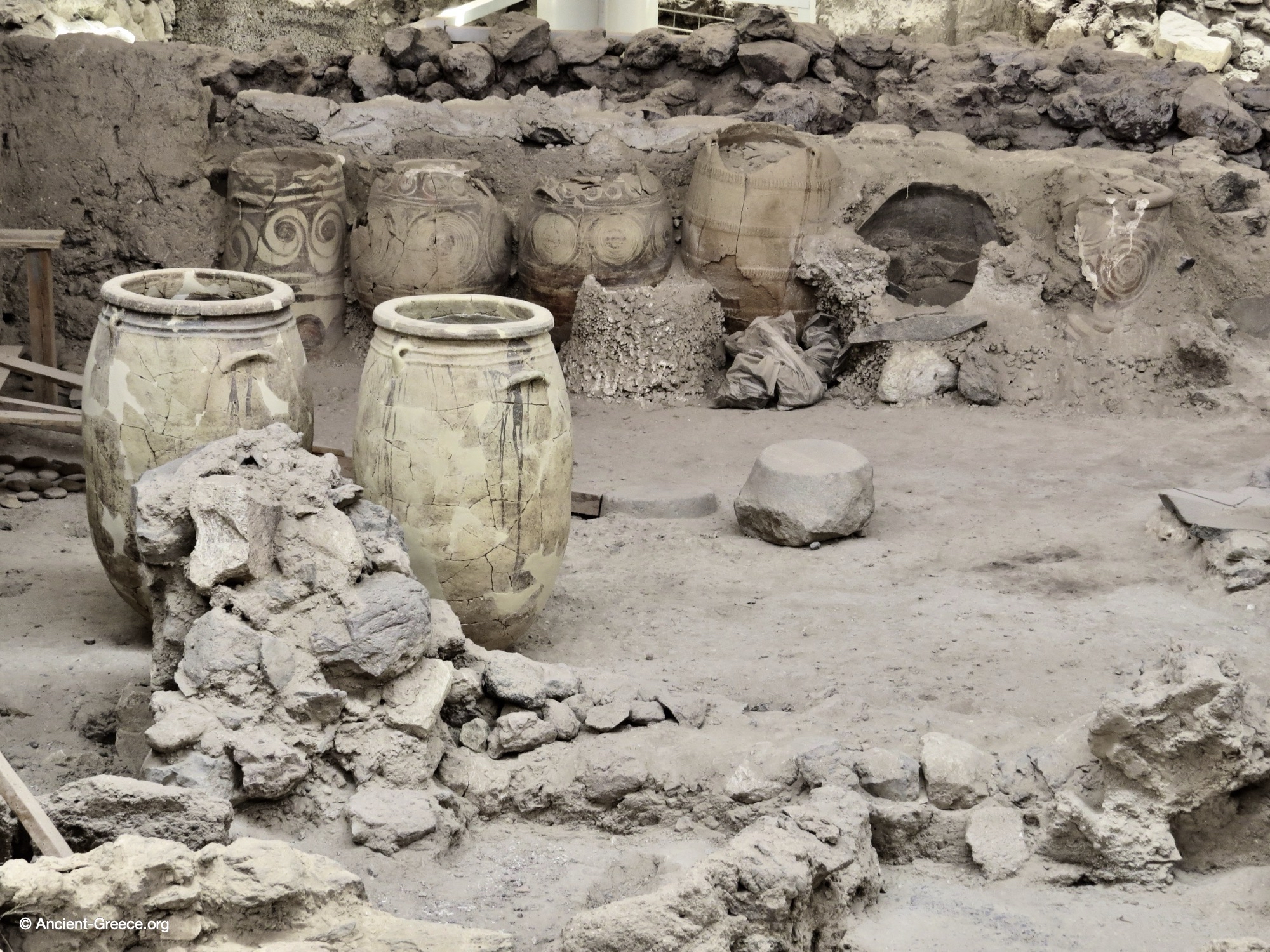
Akrotiri Archaeological Site, Santorini
17th Century BCE
Bronze Age
Ceramic (Terracotta), Stone, and Masonry
Storage Vessels
The Pithoi Storeroom at the Akrotiri Archaeological Site contains one of the most significant in situ assemblages of Bronze Age storage vessels in the Aegean. These large ceramic pithoi, situated within the Architecture of the ground floor, were utilized for the bulk storage of agricultural products such as barley, pulses, and oil. The vessels remain in their original positions, many still partially embedded in the debris that filled the ruin during the volcanic destruction. The systematic organization of these containers underscores the building’s function as a specialized facility for the collection and distribution of foodstuffs, reflecting the complex economic administration of the prehistoric settlement.
◈ ◈ ◈
Αποθήκη των Πίθων, Ακρωτήρι
Αρχαιολογικός Χώρος Ακρωτηρίου, Σαντορίνη
17ος αιώνας π.Χ.
Εποχή του Χαλκού
Κεραμική (Πηλός), Λίθος και Τοιχοποιία
Αποθηκευτικά Αγγεία
Η Αποθήκη των Πίθων στον Αρχαιολογικό Χώρο Ακρωτηρίου φιλοξενεί ένα από τα σημαντικότερα in situ σύνολα αποθηκευτικών αγγείων της Εποχής του Χαλκού στο Αιγαίο. Αυτοί οι μεγάλοι πήλινοι πίθοι, τοποθετημένοι εντός της Αρχιτεκτονικής του ισογείου, χρησιμοποιούνταν για τη μαζική αποθήκευση αγροτικών προϊόντων, όπως κριθάρι, όσπρια και λάδι. Τα αγγεία παραμένουν στις αρχικές τους θέσεις, πολλά από αυτά ακόμη εν μέρει ενσωματωμένα στα κατάλοιπα που γέμισαν το ερείπιο κατά την ηφαιστειακή καταστροφή. Η συστηματική οργάνωση αυτών των εμπορευματοκιβωτίων υπογραμμίζει τη λειτουργία του κτηρίου ως εξειδικευμένης εγκατάστασης για τη συλλογή και διανομή τροφίμων, αντανακλώντας την περίπλοκη οικονομική διοίκηση του προϊστορικού οικισμού.
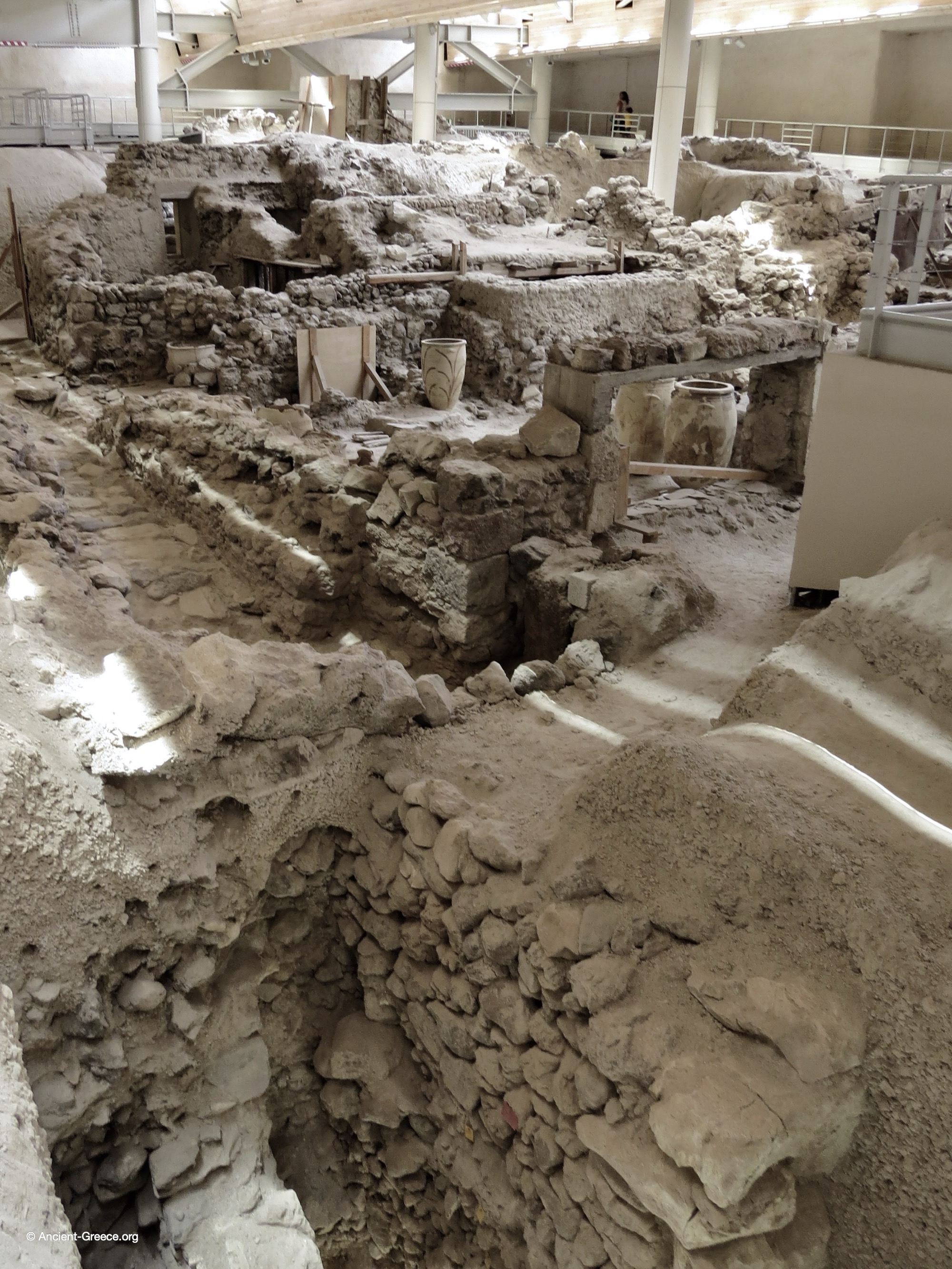
Akrotiri Archaeological Site, Santorini
17th Century BCE
Bronze Age
Stone, Masonry, and Volcanic Ash
Archaeological view
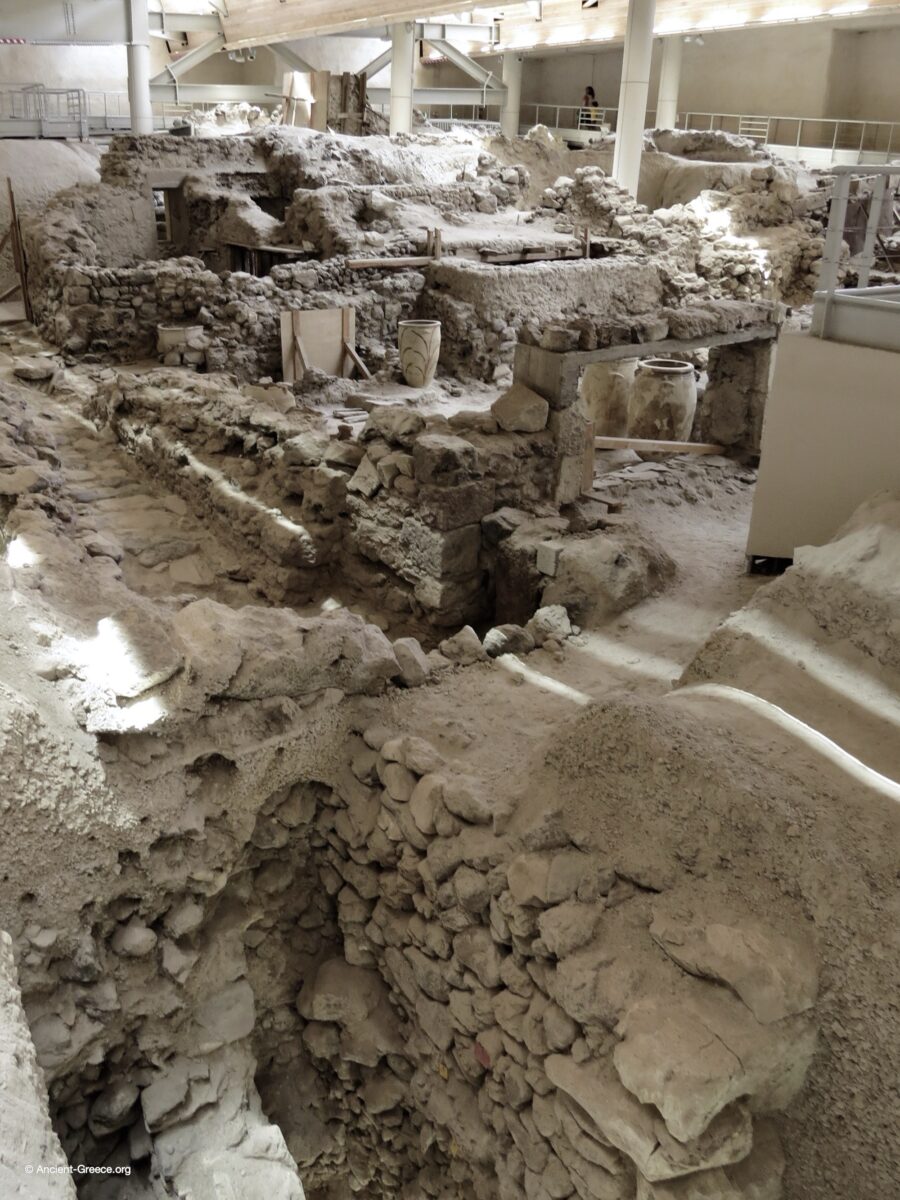
This perspective of the Akrotiri Archaeological Site illustrates the significant depth of the stratigraphic layers and the complexity of the Cycladic urban plan. In the foreground, the deep excavated pit reveals building walls that extend more than two meters below the level of the background structures. In the background, the Pithoi Storeroom and surrounding ruins showcase the dense urban fabric and sophisticated Architecture of the Bronze Age. The standing masonry and the intricate network of streets highlight the advanced engineering required to maintain a multi-level city before its final preservation by the volcanic eruption.
◈ ◈ ◈
Προϊστορικός Οικισμός Ακρωτηρίου
Αρχαιολογικός Χώρος Ακρωτηρίου, Σαντορίνη
17ος αιώνας π.Χ.
Εποχή του Χαλκού
Λίθος, Τοιχοποιία και Ηφαιστειακή Τέφρα
Αρχιτεκτονική άποψη
Αυτή η άποψη του Αρχαιολογικού Χώρου Ακρωτηρίου αποτυπώνει το βάθος των ανασκαφικών τομών και την πολυπλοκότητα του Κυκλαδικού πολεοδομικού σχεδιασμού. Στο προσκήνιο, η βαθιά ανασκαφική τάφρος αποκαλύπτει τοίχους κτηρίων που εκτείνονται σε βάθος μεγαλύτερο των δύο μέτρων κάτω από το επίπεδο των κτισμάτων στο βάθος. Στο υπόβαθρο, η Αποθήκη των Πίθων και τα γύρω ερείπια αναδεικνύουν τον πυκνό οικιστικό ιστό και την προηγμένη Αρχιτεκτονική της Εποχής του Χαλκού. Η σωζόμενη τοιχοποιία και το δίκτυο των δρόμων υπογραμμίζουν την εξελιγμένη μηχανική που απαιτούσε η συντήρηση μιας πολυεπίπεδης πόλης πριν από την τελική της κάλυψη από την ηφαιστειακή έκρηξη.
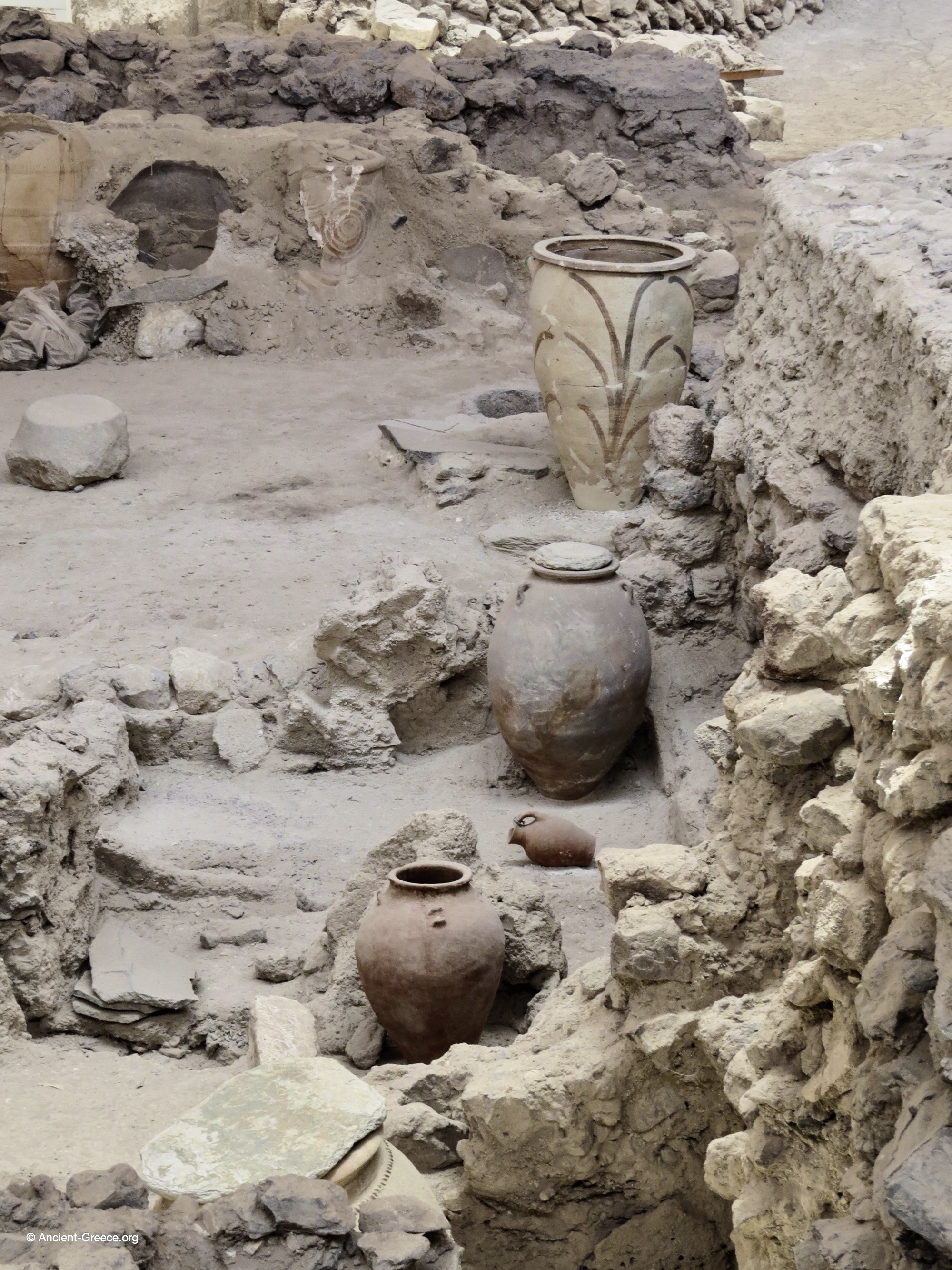
Akrotiri Archaeological Site, Santorini
17th Century BCE
Bronze Age
Ceramic (Terracotta), Stone, and Masonry
Storage Vessels
This view of the Pithoi Storeroom at the Akrotiri Archaeological Site highlights the density of the ceramic assemblages preserved within the ruin. These large-scale storage jars, or pithoi, are positioned within the ground-floor chambers, reflecting the building’s primary function as a supply hub for the Aegean settlement. The Architecture of the room incorporates sturdy masonry capable of supporting the weight of the upper stories, where weaving and other production activities occurred. The preservation of these vessels in their original archaeological context provides essential data on the storage capacities and dietary staples of the Cycladic Bronze Age. Structural elements, including the reinforced wall segments and door lintels, frame the storage area, illustrating the integration of domestic life and economic administration in prehistoric Thera.
◈ ◈ ◈
Αποθήκη των Πίθων, Ακρωτήρι
Αρχαιολογικός Χώρος Ακρωτηρίου, Σαντορίνη
17ος αιώνας π.Χ.
Εποχή του Χαλκού
Κεραμική (Πηλός), Λίθος και Τοιχοποιία
Αποθηκευτικά Αγγεία
Η συγκεκριμένη άποψη της Αποθήκης των Πίθων στον Αρχαιολογικό Χώρο Ακρωτηρίου αναδεικνύει την πυκνότητα των κεραμικών συνόλων που διατηρήθηκαν εντός του ερειπίου. Αυτοί οι μεγάλου μεγέθους πίθοι είναι τοποθετημένοι στα ισόγεια διαμερίσματα, αντικατοπτρίζοντας τον κύριο ρόλο του κτηρίου ως κέντρου εφοδιασμού για τον οικισμό στο Αιγαίο. Η Αρχιτεκτονική του χώρου περιλαμβάνει στιβαρή τοιχοποιία, ικανή να φέρει το βάρος των υπερκείμενων ορόφων, όπου λάμβαναν χώρα η υφαντουργία και άλλες παραγωγικές δραστηριότητες. Η διατήρηση των αγγείων στο αρχικό ανασκαφικό τους πλαίσιο παρέχει πολύτιμα στοιχεία για την αποθηκευτική ικανότητα και τις διατροφικές συνήθειες κατά την Κυκλαδική Εποχή του Χαλκού. Τα δομικά στοιχεία, όπως τα ενισχυμένα τμήματα των τοίχων και τα υπέρθυρα, πλαισιώνουν τον αποθηκευτικό χώρο, καταδεικνύοντας τη σύνδεση της ιδιωτικής ζωής με την οικονομική διαχείριση στην προϊστορική Θήρα.
Akrotiri Archaeological Site, Santorini
17th Century BCE
Bronze Age
Stone, Masonry, Stucco, and Wood (Remnants)
Architectural view
This panoramic view captures the Pithoi Storeroom, revealing its complex interior arrangement and relationship to the surrounding Cycladic streetscape. The facade is defined by a large central opening and two smaller windows that provided essential light to the storage chambers within the ruin. Standing in their original positions as they were over 3,500 years ago, several pithoi remain in various states of excavation; analysis of organic remains within these jars confirms they stored barley, barley flour, and various seeds. The structure occupies a significant portion of the urban block, bordered by paved paths that characterize the sophisticated town planning of the Aegean Bronze Age. Within the Architecture of the southernmost room, a hearth—a low quadrilateral platform—is situated beside a small stone basin sunk into the floor. Evidence of productivity extends vertically, as numerous loom weights discovered in front of the large window indicate that weaving activities took place on the upper floor directly above the storage area.
◈ ◈ ◈
Αποθήκη των Πίθων, Ακρωτήρι
Αρχαιολογικός Χώρος Ακρωτηρίου, Σαντορίνη
17ος αιώνας π.Χ.
Εποχή του Χαλκού
Λίθος, Τοιχοποιία, Κονίαμα και Ξύλο (Κατάλοιπα)
Αρχιτεκτονική άποψη
Η πανοραμική αυτή άποψη αποτυπώνει την Αποθήκη των Πίθων, αποκαλύπτοντας την περίπλοκη εσωτερική της διάταξη και τη σχέση της με το γύρω Κυκλαδικό οδικό δίκτυο. Η πρόσοψη ορίζεται από ένα μεγάλο κεντρικό άνοιγμα και δύο μικρότερα παράθυρα που εξασφάλιζαν τον φωτισμό των αποθηκευτικών χώρων στο εσωτερικό του ερειπίου. Στις αρχικές τους θέσεις, όπως βρίσκονταν πριν από 3.500 χρόνια, αρκετοί πίθοι παραμένουν σε διάφορα στάδια ανασκαφής· η ανάλυση των οργανικών καταλοίπων επιβεβαιώνει την αποθήκευση κριθαριού, αλεύρου και ποικίλων σπόρων. Το κτήριο καταλαμβάνει σημαντικό τμήμα του πολεοδομικού τετραγώνου, πλαισιωμένο από λιθόστρωτα μονοπάτια που χαρακτηρίζουν τον εξελιγμένο σχεδιασμό των πόλεων στο Αιγαίο κατά την Εποχή του Χαλκού. Στην Αρχιτεκτονική του νοτιότερου δωματίου διακρίνεται μια εστία —μια χαμηλή τετράπλευρη πλατφόρμα— δίπλα σε μια μικρή λίθινη λεκάνη βυθισμένη στο δάπεδο. Η παραγωγική δραστηριότητα επεκτεινόμενη καθ’ ύψος μαρτυρείται από τα πολυάριθμα βάρη αργαλειού που βρέθηκαν μπροστά από το μεγάλο παράθυρο, υποδεικνύοντας ότι στον όροφο ακριβώς πάνω από την αποθήκη λειτουργούσε υφαντουργείο.
The Pithoi Storeroom was the first structure excavated in 1967. It contained numerous large storage jars, some still holding remains of barley and flour. The building functioned as a central distribution or storage point for the community.
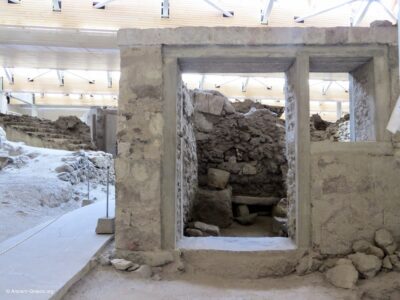
Nearby, Mill-House Square served as a small clearing off Telchines Road, featuring a functional mill installation (Room 15) and providing clear views of the volcanic stratigraphy that eventually consumed the city.
House of the Ladies
The House of the Ladies is a large, three-storey structure named for the frescoes found in its upper levels. These paintings depict female figures in Theran scale, wearing austere garments and minimal jewelry.
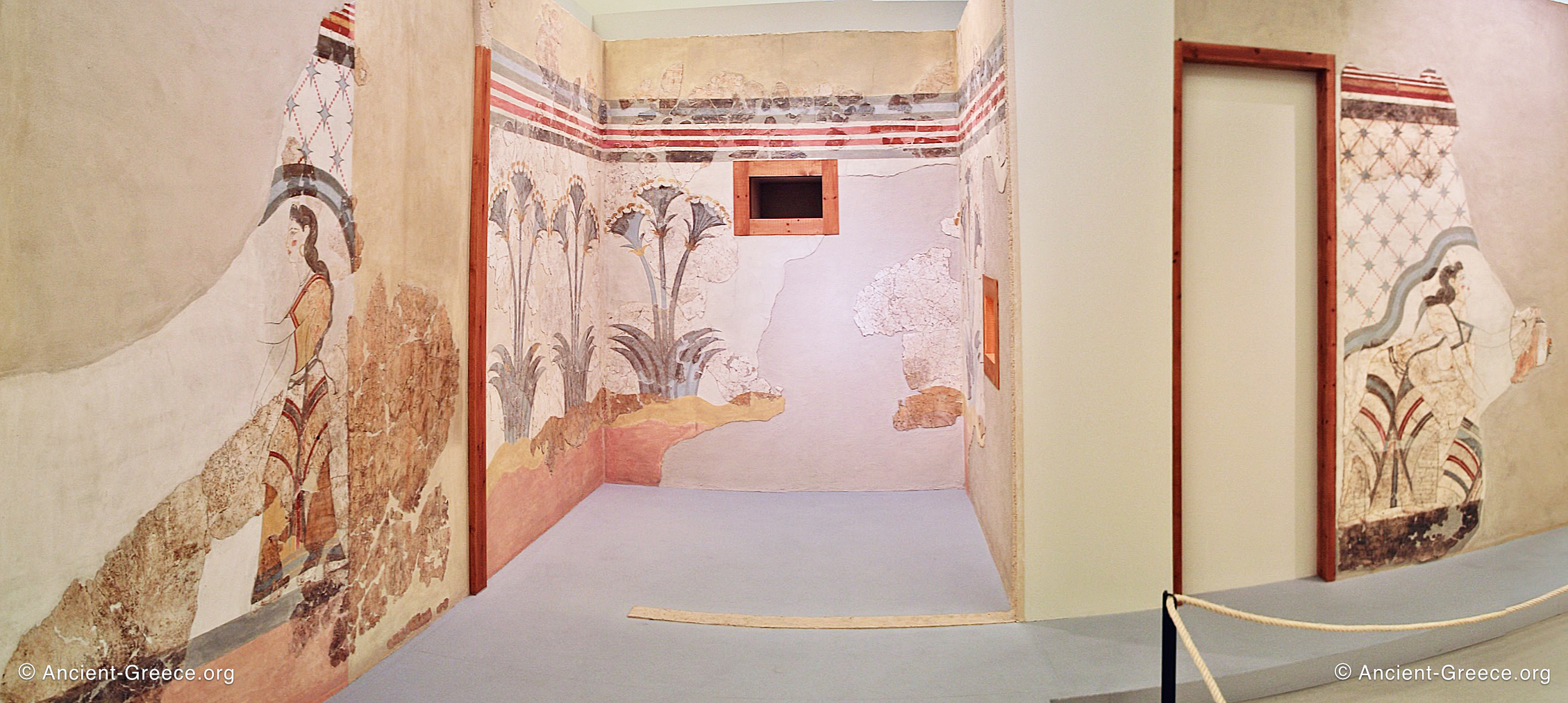
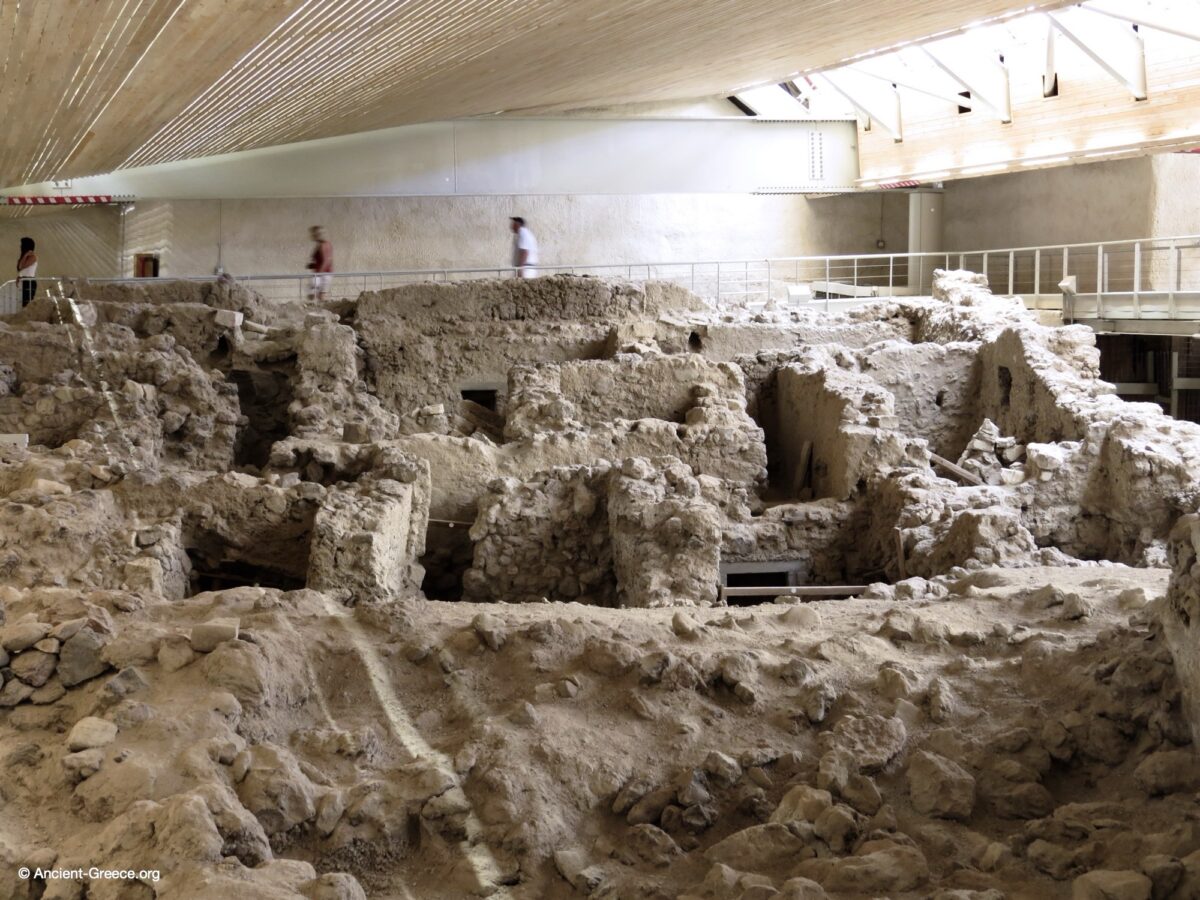
Akrotiri Archaeological Site, Santorini
17th Century BCE
Bronze Age
Stone, Masonry, and Stucco
Architectural view
This perspective of the House of the Ladies emphasizes the vertical scale of the ruin and its integration into the dense urban fabric of the Aegean settlement. The three-story structure is a primary example of Cycladic domestic Architecture, featuring a unique light-well (Space 9-the square structure in the middle) designed to illuminate the internal corridors and surrounding rooms. The masonry remains provide a clear view into the specialized spaces where the famous frescoes of the “Ladies” and “Papyri” were originally situated on the second floor. Excavations within the ground floor and first story revealed substantial evidence of storage activities, with pithoi and domestic vessels indicating the building’s function as a private residence.
◈ ◈ ◈
Οικία των Γυναικών, Ακρωτήρι
Αρχαιολογικός Χώρος Ακρωτηρίου, Σαντορίνη
17ος αιώνας π.Χ.
Εποχή του Χαλκού
Λίθος, Τοιχοποιία και Κονίαμα
Αρχιτεκτονική άποψη
Αυτή η άποψη της Οικίας των Γυναικών αναδεικνύεται η κατακόρυφη κλίμακα του ερειπίου και η ένταξή του στον πυκνό πολεοδομικό ιστό του οικισμού στο Αιγαίο. Το τριώροφο οικοδόμημα αποτελεί χαρακτηριστικό δείγμα της Κυκλαδικής οικιστικής Αρχιτεκτονικής, διαθέτοντας έναν μοναδικό φωταγωγό (χώρος 9) σχεδιασμένο για τον φωτισμό των εσωτερικών διαδρόμων και των γύρω δωματίων. Τα κατάλοιπα της τοιχοποιίας προσφέρουν μια σαφή εικόνα των εξειδικευμένων χώρων όπου βρίσκονταν αρχικά οι περίφημες τοιχογραφίες των «Γυναικών» και των «Παπύρων» στον δεύτερο όροφο. Οι ανασκαφές στο ισόγειο και στον πρώτο όροφο αποκάλυψαν σημαντικά στοιχεία αποθηκευτικών δραστηριοτήτων, με πίθους και σκεύη οικιακής χρήσης που επιβεβαιώνουν τη λειτουργία του κτηρίου ως ιδιωτική κατοικία.
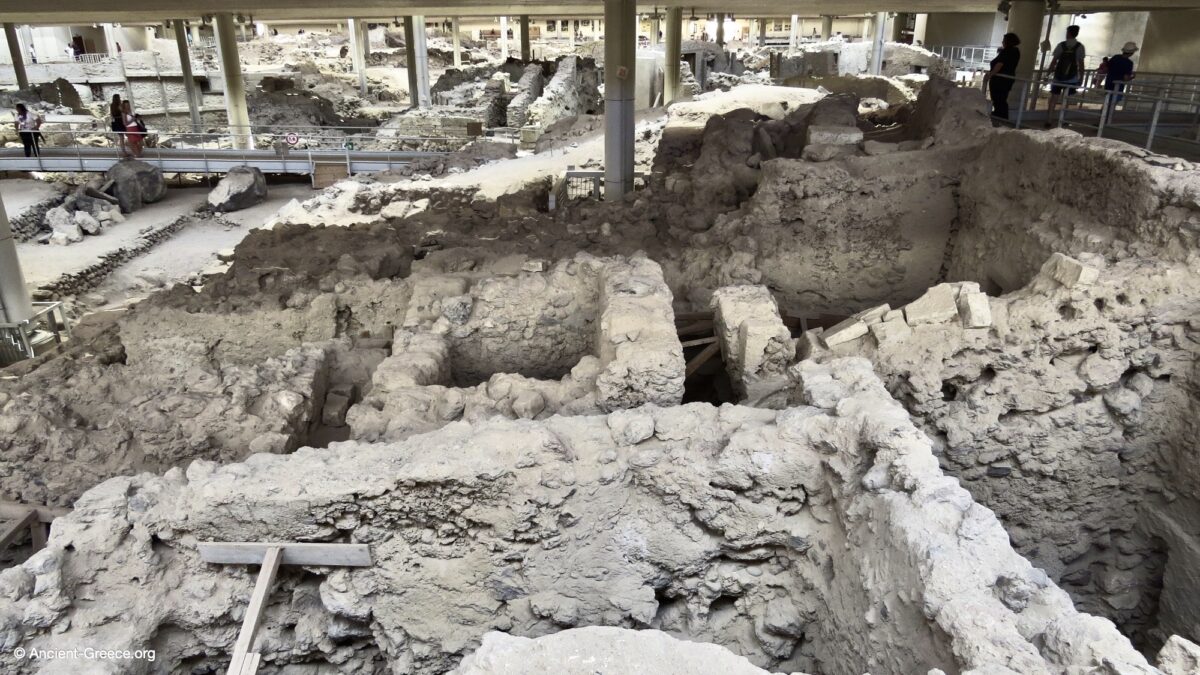
Akrotiri Archaeological Site, Santorini
17th Century BCE
Bronze Age
Stone, Masonry, and Stucco
Architectural view
The House of the Ladies is a significant three-story structure at the Akrotiri Archaeological Site, distinguished by its sophisticated Cycladic design. Named after the famous frescoes discovered in the third-story apartments of Room 1, the building served primarily as a domestic residence, as evidenced by the abundance of storage vessels and foodstuffs found on the lower levels. A unique architectural feature of this ruin is the central light-well (Space 9), the only example of its kind identified at the site to date, which provided ventilation and light to the interior rooms via a narrow corridor. The entrance and main staircase are situated at the southwest corner, with a separate service staircase located near the center. Though the east wing suffered heavy erosion from a pre-excavation torrent, the masonry and Architecture remain a primary testament to Aegean urban life. The iconic murals of the “Ladies” and “Papyri” that once adorned the interior are now preserved in the Museum of Prehistoric Thera.
◈ ◈ ◈
Οικία των Γυναικών, Ακρωτήρι
Αρχαιολογικός Χώρος Ακρωτηρίου, Σαντορίνη
17ος αιώνας π.Χ.
Εποχή του Χαλκού
Λίθος, Τοιχοποιία και Κονίαμα
Αρχιτεκτονική άποψη
Η Οικία των Γυναικών αποτελεί ένα επιβλητικό τριώροφο κτήριο στον Αρχαιολογικό Χώρο Ακρωτηρίου, χαρακτηριστικό της προηγμένης Κυκλαδικής οικιστικής Αρχιτεκτονικής. Η ονομασία του οφείλεται στις περίφημες τοιχογραφίες που κοσμούσαν τον δεύτερο όροφο (δωμάτιο 1), όπου οι συνθέσεις των «Γυναικών» και των «Παπύρων» αναδεικνύουν την καλλιτεχνική ακμή του Αιγαίου. Η παρουσία πολυάριθμων αποθηκευτικών αγγείων και τροφίμων στους κάτω ορόφους επιβεβαιώνει τη λειτουργία του κτηρίου ως κατοικία. Ιδιαίτερο ενδιαφέρον παρουσιάζει ο φωταγωγός (χώρος 9), το μοναδικό έως τώρα παράδειγμα αυτού του αρχιτεκτονικού στοιχείου στο Ακρωτήρι, ο οποίος εξασφάλιζε τον φωτισμό των γύρω δωματίων. Παρά τη διάβρωση της ανατολικής πτέρυγας από χειμαρρώδη ύδατα πριν την ανασκαφή, η τοιχοποιία διασώζει τη διάταξη με την κύρια είσοδο και το κλιμακοστάσιο στη νοτιοδυτική γωνία, προσφέροντας μια πλήρη εικόνα της προϊστορικής δομής.
The building is unique for its internal light-well, which provided illumination to the central rooms. While the ground floors were utilized as storerooms for foodstuffs, the upper storeys were dedicated to refined living and symbolic activities, possibly related to female maturation.
Xeste 3 and Public Ritual
Xeste 3 is an imposing three-story edifice that historically dominated the western harbor entrance of the city. The architecture is characterized by the use of large ashlar blocks on its exterior facades and a sophisticated interior plan. A defining feature of the structure is the extensive use of polythyra (pier-and-door partitions) on all levels, which allowed for the flexible modulation of interior space and the creation of expansive, light-filled halls. The building is most notable for its lustral basin located in the northeast corner—a sunken ceremonial space typical of religious contexts. The interior was decorated with a wall-painting ensemble covering scores of square meters, representing the largest known fresco cycle in the prehistoric Aegean.
The striking lack of vessels for domestic use and the host of objects of ceremonial/ritual character led to the interpretation of Xeste 3 as a public building dedicated to rituals. The iconography of the frescoes and the separation by gender of the participants in the ritual enactments depicted advocate the view that the building was a venue for rites of passage of the young members of Theran society.
Because of the scarcity of domestic vessels and the abundance of ritual objects, scholars interpret Xeste 3 as a public venue for community rites. The building’s extensive wall paintings, including the Crocus Gatherers, represent the largest prehistoric Aegean fresco ensemble. The iconographic program suggests these spaces were used for rites of passage, specifically for the maturation of younger members of society.
Photographs – Φωτογραφίες
Related Pages
Bibliography
- Angelakis, A. N., & Spyridakis, S. V. (1996). “The Status of Water Resources in Minoan Times: A Preliminary Study.” Water Science and Technology.
- Archaeological Society of Athens. (2012). The New Shelter of the Archaeological Site of Akrotiri, Thera. Athens.
- Broodbank, C. (2000). An Island Archaeology of the Early Cyclades. Cambridge: Cambridge University Press.
- Dickinson, O. (2006). The Aegean from Bronze Age to Iron Age. London: Routledge.
- Doumas, C. (1983). Thera: Pompeii of the Ancient Aegean. London: Thames & Hudson.
- Doumas, C. (1992). The Wall-Paintings of Thera. Athens: The Thera Foundation.
- Hardy, D. A., ed. (1990). Thera and the Aegean World III. London: The Thera Foundation.
- Marinatos, N. (1984). Art and Religion in Thera: Reconstructing a Bronze Age Society. Athens: I. Mathioulakis & Co.
- Marinatos, S. (1968-1976). Excavations at Thera I-VII. Athens: Archaeological Society of Athens.
- Ministry of Culture and Sports. Archaeological Site of Akrotiri, Thera. [Online] Available at: https://cyclades.culture.gov.gr/
- National Archaeological Museum. (2026). Exhibition Guide: The Minoan Civilization and Thera. Athens.
- Palyvou, C. (1986). “Notes on Proxemics: Aspects of Space Organization in Ancient Greek Architecture.” Architecture & Comportement, 3(1), 5-21.
- Palyvou, C. (2005). Akrotiri Thera: An Architecture of Affluence 3,500 Years Old. Philadelphia: INSTAP Academic Press.
- Sbonias, K. (1999). “Social Development, External Relations and Ideology in Early Cycladic Society.” American Journal of Archaeology, 103(1), 120-125.
- Schofield, E. (1982). “The Town Plan of Akrotiri.” Bulletin of the Institute of Classical Studies, 29, 145-147.
- Shaw, J. W. (2009). Minoan Architecture: Materials and Techniques. Padova: Bottega d’Erasmo.
- Thera Prehistoric Museum. (2026). Geological and Archaeological Records of the Akrotiri Settlement. Santorini.