On this page:
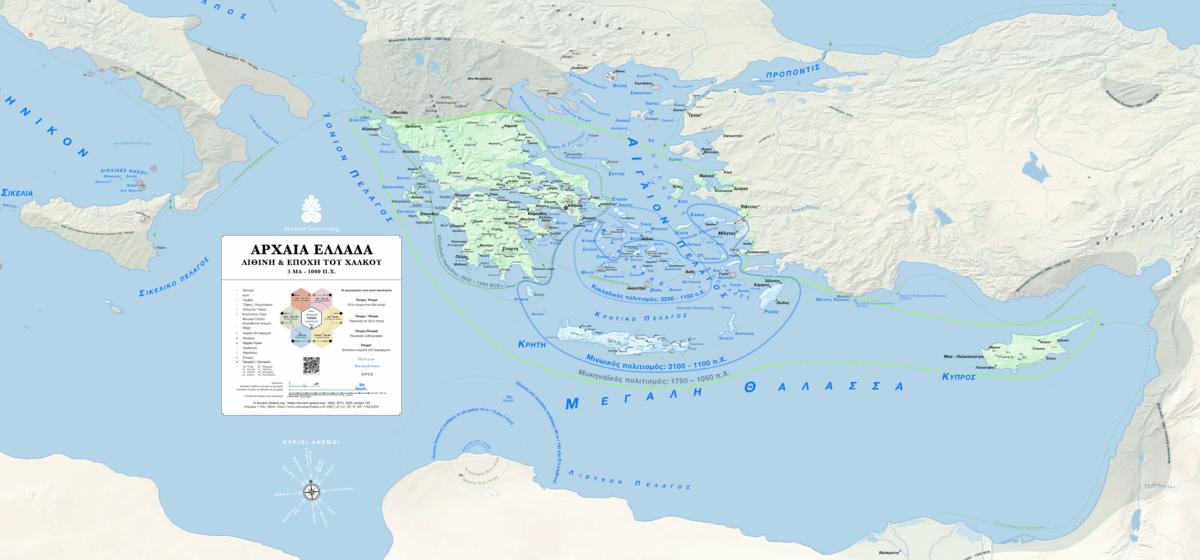
The Minoans (c. 3500 – 1100 BCE) had developed significant naval power and for many centuries lived in contact with all the major civilizations of the time. With their powerful navy they flourished in the island of Crete and in several other islands of the Aegean Sea without being significantly threatened by external forces.
Their commercial contact with ancient Egypt and the Levant influenced their own culture, and the Minoan civilization in turn appeared as a major influence on their contemporary Mycenaeans who wear the forerunners of Greek civilization.
Archaeological evidence suggests that they excelled in art and architecture which show refinement and sophistication that is not typically found in the European mainland of the time.
Thus the Minoans are credited as the first European civilization.
◈ Οι Μινωίτες (περ. 3500 – 1100 π.Χ.) είχαν αναπτύξει σημαντική ναυτική δύναμη και για πολλούς αιώνες ζούσαν σε επαφή με όλους τους μεγάλους πολιτισμούς της εποχής. Με το ισχυρό ναυτικό τους άκμασαν στο νησί της Κρήτης και σε αρκετά άλλα νησιά του Αιγαίου Πελάγους, χωρίς να απειληθούν σημαντικά από εξωτερικές δυνάμεις.
Η εμπορική τους επαφή με την αρχαία Αίγυπτο και τη Μεσοποταμία αναμφισβήτητα επηρέασε τον δικό τους πολιτισμό, και ο μινωικός πολιτισμός με τη σειρά του εμφανίστηκε ως ο πρόδρομος του ελληνικού πολιτισμού.
Τα αρχαιολογικά στοιχεία υποδηλώνουν ότι διέπρεψαν στην τέχνη και την αρχιτεκτονική, οι οποίες παρουσιάζουν μια εκλέπτυνση και πολυπλοκότητα που δεν συναντάται συνήθως στην ευρωπαϊκή ηπειρωτική χώρα εκείνης της εποχής.
Έτσι, οι Μινωίτες αναγνωρίζονται ως ο πρώτος ευρωπαϊκός πολιτισμός.
Geography and Economy | Γεωγραφία και Οικονομία
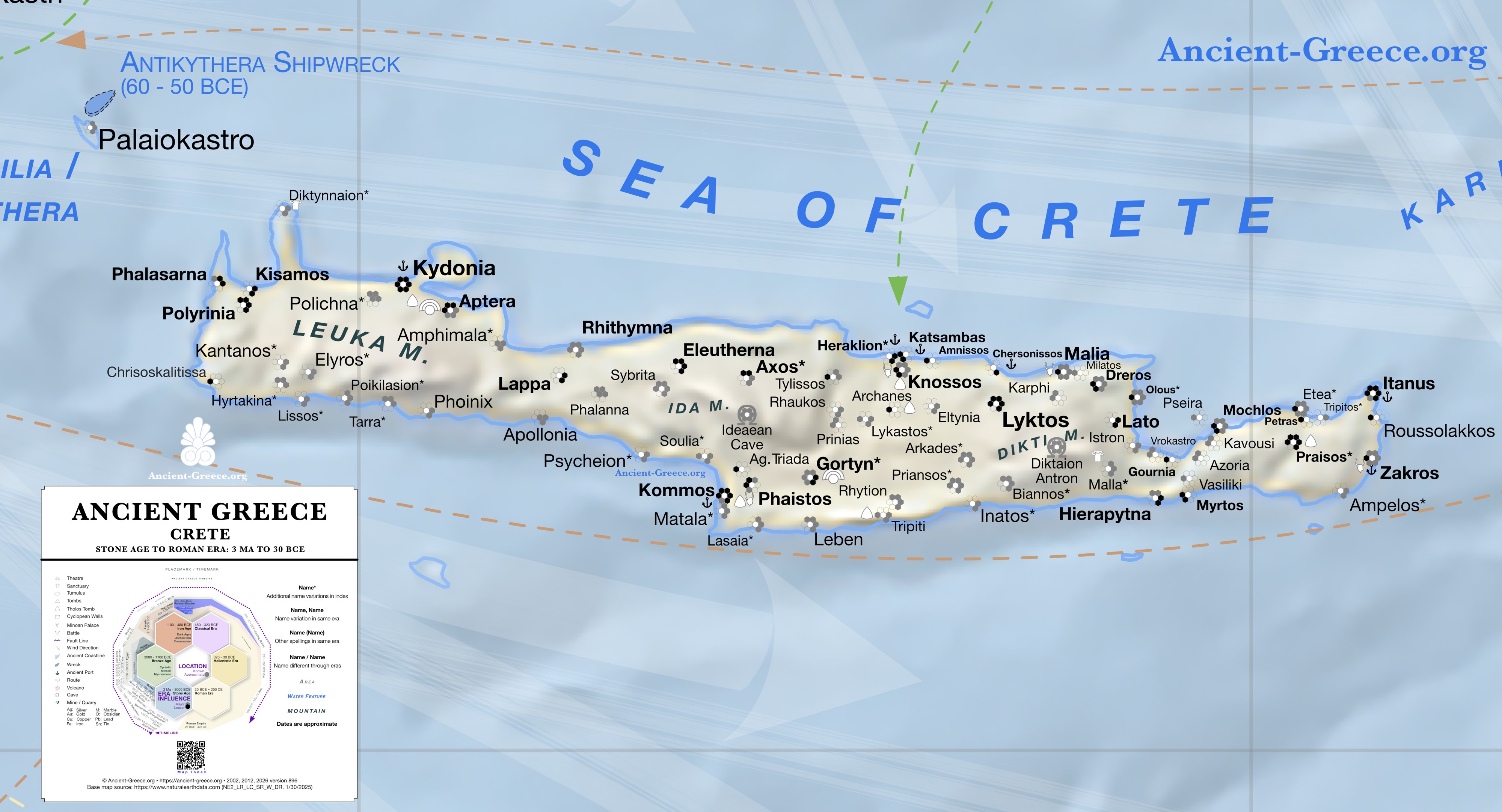
The island of Crete is located in the center of the eastern Mediterranean at the crossroads of Africa, Asia, and Europe. It measures about 200 Km from east to west, and between 12 to 58 Km from north to south at its narrowest and widest distances, making it one of the largest islands in the Mediterranean sea.
Crete’s largest modern town is Heraklion (35° 20′ latitude, 25° 08′ longitude), which now encompasses the Bronze Age ports of the nearby Minoan Palace of Knossos. The Cretan landscape oscillates between tall, rugged mountains, gentle hills, and plateaus, which are framed by the Aegean Sea to the North, and the Libya Sea to the south.
The temperate climate of Crete with its short, mild winters and its dry, warm summers, along with the fertility of the Cretan plains produces sufficient food supplies to support an affluent local population, and for exports.
The inhabitants of ancient Crete whom we call Minoans, produced a culture based on the abundance of the land’s natural resources, and on intense maritime trade. While the island appears today almost completely deforested, in ancient times timber was one of the natural resources that was commercially exploited and exported to nearby Egypt, Syria, Cyprus, the Aegean Islands and the Greek mainland.
Crete also exported food, cypress wood, wine, currants, olive oil, wool, cloth, herbs, and purple dye. Its imports consisted of precious stones, copper (most likely from Cyprus), ivory, silver, gold, and other raw material. They also imported tin that was used in the production of bronze alloys. Evidently the Minoan’s commercial ties with far away places since the nearest known tin mines of the time were as far as Spain, Britain, central Europe, and Iran.
Egyptian influence on art and architecture, as well as goldsmithing techniques imported from Syria indicate that besides trade, the Minoans adopted artistic ideas from the surrounding cultures.
◈ Το νησί της Κρήτης βρίσκεται στο κέντρο της ανατολικής Μεσογείου, στο σταυροδρόμι της Αφρικής, της Ασίας και της Ευρώπης. Έχει μήκος περίπου 200 χλμ. από τα ανατολικά προς τα δυτικά και πλάτος από 12 έως 58 χλμ. στα στενότερα και πλατύτερα σημεία του, γεγονός που το καθιστά ένα από τα μεγαλύτερα νησιά της Μεσογείου.
Η μεγαλύτερη σύγχρονη πόλη της Κρήτης είναι το Ηράκλειο (35° 20′ γεωγραφικό πλάτος, 25° 08′ γεωγραφικό μήκος) και το τοπίο της εναλλάσσεται μεταξύ ψηλών, τραχιών βουνών, ήπιων κλιτύων και οροπεδίων, τα οποία πλαισιώνονται από την ακτογραμμή του Αιγαίου στα βόρεια και του Λιβυκού Πελάγους στα νότια.
Το εύκρατο κλίμα της Κρήτης με τους σύντομους, ήπιους χειμώνες και τα ξηρά, ζεστά καλοκαίρια, σε συνδυασμό με τη γονιμότητα των κρητικών πεδιάδων, παράγει επαρκή αποθέματα τροφίμων για τη συντήρηση ενός ευημερούντος τοπικού πληθυσμού, καθώς και για εξαγωγές.
Οι κάτοικοι της αρχαίας Κρήτης —τους οποίους αποκαλούμε Μινωίτες— ανέπτυξαν έναν αποκεντρωμένο πολιτισμό που βασιζόταν στην αφθονία των φυσικών πόρων της γης και στην έντονη εμπορική δραστηριότητα. Ενώ το νησί εμφανίζεται σήμερα σχεδόν εντελώς αποψιλωμένο, κατά την αρχαιότητα η ξυλεία ήταν ένας από τους φυσικούς πόρους που αποτελούσε αντικείμενο εμπορικής εκμετάλλευσης και εξαγόταν στην κοντινή Αίγυπτο, τη Συρία, την Κύπρο, τα νησιά του Αιγαίου και την ηπειρωτική Ελλάδα.
Η Κρήτη εξήγε επίσης τρόφιμα, ξύλο κυπαρισσιού, κρασί, σταφίδες, ελαιόλαδο, μαλλί, υφάσματα, βότανα και πορφύρα. Οι εισαγωγές της αποτελούνταν από πολύτιμους λίθους, χαλκό (πιθανότατα από την Κύπρο), ελεφαντόδοντο, ασήμι, χρυσό και άλλες πρώτες ύλες. Εισήγαν επίσης κασσίτερο, ο οποίος χρησιμοποιούνταν στην παραγωγή κραμάτων ορείχαλκου. Προφανώς, οι εμπορικοί δεσμοί των Μινωιτών εκτείνονταν σε μακρινά μέρη, καθώς τα πλησιέστερα γνωστά ορυχεία κασσίτερου της εποχής βρίσκονταν τόσο μακριά όσο η Ισπανία, η Βρετανία, η κεντρική Ευρώπη και το Ιράν.
Η αιγυπτιακή επιρροή στην τέχνη και την αρχιτεκτονική, καθώς και οι τεχνικές χρυσοχοΐας που εισήχθησαν από τη Συρία, υποδηλώνουν ότι πέρα από τις πρώτες ύλες, οι Μινωίτες υιοθέτησαν καλλιτεχνικές ιδέες από τους γύρω πολιτισμούς.
Habitation and Chronology | Κατοίκηση και Χρονολόγηση
Archaeological evidence testifies to the island’s habitation since the 7th millennium BCE. After the 5th millennium BCE we find the first evidence of hand-made ceramic pottery which marks the beginning of the civilization.
Evans, the famed archaeologist who excavated Knossos, named the civilization “Minoan” after the legendary king Minos.
Evans divided the Minoan civilization into three eras on the basis of the stylistic changes of the pottery. His comparative chronology included an Early (3000 – 2100 BCE), a Middle (2100 – 1500 BCE), and a Late Minoan period (1500 – 1100 BCE). Since this chronology posed several problems in studying the culture, professor N. Platon developed a chronology based on the palaces’ destruction and reconstruction. He divided Minoan Crete into Prepalatial (2600-1900 BCE), Protopalatial (1900 – 1700 BCE), Neopalatial (1700-1400 BCE), and Postpalatial (1400-1150 BCE).
We do not have much information about the very early Minoans before 2600 BCE besides evidence of several minor settlements near the coast, the beginning of burials in tholos tombs, as well as artifacts in caves around the island.
Prepalatial Minoan Crete (2600 – 1900 BCE) | Προανακτορική Μινωική Κρήτη (2600 – 1900 π.Χ.)
Neolithic life in ancient Crete consisted of major settlements at Myrtos and Mochlos. During this period the Minoans had contact with Egypt, Asia Minor, and Syria with whom they traded for copper, tin, ivory, and gold.
It was a decentralized culture with no powerful landlords and no centralized authority. The palaces of this period are focused around communities, and circular tholos tombs were the major architectural structures of the time. The manner by which the dead were buried in these tombs indicate a society without hierarchical structure.
The tholos tombs were used for centuries by entire villages, or clans and older corpses and offerings were placed aside to make room for a new burial. Older bones were removed from the tomb and placed in bone chambers outside the tholos structure. Most of the tholos tombs were circular while in Palekastro and Mochlos they were of a rectangular in shape with a flat roof.
Protopalatial Minoan Crete (1900 – 1700 BCE)
The protopalatial era began with social upheaval, external dangers, and migrations from mainland Greece and Asia Minor. During this time the Minoans began establishing colonies at Thera, Rhodes, Melos, and Kythera islands of the Aegean Sea.
Around 2000 BCE a new political system was established with authority concentrated around a central figure–a king. At this time the first large palaces were founded and acted as centers for their respective communities, while at the same time they developed a bureaucratic administration which permeated Minoan society henceforth. Distinctions between social classes forged a social hierarchy and divided the people into nobles, peasants, and perhaps slaves.
Besides its tumultuous beginning, this was a peaceful and prosperous period for the Minoans who prospered thorough trade with Egypt and the Middle East. They constructed a paved road network across the island to connect the major cultural centers. This period also marks the development of some settlements outside the palaces, and the end of the extensive use of tholos tombs.
The palaces of the period were destroyed in 1700 BCE by forces unknown to us. Speculation blames the destruction either on a powerful earthquake, or on outside invaders. Despite the abrupt destruction of the palaces however, Minoan civilization continued to flourish into the Neopalatial Period.
Neopalatial Minoan Crete (1700 – 1400 BCE)
During the Neopalatial period we see evidence of administrative and economic unity throughout the island, and Minoan Crete reach its zenith.
The destroyed palaces were quickly rebuilt on the ruins to form even more spectacular structures. This is the time when Knossos, Phaistos, Malia, and Zakros were built, along side smaller palaces which stretched along the Cretan landscape. The paved road network was vastly expanded to connect most major Minoan palaces and towns, and we have evidence of extensive trade activity.
Small towns developed near the palaces and the dead were buried in pithoi and larnakes, along rock-cut chambers and above-ground tholos tombs. For the first time smaller residencies that we call villas appeared in the rural landscape, and were modeled after the large palaces with storage facilities, worship, and workshops. They appear to be lesser centers of power away from the palaces, and homes for affluent landlords.
In the beginning of this era, Minoan culture dominates the Aegean islands and expands into the Peloponnese. We see its strong influence in the Argolis area during the Mycenaean time of grave circles, and in the southern Peloponnese, especially around Pylos.
The Minoan culture’s fusion with the Helladic (mainland Greek) traditions of the time eventually morphed into the Mycenaean civilization, which in turn challenged the Minoan supremacy in the Aegean.
For the first time, late in the Neopalatial period, the powerful fleet of the Minoans encountered competition from an emerging power from mainland Greece: the Mycenaeans whose influence began permeating Minoan Crete itself. Life on the island became more militaristic as evident by the large number of weapons which we find for the first time in royal tombs.
Women played a powerful role in society, and the gold artifacts, seals, and spears speak of a very affluent upper class. This affluence is also evident in the frescoes found in the Cretan palaces and in Thera, Melos, Kea, and Rhodes.
The end of this flourishing culture came with the destruction of most of the palaces and villas of the countryside in the middle of the 15th century BCE, and with the destruction of Knossos in 1375. During this late period there is evidence in tablets inscribed in Linear B language that the Mycenaeans controlled the entire island, while many Minoan sites were abandoned for a long time.
We cannot be certain of the causes for this sudden interruption of the Minoan civilization. However scholars have pointed to invasion of outside forces, or to the colossal eruption of the Thera volcano as likely causes.
Postpalatial Period (1400 – 1150 BCE)
With the destruction of Knossos the power in the Aegean shifts to Mycenae. While both Knossos and Phaistos remain active centers of influence, they do not act as the central authority of the island any longer. During the postpalatial period the western part of Crete flourishes. Several important settlements developed around Kasteli and Chania, while Minoan religion begins to exhibit influences from the Greek mainland.
An examination of the changes in Minoan society during this period reveals it is likely that Mycenae controlled Crete directly. Helladic god names such as Zeus begin to appear in tablets, new shapes develop in pottery, and vaulted tholos tombs appear for the first time. The tablets of Linear B which were unearthed during excavations provide the more concrete evidence of this theory.
Sub-Minoan Crete (1150 – 1100 BCE)
Around 1150 BCE the Dorians destroyed the Mycenaean civilization in the Peloponnese and by 1100 BCE they reached Crete.
This period marks the assimilation of all remaining Minoan elements of Crete into the new Hellenic culture. This new culture eventually transformed into the Classical Greek civilization which had its focus in Athens, Sparta, and the shores of the Mediterranean and Black Sea.
Doric Crete
Under Doric dominance, Crete social structure shifted from monarchy to aristocracy, and early Iron Age art permeates the island. The old Minoan traditions remain influential, and the Spartan legislator Lykourgos studied the Cretan legal system before he created the laws that governed the Lakedemonian state.
Knossos, Arkades, Dreros, Gortyn, Lato, and Lyktos become the most important centers of the island which continues to trade with Cyprus, Syria, and the Aegean.
The art of Doric Crete exhibits orientalizing trends even during the “Geometric” period, possibly due to the islands proximity and close commercial ties with the East.
The islands isolation prevented it from being an important player in the events which forged history during the classical and hellenistic eras, and eventually its culture declined and became a Roman province in 67 BC.
◈ Τα αρχαιολογικά στοιχεία μαρτυρούν την κατοίκηση του νησιού ήδη από την 7η χιλιετία π.Χ. Μετά την 5η χιλιετία π.Χ. εντοπίζουμε τις πρώτες αποδείξεις χειροποίητης κεραμικής, η οποία σηματοδοτεί την αρχή του πολιτισμού.
Ο Έβανς, ο φημισμένος αρχαιολόγος που ανέσκαψε την Κνωσό, ονόμασε τον πολιτισμό «Μινωικό» από τον θρυλικό βασιλιά Μίνωα. Ο Έβανς χώρισε τον μινωικό πολιτισμό σε τρεις εποχές με βάση τις υφολογικές αλλαγές της κεραμικής. Η συγκριτική του χρονολόγηση περιλάμβανε μια Πρώιμη (3000 – 2100 π.Χ.), μια Μέση (2100 – 1500 π.Χ.) και μια Ύστερη Μινωική περίοδο (1500 – 1100 π.Χ.). Επειδή αυτή η χρονολόγηση παρουσίασε αρκετά προβλήματα στη μελέτη του πολιτισμού, ο καθηγητής Ν. Πλάτων ανέπτυξε μια χρονολόγηση βασισμένη στην καταστροφή και την ανακατασκευή των ανακτόρων. Χώρισε τη μινωική Κρήτη σε Προανακτορική (2600 – 1900 π.Χ.), Πρωτοανακτορική (1900 – 1700 π.Χ.), Νεοανακτορική (1700 – 1400 π.Χ.) και Μετανακτορική (1400 – 1150 π.Χ.).
Δεν διαθέτουμε πολλές πληροφορίες για τους πολύ πρώιμους Μινωίτες πριν από το 2600 π.Χ., εκτός από στοιχεία για αρκετούς μικρούς οικισμούς κοντά στην ακτή, την έναρξη των ταφών σε θολωτούς τάφους, καθώς και ευρήματα σε σπήλαια σε όλο το νησί.
Προανακτορική Μινωική Κρήτη (2600 – 1900 π.Χ.) Η νεολιθική ζωή στην αρχαία Κρήτη περιλάμβανε σημαντικούς οικισμούς στον Μύρτο και τον Μόχλο. Κατά την περίοδο αυτή οι Μινωίτες είχαν επαφή με την Αίγυπτο, τη Μικρά Ασία και τη Συρία, με τις οποίες εμπορεύονταν χαλκό, κασσίτερο, ελεφαντόδοντο και χρυσό. Ήταν ένας αποκεντρωμένος πολιτισμός χωρίς ισχυρούς γαιοκτήμονες και κεντρική εξουσία. Τα ανάκτορα αυτής της περιόδου επικεντρώνονται γύρω από κοινότητες, και οι κυκλικοί θολωτοί τάφοι ήταν τα κύρια αρχιτεκτονικά κτίσματα της εποχής. Ο τρόπος με τον οποίο θάβονταν οι νεκροί σε αυτούς τους τάφους υποδηλώνει μια κοινωνία χωρίς ιεραρχική δομή. Οι θολωτοί τάφοι χρησιμοποιούνταν για αιώνες από ολόκληρα χωριά ή γένη, και τα παλαιότερα σώματα και προσφορές παραμερίζονταν για να γίνει χώρος για μια νέα ταφή. Τα παλαιότερα οστά αφαιρούνταν από τον τάφο και τοποθετούνταν σε οστεοφυλάκια έξω από τη θολωτή κατασκευή. Οι περισσότεροι θολωτοί τάφοι ήταν κυκλικοί, ενώ στο Παλαίκαστρο και τον Μόχλο είχαν ορθογώνιο σχήμα με επίπεδη στέγη.
Πρωτοανακτορική Μινωική Κρήτη (1900 – 1700 π.Χ.) Η πρωτοανακτορική εποχή ξεκίνησε με κοινωνικές αναταραχές, εξωτερικούς κινδύνους και μεταναστεύσεις από την ηπειρωτική Ελλάδα και τη Μικρά Ασία. Κατά τη διάρκεια αυτής της περιόδου οι Μινωίτες άρχισαν να ιδρύουν αποικίες στη Θήρα, τη Ρόδο, τη Μήλο και τα Κύθηρα. Γύρω στο 2000 π.Χ. εγκαθιδρύθηκε ένα νέο πολιτικό σύστημα με την εξουσία συγκεντρωμένη γύρω από ένα κεντρικό πρόσωπο — έναν βασιλιά. Αυτή την εποχή ιδρύθηκαν τα πρώτα μεγάλα ανάκτορα που λειτουργούσαν ως κέντρα για τις αντίστοιχες κοινότητές τους, ενώ ταυτόχρονα αναπτύχθηκε μια γραφειοκρατική διοίκηση που διαπέρασε έκτοτε τη μινωική κοινωνία. Οι διακρίσεις μεταξύ των κοινωνικών τάξεων δημιούργησαν μια κοινωνική ιεραρχία και χώρισαν τους ανθρώπους σε ευγενείς, χωρικούς και ίσως δούλους. Εκτός από το ταραγμένο ξεκίνημά της, αυτή ήταν μια ειρηνική και ευημερούσα περίοδος για τους Μινωίτες. Κατασκεύασαν ένα λιθόστρωτο οδικό δίκτυο σε όλο το νησί για να συνδέσουν τα κύρια πολιτιστικά κέντρα. Αυτή η περίοδος σηματοδοτεί επίσης την ανάπτυξη ορισμένων οικισμών έξω από τα ανάκτορα και το τέλος της εκτεταμένης χρήσης των θολωτών τάφων. Τα ανάκτορα της περιόδου καταστράφηκαν το 1700 π.Χ. από δυνάμεις άγνωστες σε εμάς. Οι εικασίες αποδίδουν την καταστροφή είτε σε έναν ισχυρό σεισμό είτε σε εξωτερικούς εισβολείς. Παρά την απότομη καταστροφή των ανακτόρων, ο μινωικός πολιτισμός συνέχισε να ακμάζει κατά τη Νεοανακτορική Περίοδο.
Νεοανακτορική Μινωική Κρήτη (1700 – 1400 π.Χ.) Κατά τη Νεοανακτορική περίοδο παρατηρούμε στοιχεία διοικητικής και οικονομικής ενότητας σε όλο το νησί, και η μινωική Κρήτη φτάνει στο ζενίθ της. Τα κατεστραμμένα ανάκτορα ανοικοδομήθηκαν γρήγορα πάνω στα ερείπια σχηματίζοντας ακόμη πιο θεαματικές κατασκευές. Αυτή είναι η εποχή που χτίστηκαν η Κνωσός, η Φαιστός, τα Μάλια και η Ζάκρος. Το λιθόστρωτο οδικό δίκτυο επεκτάθηκε σημαντικά και έχουμε στοιχεία εκτεταμένης εμπορικής δραστηριότητας. Μικρές πόλεις αναπτύχθηκαν κοντά στα ανάκτορα και οι νεκροί θάβονταν σε πίθους και λάρνακες, καθώς και σε θαλαμοειδείς τάφους και υπέργειους θολωτούς τάφους. Για πρώτη φορά εμφανίστηκαν στην ύπαιθρο μικρότερες κατοικίες που ονομάζουμε «βίλες», οι οποίες είχαν ως πρότυπο τα μεγάλα ανάκτορα με αποθηκευτικούς χώρους, χώρους λατρείας και εργαστήρια. Φαίνεται πως ήταν μικρότερα κέντρα εξουσίας και κατοικίες εύπορων γαιοκτημόνων.
Στην αρχή αυτής της εποχής, ο μινωικός πολιτισμός κυριαρχεί στα νησιά του Αιγαίου και επεκτείνεται στην Πελοπόννησο. Η μινωική κουλτούρα συγχωνεύτηκε με τις ελλαδικές παραδόσεις και τελικά μετεξελίχθηκε στον μυκηναϊκό πολιτισμό, ο οποίος με τη σειρά του αμφισβήτησε τη μινωική υπεροχή. Για πρώτη φορά, αργά στη Νεοανακτορική περίοδο, ο ισχυρός στόλος των Μινωιτών συνάντησε τον ανταγωνισμό από μια αναδυόμενη δύναμη: τους Μυκηναίους. Η ζωή στο νησί έγινε πιο στρατιωτική, όπως μαρτυρά ο μεγάλος αριθμός όπλων που βρίσκουμε για πρώτη φορά σε βασιλικούς τάφους. Οι γυναίκες έπαιζαν ισχυρό ρόλο στην κοινωνία και τα χρυσά αντικείμενα μιλούν για μια πολύ εύπορη ανώτερη τάξη. Αυτή η ευημερία είναι επίσης εμφανής στις τοιχογραφίες που βρέθηκαν στα κρητικά ανάκτορα και στη Θήρα. Το τέλος αυτού του πολιτισμού ήρθε με την καταστροφή των περισσότερων ανακτόρων και επαύλεων στα μέσα του 15ου αιώνα π.Χ. και με την καταστροφή της Κνωσού το 1375 π.Χ. Κατά τη διάρκεια αυτής της ύστερης περιόδου υπάρχουν στοιχεία σε πινακίδες Γραμμικής Β ότι οι Μυκηναίοι έλεγχαν ολόκληρο το νησί.
Μετανακτορική Περίοδος (1400 – 1150 π.Χ.) Με την καταστροφή της Κνωσού η ισχύς στο Αιγαίο μετατοπίζεται στις Μυκήνες. Κατά τη μετανακτορική περίοδο το δυτικό τμήμα της Κρήτης ακμάζει. Σημαντικοί οικισμοί αναπτύχθηκαν γύρω από το Καστέλι και τα Χανιά, ενώ η μινωική θρησκεία αρχίζει να παρουσιάζει επιρροές από την ηπειρωτική Ελλάδα. Είναι πιθανό οι Μυκήνες να έλεγχαν την Κρήτη άμεσα. Ονόματα ελλαδικών θεών όπως ο Ζευς αρχίζουν να εμφανίζονται σε πινακίδες, αναπτύσσονται νέα σχήματα στην κεραμική και εμφανίζονται για πρώτη φορά κτιστοί θολωτοί τάφοι.
Υπομινωική Κρήτη (1150 – 1100 π.Χ.) Γύρω στο 1150 π.Χ. οι Δωριείς κατέστρεψαν τον μυκηναϊκό πολιτισμό στην Πελοπόννησο και μέχρι το 1100 π.Χ. έφτασαν στην Κρήτη. Αυτή η περίοδος σηματοδοτεί την αφομοίωση όλων των υπολειπόμενων μινωικών στοιχείων στον νέο ελληνικό πολιτισμό.
Δωρική Κρήτη Υπό τη δωρική κυριαρχία, η κοινωνική δομή της Κρήτης μετατοπίστηκε από τη μοναρχία στην αριστοκρατία. Οι παλιές μινωικές παραδόσεις παραμένουν ισχυρές, και ο Σπαρτιάτης νομοθέτης Λυκούργος μελέτησε το κρητικό νομικό σύστημα πριν δημιουργήσει τους νόμους που κυβέρνησαν το λακεδαιμονικό κράτος. Η Κνωσός, οι Αρκάδες, η Δρήρος, η Γόρτυνα, η Λατώ και η Λύκτος γίνονται τα σημαντικότερα κέντρα του νησιού. Η τέχνη της δωρικής Κρήτης παρουσιάζει ανατολίζουσες τάσεις λόγω των στενών εμπορικών δεσμών με την Ανατολή. Τελικά η κουλτούρα της παρήκμασε και το νησί έγινε ρωμαϊκή επαρχία το 67 π.Χ.
Demise of Minoan Civilization | Κατάρρευση του Μινωικού Πολιτισμού
One of the favorite themes for discussion among scholars is the possible causes for the destruction of the Minoan Civilization. Evidence of a violent end through fire and demolition is clear, but the clues to what caused such destruction have been elusive.
Professor Marinatos was the first to suggest in 1939 that the eruption of Thera, along with the associated effects, was the cause for the catastrophe. The theory argues that the earthquakes destroyed the palaces, tsunamis obliterated the fleet and piers of the Minoans, and the volcanic ash of Thera covered the whole island destroying crops and suffocating animals.
Many geologists have argued that the Thera eruption was of a colossal scale, and the effects described by Marinatos were possible. Others have disagreed. Recent data places the bulk of the ash deposits of the volcano to the East caried by the easterly jet streems of the area, with little effect upon the island of Crete (D.M. Pyle, “New estimates for the volume of the Minoan Eruption”. Thera and the Aegean World III)
The biggest setback to Marinatos’ theory came in 1987 from studies conducted in the Greenland ice cap. Scientists dated frozen ash from the Thera eruption and concluded that it occurred in 1645 BC, some 150 years before the final destruction of the Minoan palaces.
Even so, the tsunamis and earthquakes associated with the Thera eruption could have still caused much physical damage to the Minoan fleet and infrastructure, and it would have affected the climate, the economy, and the politics of the region.
However, it is doubtful that it could have caused in itself the end of the Minoan civilization. After all, the Minoan society had exhibited acute reflexes in its past history when it rebounded from other physical disasters to elevate its culture to even higher levels. So why did it not recover after the destructions of 1450 BC?
Another factor that might have contributed to the end of Minoan civilization is the invasion and occupation of Crete by the Mycenaeans. Their documented invasion took place around 1400, and in combination with the effects of the Thera eruption present a likely scenario for the final destruction of the Minoan civilization.
In this theory, the Minoan fleet and ports were destroyed by the 50 foot waves and were never rebuilt. Possible climatic changes affected crops for many years, which in turn could have led to economic downfall and social upheaval. In this background, the foreign invaders from Mycenae provided the conclusion to a splendid culture which flourished for 1600 years.
One question still remains however. How did the inhabitants of Mycenae escape the effects of the volcanic eruption, when the Minoan civilization was brought to its knees by them? Considering the topography of the Aegean, and accepting the enormity of the volcanic eruption of Thera, it is hard to understand how the Mycenaeans who were just as vulnerable were able to overcome the destruction, while at the same time they were able to preserve (or rebuilt) their fleet and to mount an ambitious expedition to conquer the vast island of Crete.
Given the scant historical evidence for a definitive answer, questions regarding the destruction of the Minoan civilization continue linger precariously. These tantalizing questions have shrouded prehistoric Crete with an aura of seductive enchantment.
Ένα από τα αγαπημένα θέματα συζήτησης μεταξύ των μελετητών είναι τα πιθανά αίτια για την καταστροφή του Μινωικού Πολιτισμού. Τα στοιχεία για ένα βίαιο τέλος μέσω φωτιάς και κατεδαφίσεων είναι σαφή, αλλά οι ενδείξεις για το τι προκάλεσε μια τέτοια καταστροφή παραμένουν ασαφείς.
Ο καθηγητής Μαρινάτος ήταν ο πρώτος που πρότεινε το 1939 ότι η έκρηξη της Θήρας, μαζί με τις συναφείς επιπτώσεις της, ήταν η αιτία της καταστροφής. Η θεωρία υποστηρίζει ότι οι σεισμοί κατέστρεψαν τα ανάκτορα, τα τσουνάμι αφάνισαν τον στόλο και τις αποβάθρες των Μινωιτών, και η ηφαιστειακή τέφρα της Θήρας κάλυψε ολόκληρο το νησί καταστρέφοντας τις καλλιέργειες και προκαλώντας ασφυξία στα ζώα.
Πολλοί γεωλόγοι έχουν υποστηρίξει ότι η έκρηξη της Θήρας ήταν κολοσσιαίας κλίμακας και οι επιπτώσεις που περιέγραψε ο Μαρινάτος ήταν πιθανές. Άλλοι διαφώνησαν. Πρόσφατα δεδομένα τοποθετούν τον κύριο όγκο των αποθέσεων τέφρας του ηφαιστείου στα ανατολικά, μεταφερόμενο από τα ανατολικά αέρια ρεύματα της περιοχής, με ελάχιστες επιπτώσεις στο νησί της Κρήτης (D.M. Pyle, “New estimates for the volume of the Minoan Eruption”. Thera and the Aegean World III).
Το μεγαλύτερο πλήγμα στη θεωρία του Μαρινάτου ήρθε το 1987 από μελέτες που διεξήχθησαν στο στρώμα πάγου της Γροιλανδίας. Οι επιστήμονες χρονολόγησαν παγωμένη τέφρα από την έκρηξη της Θήρας και κατέληξαν στο συμπέρασμα ότι συνέβη το 1645 π.Χ., περίπου 150 χρόνια πριν από την τελική καταστροφή των μινωικών ανακτόρων.
Ακόμα κι έτσι, τα τσουνάμι και οι σεισμοί που σχετίζονται με την έκρηξη της Θήρας θα μπορούσαν να έχουν προκαλέσει μεγάλη φυσική ζημιά στον μινωικό στόλο και τις υποδομές, και θα είχαν επηρεάσει το κλίμα, την οικονομία και την πολιτική της περιοχής. Ωστόσο, είναι αμφίβολο αν θα μπορούσε να προκαλέσει από μόνο του το τέλος του μινωικού πολιτισμού. Εξάλλου, η μινωική κοινωνία είχε επιδείξει οξεία αντανακλαστικά στο ιστορικό της παρελθόν, όταν ανέκαμψε από άλλες φυσικές καταστροφές για να ανυψώσει τον πολιτισμό της σε ακόμη υψηλότερα επίπεδα. Γιατί λοιπόν δεν ανέκαμψε μετά τις καταστροφές του 1450 π.Χ.;
Ένας άλλος παράγοντας που μπορεί να συνέβαλε στο τέλος του μινωικού πολιτισμού είναι η εισβολή και η κατοχή της Κρήτης από τους Μυκηναίους. Η τεκμηριωμένη εισβολή τους έλαβε χώρα γύρω στο 1400 π.Χ. και, σε συνδυασμό με τις επιπτώσεις της έκρηξης της Θήρας, παρουσιάζει ένα πιθανό σενάριο για την τελική καταστροφή του μινωικού πολιτισμού.
Σε αυτή τη θεωρία, ο μινωικός στόλος και τα λιμάνια καταστράφηκαν από κύματα ύψους 15 μέτρων και δεν ξαναχτίστηκαν ποτέ. Πιθανές κλιματικές αλλαγές επηρέασαν τις καλλιέργειες για πολλά χρόνια, γεγονός που με τη σειρά του θα μπορούσε να έχει οδηγήσει σε οικονομική κατάρρευση και κοινωνική αναταραχή. Σε αυτό το υπόβαθρο, οι ξένοι εισβολείς από τις Μυκήνες έδωσαν τον επίλογο σε έναν λαμπρό πολιτισμό που άκμασε για 1600 χρόνια.
Ένα ερώτημα παραμένει ωστόσο. Πώς ξέφυγαν οι κάτοικοι των Μυκηνών από τις επιπτώσεις της ηφαιστειακής έκρηξης, όταν ο μινωικός πολιτισμός γονάτισε εξαιτίας τους; Λαμβάνοντας υπόψη την τοπογραφία του Αιγαίου και αποδεχόμενοι το τεράστιο μέγεθος της ηφαιστειακής έκρηξης της Θήρας, είναι δύσκολο να κατανοήσουμε πώς οι Μυκηναίοι, που ήταν εξίσου ευάλωτοι, κατάφεραν να ξεπεράσουν την καταστροφή, ενώ ταυτόχρονα μπόρεσαν να διατηρήσουν (ή να ξαναχτίσουν) τον στόλο τους και να οργανώσουν μια φιλόδοξη εκστρατεία για την κατάκτηση του τεράστιου νησιού της Κρήτης.
Δεδομένων των ισχνών ιστορικών στοιχείων για μια οριστική απάντηση, τα ερωτήματα σχετικά με την καταστροφή του μινωικού πολιτισμού συνεχίζουν να πλανώνται επικίνδυνα. Αυτά τα δελεαστικά ερωτήματα έχουν περιβάλει την προϊστορική Κρήτη με μια αύρα γοητευτικής μυστηριακής έλξης.
Chapters | Κεφάλαια
This history of Ancient Greece is divided into the following chapters: | Αυτή η ιστορία της Αρχαίας Ελλάδας είναι χωρισμένη στα ακόλουθα κεφάλαια:
- Timeline | Χρονολόγιο
- Introduction | Εισαγωγή
- Overview | Επισκόπηση
- Geography & Geology | Γεωγραφία & Γεολογία
- Stone Age | Λίθινη Εποχή
- Bronze Age | Εποχή του Χαλκού
6.2 Minoan | Μινωικός Πολιτισμός
6.3 Mycenaean | Μυκηναϊκός Πολιτισμός - Iron Age | Εποχή του Σιδήρου
7.1 Geometric or Dark Age | Γεωμετρική ή Σκοτεινή Εποχή
7.2 Archaic Era | Αρχαϊκή Εποχή - Classical Era | Κλασική Εποχή
- Hellenistic Era | Ελληνιστική Εποχή
Related Topics